Talking About Menopause
Drawing on the experiences of 60 women, Carleton researchers examine one of life’s most common and least discussed transitions
Looking back, Dr. Anne Bowker can now identify dozens of symptoms she experienced without ever realizing they were part of menopause.
Insomnia, brain fog, emotional shifts that seemed to arrive without explanation. Like so many other women, the Dean of the Faculty of Arts and Social Sciences at Carleton University largely navigated the experience privately, and without much guidance.
“At the beginning of the pandemic, I was reading Jen Gunter’s book on menopause,” recalls Bowker, who is also a professor in the Department of Psychology at Carleton. “I was fairly recently post-menopausal by that time, and I don’t think I had ever really talked about menopause with anyone.”
As she read, she recognized many parts of her own experience.
“All these symptoms that I’d been through — difficulties sleeping, changes in my period, emotional issues — were actually symptoms of peri-menopause,” she said. “My doctor never said anything to me when I complained about sleeping problems. She could have said or understood that this was part of peri-menopause, along with hot flashes and brain fog and about 40 other potential symptoms. But she didn’t.”
A developmental psychologist whose research has long explored life transitions, relationships, and well-being, Bowker was already interested in the ways people navigate major periods of change. Menopause, she realized, was one of the most significant and least discussed transitions many people experience.
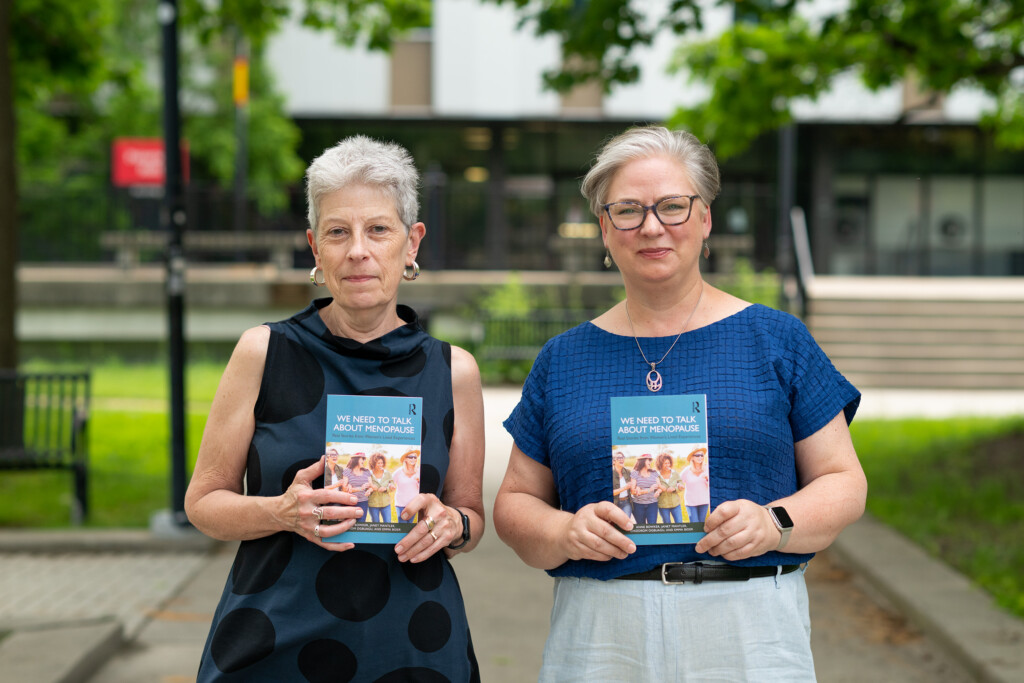
Bowker’s revelation was the eventual starting point for We Need to Talk About Menopause: Real Stories from Women’s Lived Experiences, a new interdisciplinary book co-authored by Bowker, Carleton psychology professor Dr. Janet Mantler, anthropologists Chizorom Ogbuagu and Dr. Emma Bider, and published by Routledge.
Drawing on in-depth interviews with 60 women between the ages of 45 and 61, the book explores menopause not just as a medical occurrence, but as a social, emotional, relational, and professional experience. The stories collected throughout the project reveal how profoundly and diversely menopause can shape someone’s life, while also drawing attention to how rarely those experiences are discussed openly.
“So many women had never talked with anyone about menopause before our study,” explains Bowker. “That was really striking.”
Through their interviews, the authors quickly came to comprehend just how impactful menopause can be – affecting their relationships, their confidence, their work lives, and their understanding of aging. The research team set out to examine the broader social expectations surrounding women’s bodies and midlife, and to see who women spoke to, if anyone, about this difficult transition.
“Even the strongest women can be defeated, at least temporarily, by how society views aging and what the ‘ideal image’ of a woman is supposed to be,” Bowker said. “We met some really strong women who had close friend groups and talked openly about menopause. And then there were other women who had little social support, who had never talked with anyone about menopause before our study, who really struggled.”
For Mantler, whose research focuses on work, stress, and organizational well-being, the interviews revealed the cost of that silence, with many women enduring years of disruptive symptoms largely on their own.
“The first thing that really caught my attention was how little some of the women had spoken to anyone about their menopause journey,” she said. “This was something affecting their lives every day, sometimes for up to a decade.”
In some cases, women described experiences that were physically and emotionally overwhelming but still minimized their own distress.
“They would tell these horror stories,” Mantler explains, “for example, talking about how a period made their home look like a crime scene but then would say it wasn’t so bad because other people had it worse.”
“Not talking about such an important part of one’s life can be isolating. They didn’t know if what they were experiencing was normal or what else to expect.”
This reluctance to speak openly extended into workplaces and medical settings alike.
“Women didn’t talk to men, including supervisors, at work about menopause because they knew the men would be uncomfortable with the topic,” Mantler said. “And too many women weren’t talking with their doctors.”
The researchers argue that this often-devastating silence is deeply cultural.
“I think another reason is that we, as a society, historically, don’t like talking about women’s ‘issues,’” says Bowker. “We’re more comfortable with Viagra commercials than tampon commercials. We don’t like talking about menstrual blood or periods; you’re supposed to try and act like ‘nothing is happening.’ Menopause is like talking about periods, but even more ‘icky.’”
Yet despite that long-standing discomfort, conversations about menopause have become increasingly visible in recent years. Social media, celebrity discussions, podcasts, books, and even some workplace conversations have pushed the topic into mainstream culture in ways that would have been almost unimaginable a generation ago.
But Bowker says increased visibility has not necessarily translated into better support or clearer knowledge-sharing. “There is more info about menopause now,” she says. “But there’s also lots of misinformation and social media that focuses on how to lose weight during menopause, which isn’t particularly empowering.”
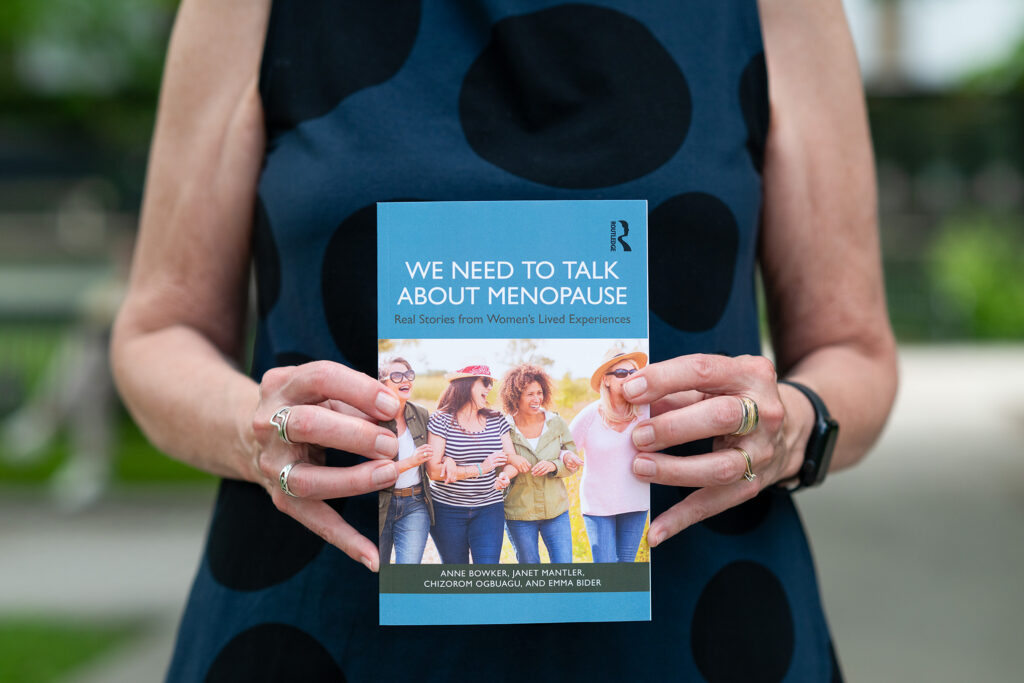
Part of what distinguishes We Need to Talk About Menopause is its refusal to reduce menopause to a checklist of symptoms or clinical interventions. The book blends psychology, anthropology, qualitative research, and lived experience to create something more conversational, personal, and reflective of the complexity of women’s experiences. “It’s not a self-help book,” Bowker says, “but it does present many different experiences with menopause, from virtually no symptoms or issues, to radically changing your life.”
The complexity of the stories participants shared also shaped the research process itself. Bowker and Mantler, both psychologists with backgrounds in more traditional quantitative methods, found themselves working closely with Ogbuagu and Bider, whose training in anthropology brought different perspectives and approaches to understanding the data.
“Sometimes it was a bit challenging, to think about things from a different perspective,” Bowker says, “but ultimately really rewarding.”
This was one of the underlying apprehensions of the project – that often human experiences are too complicated, too emotional, too socially embedded to be fully understood through statistics or clinical measurement alone. Mantler concurs: “Working with an interdisciplinary team is the dream.”
“We were able to talk about the same menopause topic or idea and see how other disciplines approach it. Many of our meetings sounded like we were just chatting, but it was through these casual conversations that we were alerted to alternative ways of viewing the world.”
The dialogues that emerged through the project ultimately changed the researchers, too.
“It’s definitely made me more of a feminist,” Bowker states. “I think we (the authors) share pretty strong opinions now on women’s experiences with the medical field and how they should be so much better.”
“Menopause is messy. It’s totally idiosyncratic and not something you can adequately capture with a questionnaire or a blood test.”
For the authors, one of the book’s most important messages is that there is no “right” way to experience menopause. It looks different for everyone.
“What I really hope,” Mantler said, “is that readers understand the vast range of experiences people have during the menopausal transition and that it is normal to feel the way they do”
In fact, she suggests that this may be the project’s simplest and most important conclusion.
“We need to talk about menopause with our partners, our children, our families, our supervisors, our colleagues, and our doctors,” she says. “I hope we give people some language to begin those conversations.”
Carleton University will host a public launch for We Need to Talk About Menopause: Real Stories from Women’s Lived Experiences on Monday, June 22 from 7 to 8:30 p.m. at the Carleton Dominion-Chalmers Centre. The evening will feature a conversation with the book’s four authors, an audience discussion period, and a reception.
You can purchase We Need to Talk About Menopause: Real Stories from Women’s Lived Experiences through the Routledge website.