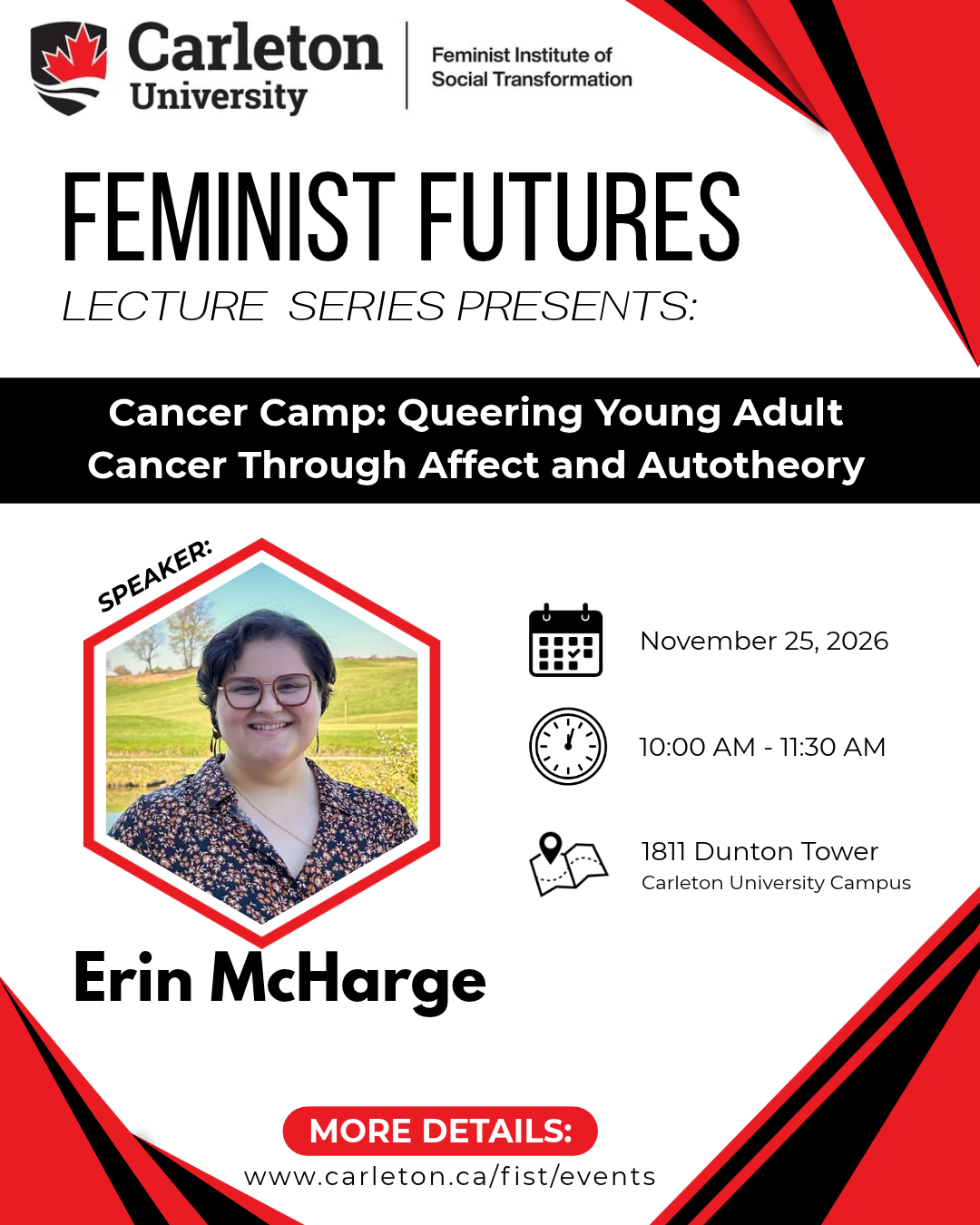
Cancer Camp: Queering Young Adult Cancer Through Affect and Autotheory
Wednesday, November 25, 2026 from 10:00 am to 11:30 am
- In-Person event
- 1811, Dunton Tower, Carleton University
- 1125 Colonel By Drive, Ottawa, ON, K1S 5B6
- Contact
- Lana Keon, LanaKeon@Cunet.Carleton.Ca
Abstract:
What is it like to have cancer as a queer young adult? How do matrices of identity like age, gender, and sexuality change how cancer is experienced and felt? Diagnosed with incurable uterine cancer in her twenties, McHarge turned inward to study the feelings produced by having cancer and to understand the cultural resistances surrounding young adults with chronic illnesses. Unlike the majority of cultural research on cancer that focuses on patienthood, this work centres sexuality and disability as foundational components of having cancer. Cancer Camp is a meta-analysis of the real-life incurable young adult cancer experiences that can be found in cancer memoirs in conjunction with McHarge’s own autotheoretical perspective to give insight into cancer as queered and cripped. Calling all campers, Cancer Camp is in session.
About the Speaker:
Erin McHarge is a PhD candidate in Communication and Media Studies at Carleton University. With an interest in queer theory and affect theory, McHarge’s area of expertise focuses on gender and sexuality in media and culture. McHarge’s PhD research is an autotheoretical study of incurable young adult cancer in disability media. As a graduate of the Feminist Institute of Social Transformation at Carleton University, McHarge is proud to be returning as a speaker in the Feminist Futures Lecture Series.
Feminist Futures Lecture Series
The Feminist Futures Lecture Series offers presentations of current feminist research being carried out by faculty associated with the Institute. Drawing from the rich interdisciplinary, intersectional research environment that marks past work and frames future endeavors, the Feminist Futures Lecture Series continues the development of critical intellectual and political spaces and knowledge-building around gendered issues. In this friendly but critically engaged space, you are invited to connect with a community of scholar-activists associated with the Institute at Carleton University.