New Student Guide to Travel and Arrival in Canada
Kindly note that the information on this web site does not, and is not intended to constitute legal advice, and instead all information, content and material is for general information purposes only. Readers should contact and consult with an authorized immigration representative to obtain advice with respect to any particular legal matter. No reader should act or refrain from acting on the basis of information on this site without first seeking legal advice from an authorized representative in the relevant jurisdiction and with expertise in immigration law. Only your authorized representative can provide assurances that the information contained herein – and your interpretation of it – is applicable or appropriate to your particular situation. The content and information are provided “as is;” and no representations are made that the content or information is accurate, complete or error-free. Any liability is expressly disclaimed and Carleton University will not be liable for any losses, injuries or damages from the use or reliance on the information or content.
Canada has two government bodies that oversee immigration and entry to Canada.
- Immigration, Refugees and Citizenship Canada (IRCC) – This is the department of the Government of Canada that develops and administrates Canada’s immigration policies and programs.
- Students submit their applications for visas, study and work permits to IRCC.
- Canada Border Services Agency (CBSA) — This is the government agency that provides border services to support national security and public safety priorities, and the flow of goods and services
- CBSA officers examine students at Canadian Ports of Entry (international airports and land borders).
Both IRCC and CBSA play a role in ensuring the study permit holders are eligible to enter Canada and, following entry, that they meet the conditions of their status in Canada, which include actively studying, and working only as authorized by their study permits.
Travel Information for New Students
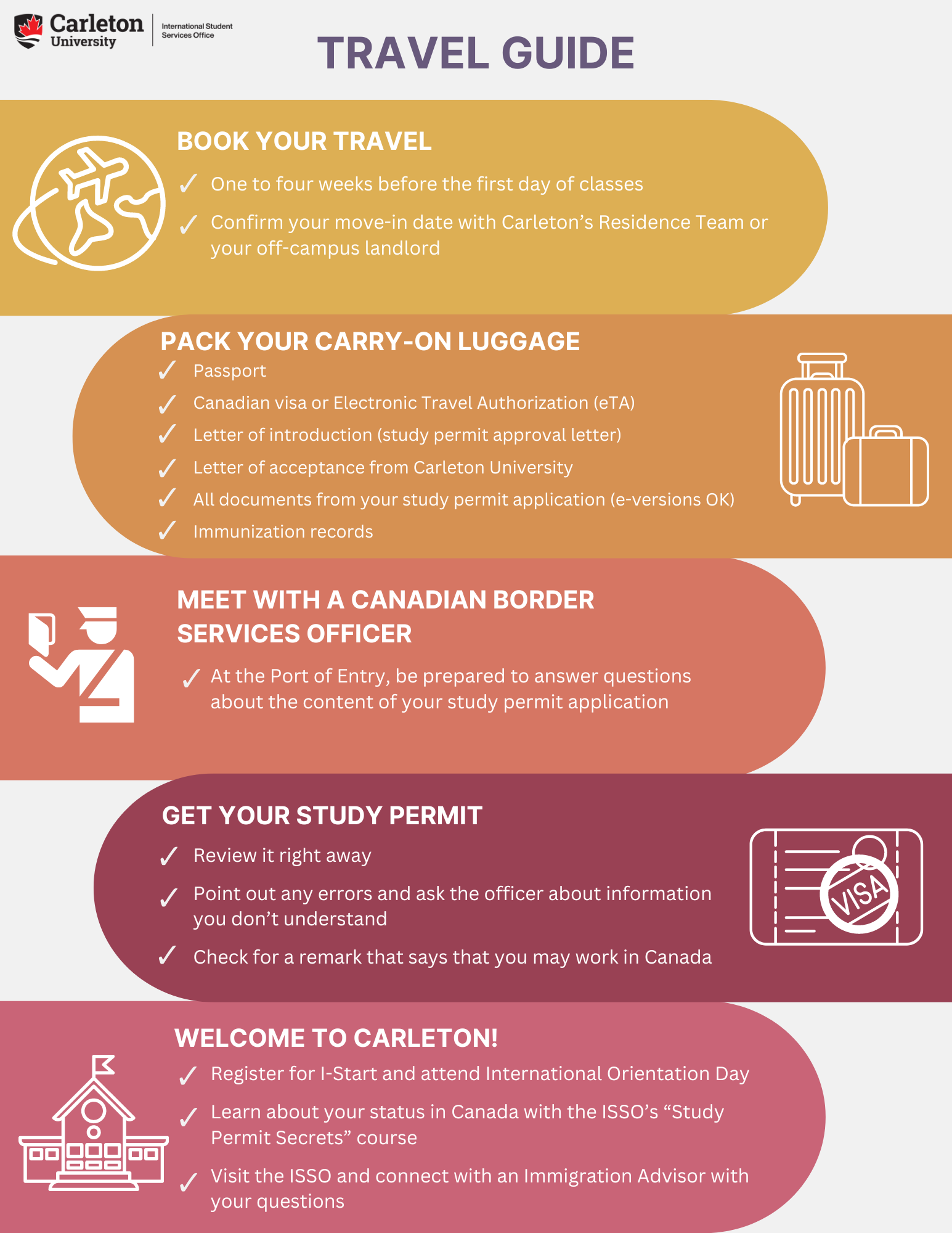
Infographic: Quick Travel Guide
Most international students apply online for a study permit before coming to Canada. IRCC, represented by the visa office in the student’s country of residence, makes a decision on the application.
After approving the application, IRCC issues appropriate travel authorization, which is either an electronic Travel Authorization (eTA) or Temporary Resident Visa (TRV), so the student may travel to Canada. The proper travel authorization for the student is automatically processed as part of a visa office study permit application. Learn more about TRVs and eTAs at the IRCC website.
IRCC also provides, through the applicant’s online account, a Letter of Introduction, which indicates that the application for a study permit has been approved. A CBSA officer makes the final decision to issue a study permit after the student is examined at a Canadian Port of Entry.
Students can prepare for this examination by being knowledgeable about their study permit application and presenting the correct documents to the CBSA officer.
Deciding When to Travel
Arrival Before the Start of the Term
Two to four weeks before the start of classes for your first term is the recommended timeframe. Some considerations for deciding what works best for you:
- Consult the GO-ISSO’s Before You Arrive information.
- You may need a couple of weeks to become oriented to Ottawa and the Carleton campus before starting classes.
- If you will live in the Carleton Residence, check move-in information on the Housing and Residence Life website and work closely with their team when planning your arrival
- UHIP coverage (student health insurance) becomes available during this time period. Contact uhip@carleton.ca to learn the exact date for each term, or to activate coverage.
- Your study permit will authorize you to work in Canada, but not until your classes have started. Learn more about authorized work for study permit holders.
Arrival After the Start of the Term
All students are strongly advised to travel to Ottawa in time for the first day of classes in their term of admission. This is particularly emphasized for graduate students, for engineering students, and for students in programs that have lab courses.
Arriving after the start of the term can be a risky choice for international students.
- A student who arrives late will miss welcome and orientation events. These experiences contribute greatly to academic and personal success at Carleton.
- Most Carleton courses have some requirement for in-person attendance. (Learn about course delivery types). Students can view the mode of delivery for courses on Carleton Central prior to registration.
- Many students who have not had time to get oriented to life in Canada before the start of the term will find themselves overwhelmed if they are also trying to catch up academically.
Students who arrive late may miss in-class instruction, lab work, group work, in-class tests, and marks for attendance. This will have academic consequences, which can lead to serious immigration consequences for international students. Leaving school after arrival in Canada makes the student non-compliant with the conditions of their status in Canada. Withdrawing from several courses and becoming a part-time student (fewer than 1.5 credits) makes the student ineligible for a Post-Graduation Work Permit (PGWP) at the end of their studies. The PGWP is an important goal for many international students. A reduced course load may also affect eligibility for the supplemental health insurance plans provided through Carleton’s student’s associations.. Students are encouraged to consult CUSA information (for Undergraduate Students) or GSA information (for Graduate students).
Residence Late Arrival
Please refer to the Carleton Housing and Residence Life Services website for:
Contact residence@carleton.ca if you have additional questions.
Preparing for Travel to Canada
The documents you will show at your immigration examination should be readily available in your carry-on luggage.
- Valid travel authorization: visa or eTA; or proof of US citizenship or Permanent Resident (PR) status
- Valid passport
- Valid travel authorization (eTA, visa or proof of US citizenship or PR status)
- Port of Entry Letter/ Letter of Introduction – This is the Government of Canada letter that says “Your application to study in Canada has been approved”.
- Carleton’s admission information, including “Student Information for a Study Permit”
- VERY IMPORTANT Students travelling to Canada intending to study at Carleton University must have applied for their study permit with a Carleton Letter of Acceptance. The study permit that is issued to them will name Carleton University and the student will be authorized to study only at Carleton.
- A Carleton Certificate of Enrolment for the upcoming school term or year.
- Proof of sufficient available funds for at least one year of tuition and living expenses.
- This proof should be similar to what was used for the study permit application. The documents should be updated if the application was made more than 3-4 months ago.
- Valid immigration medical exam results, if required for the study permit application (not more than 1 year old) and evident good health upon arrival.
- Immunization/vaccination records
- Strongly recommended: A full copy of the online study permit application. Students should be knowledgeable of the application’s contents, even if an agent prepared the application for them, and prepared to answer a border officer’s questions.
In addition to examining your documents, the CBSA will also check their own databases for criminal or immigration-related convictions that might make someone inadmissible to Canada.
See also: IRCC Travel Information for Students
Examination and Issuing of the Study Permit
Putting together your documents for travel will help you prepare for an examination by the Canadian Border Services officer. The officer will ask your purpose in visiting Canada, which is to study. An officer will examine your documents and may ask you questions about them. Remain calm and answer simply and always truthfully, even if the answer is that you don’t know or aren’t sure.
After your examination, the officer will print your study permit. This document shows you have temporary resident status in Canada and are authorized to study and do some work, according to conditions that are referenced on the document.
Before leaving the airport or land border crossing, look over your study permit. It is easiest to correct errors and ask questions at the Port of Entry.
- Check that your personal information has no typographic or other clerical errors.
- Look at the expiry date of the study permit. Often the expiry date matches the expected length of the program of study, but the officer may select any date. Students may ask politely how the officer selected the date.
- Students should note the expiry date and make a reminder notice to themselves that they may have to renew the study permit to complete their studies. Carleton does not have access to your study permit documentation, including the expiration date. While we are here to guide and support, it is ultimately a student’s responsibility to maintain their immigration status during their studies (and beyond).
- Most Carleton students should see a remark on their study permit that starts with “may work…” or “may accept employment”. It’s important to know that there are conditions related to the work authorization. Before starting to work, students should consult IRCC information about authorized work for study permit holders.
After Arrival
Students should keep their study permit at home in a safe place, and not carry it around with them. In most circumstances, a student permit is not useful as a piece of personal identification. However:
- The Global Opportunities & International Student Services Office (GO-ISSO) may need to see a copy of the study permit to advise on immigration matters.
- An employer will need to see a copy of the study permit to confirm the student is authorized to work in Canada.
International students must know that there are conditions they must meet to keep their study permit valid. Most importantly, they must remain in school and make progress in their studies. They are encouraged to contact the GO-ISSO or visit our website to learn more.