Shannon Lectures – Fall 2026
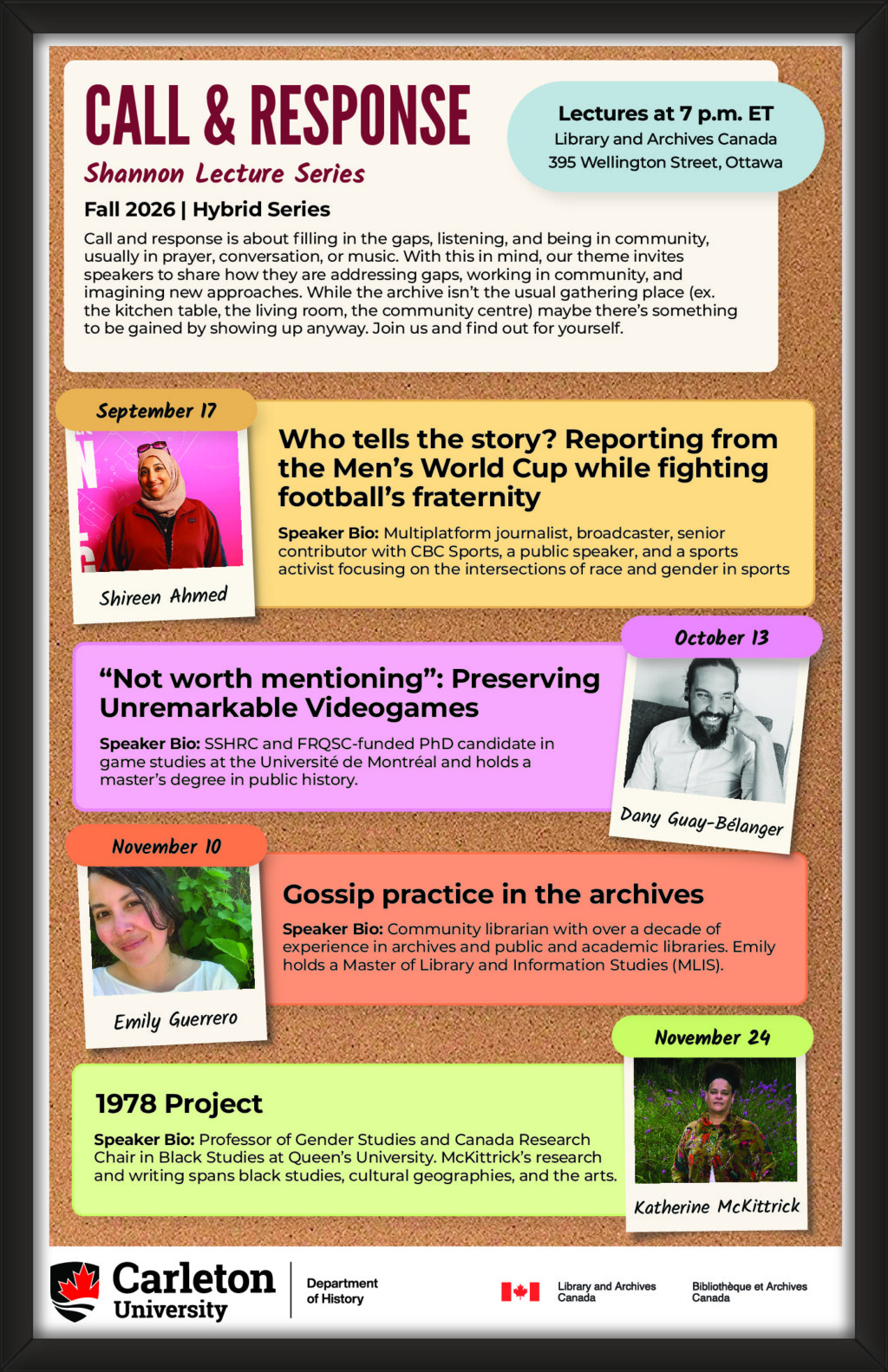
Call & Response | Appel et Réponse
Convenor: Sali Lafrenie, Archivist, Private Archives, Library and Archives Canada
Description: Call and response is about filling in the gaps, listening, and being in community usually in prayer, conversation or music. With this in mind, our theme invites speakers to share how they are addressing gaps, working in community, and imagining new approaches. While the archive isn’t the usual gathering place (ex. the kitchen table, the living room, the community centre) maybe there’s something to be gained by showing up anyway. Join us and find out for yourself.
All lectures will take place in the Pellan Room at Library and Archives Canada (395 Wellington Street). Lectures will begin at 7pm.
Community Reading Corner: Curated with community and conversation in mind, everyone is invited to spend time with a selection of books and photos from the collection. On the shelves you’ll find work by Black photojournalists like Jules Elder, Eddie Grant, Diane Liverpool, Al Peabody, and James Russell who documented significant events and influential figures, capturing periods of transition and intensity alongside protests, moments of joy, and celebration.
Together, the books and the photos aim to recreate the feeling of being at home in every sense of the expression. At home, in your body. At home, finally. At home, in community. At home, in the archive.
Located in the Alfred Pellan room, the reading corner was made possible by Library and Archives Canada in conjunction with the Shannon Lectures, and Black Artists’ Networks in Dialogue (BAND) Gallery. It will be available throughout the lecture series.
Session 1: Thursday, September 17
Title: Who tells the story? Reporting from the Men’s World Cup while fighting football’s fraternity
Description: Shireen Ahmed has attended five World Cups. Although each is unique, they share a commonality: the low number of women in the press corps or at media centres in host cities. Does this affect the reporting? What is it like covering the beautiful game when so much of it is ugly? How many important stories die on the vine? What can Canadians and soccer fans do to make it a more equitable space for consuming soccer at home?
Biography:

Shireen Ahmed is an award-winning multiplatform journalist, broadcaster, Senior Contributor with CBC Sports, a public speaker, and a Sports Activist focusing on the intersections of race and gender in sports. She is a global expert on Muslim women in Sports.
She is a 2019 TEDxToronto Speaker and is the national ambassador to Sakeenah Canada, an organization that offers essential services to women and families who have survived violence.
She has lectured and presented her work and research at a number of post-secondary institutions and organizations in Canada, Australia, the United States and Europe.
Shireen’s passion for sports, politics and women’s issues has been recognized by Sports Media for its candid discussions. Her work has been featured and discussed in The Guardian, TIME magazine, Sports Illustrated, The Walrus, Football Weekly, Racialicious, Chatelaine, The National Post, espnW, Globe and Mail, MSNBC Democracy Now! and TRT World. Shireen’s work was published in Best Canadian Sports Writing 2017. Her expertise is sought after by a host of international news outlets. In 2021, her academic work was published in Sports Media Vectors: Gender and Diversity, Reconstructing the Field.
She is part of the team of women who create the Burn It All Down podcast. The first feminist sports podcast that analyzes sports and sports culture from an intersectional feminist lens.
Shireen holds a Master of Arts degree with a specialty in Media Production. She currently teaches Journalism and Sport Media at Toronto Metropolitan University.
Session 2: Tuesday, October 13
Title: “Not worth mentioning”: Preserving Unremarkable Videogames
Description:
Classic videogames are in peril. Indeed, a 2023 report by The Video Game History Foundation and the Software Preservation Network revealed that 87% of games released in the United States before 2010 are critically endangered. The frequent removal of games from online stores, their closure, and recent announcements that physical game production will be discontinued only serve to reinforce this call to action. Fortunately, the fields of video game preservation and history are quite healthy, but initial efforts to preserve video games and their history focused generally on the great men of videogame history, the most successful or impactful titles or series and companies, or the countries whose industry was most developed or had the most impact on gaming culture. This effectively relegated most of videogame history to the shadows.
Dany Guay-Bélanger will present a novel approach to researching and preserving the history of videogames that answers this call by putting players first. By conducting interviews that position participants as experts on their own memories and taking seriously the contributions of lay historians and the gaming community, this approach attempts to create fissures in the proverbial ivory tower and create better, more connected scholarship that will hopefully change the public’s perception of academic video game historians and vice versa.
Biography:

Dany Guay-Bélanger is a SSHRC and FRQSC-funded PhD candidate in game studies at the Université de Montréal and holds a master’s degree in public history from Carleton University. His research aims to devise a methodology favouring a holistic approach for the preservation and study of videogames as cultural heritage artefacts in order to allow players and researchers, present and future, to access videogames from every era of this medium’s history. Dany has worked in the Canadian heritage sector for several years and is currently the treasurer of the Canadian Game Studies Association and a member of the History of Games conference steering committee.
RSVP here: https://carleton.ca/history/event/not-worth-mentioning-preserving-unremarkable-videogames/
Session 3: Tuesday, November 10
Title: Gossip practice in the archives
Description:
What does it mean to take gossip seriously as an information practice in archival work? Often maligned as untrustworthy, gossip’s focus on relationships and feelings can help open up alternative paths through institutional records. In this talk, I’ll be using the archives of artist-run centres as a case study, considering them as a site that is in-between an institutional and community archive. How might this mutability create openings for thinking about how we can work in (and across) different archival spaces as information labourers and researchers? A good gossip session usually happens on the apartment stoop or in the bar, but gossiping in the archive can similarly help us get under and through the “official” record, when too often the record means gaps, silences, and erasures
Biography:

Emily Guerrero is an information worker, writer and parent living in Vancouver, on the unceded territories of the Musqueam, Squamish and Tsleil-Waututh peoples. They hold an MLIS from the University of British Columbia, and have worked in archives and both public and academic libraries for over a decade. They currently work as a Community Librarian with a focus on providing library services to patrons who are historically underserved and systematically marginalized. Their work on gossip, arts archives, community work, and abolitionist librarianship have been published in Archivaria, C Magazine, and forthcoming in In The Library With a Lead Pipe.
RSVP here: https://carleton.ca/history/event/gossip-practice-in-the-archives/
Session 4: Tuesday, November 24
Title: 1978
Description:
Published in 1977, Toni Morrison’s Song of Solomon is a story of overwhelming grief, the search for gold, and bags of bones. It is a story of flying and magic. The following year, Song of Solomon won the National Book Critics award and in a 1978 interview about her work as an editor, as a mother, about hurt and loneliness, Morrison shares that writing novels brought her relief, a way of ordering the world. It is well known that Song of Solomon and her other brilliant writing projects were acts of creation that were worked on after-hours. Moved by the creative relief that Morrison shares, as well as her demanding schedule, in this presentation, I draw connections between black cultural production, representation, and creative labour that is performed “off the clock” or outside our normative rhythms. Using 1978 as a touch point, or a prompt (call), I will share a set of materials, that are tactile and nostalgically analogue, sonic and groovy and sad, and function to elicit solace and creative relief (response) precisely because they cannot be easily captured or institutionalized.
Biography:
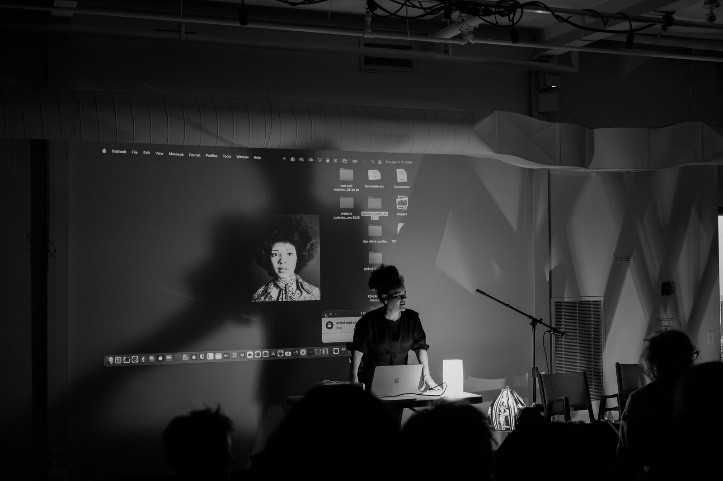
Katherine McKittrick is Professor of Gender Studies and Canada Research Chair in Black Studies at Queen’s University. Her book projects include Dear Science and Other Stories, Demonic Grounds: Black Women and the Cartographies of Struggle, Sylvia Wynter: On Being Human as Praxis, and Heartbreak and Other Geographies (edited by Brittany Meché and Camilla Hawthorne). Her collaborative and creative projects include Yarns (Haint Blue), Trick Not Telos, Twenty Dreams, and A Smile Split by the Stars. McKittrick’s research and writing spans black studies, cultural geographies, and the arts, with a steady focus on how black creatives and theorists disrupt and remake spatial and scholarly norms. McKittrick is also a scholar of Sylvia Wynter. She participates in the working group, the Revolutionary Demand for Happiness, who dream and realize small scale placemaking projects and other creative adventures.
RSVP here: https://carleton.ca/history/event/1978/