Notice:
This event occurs in the past.
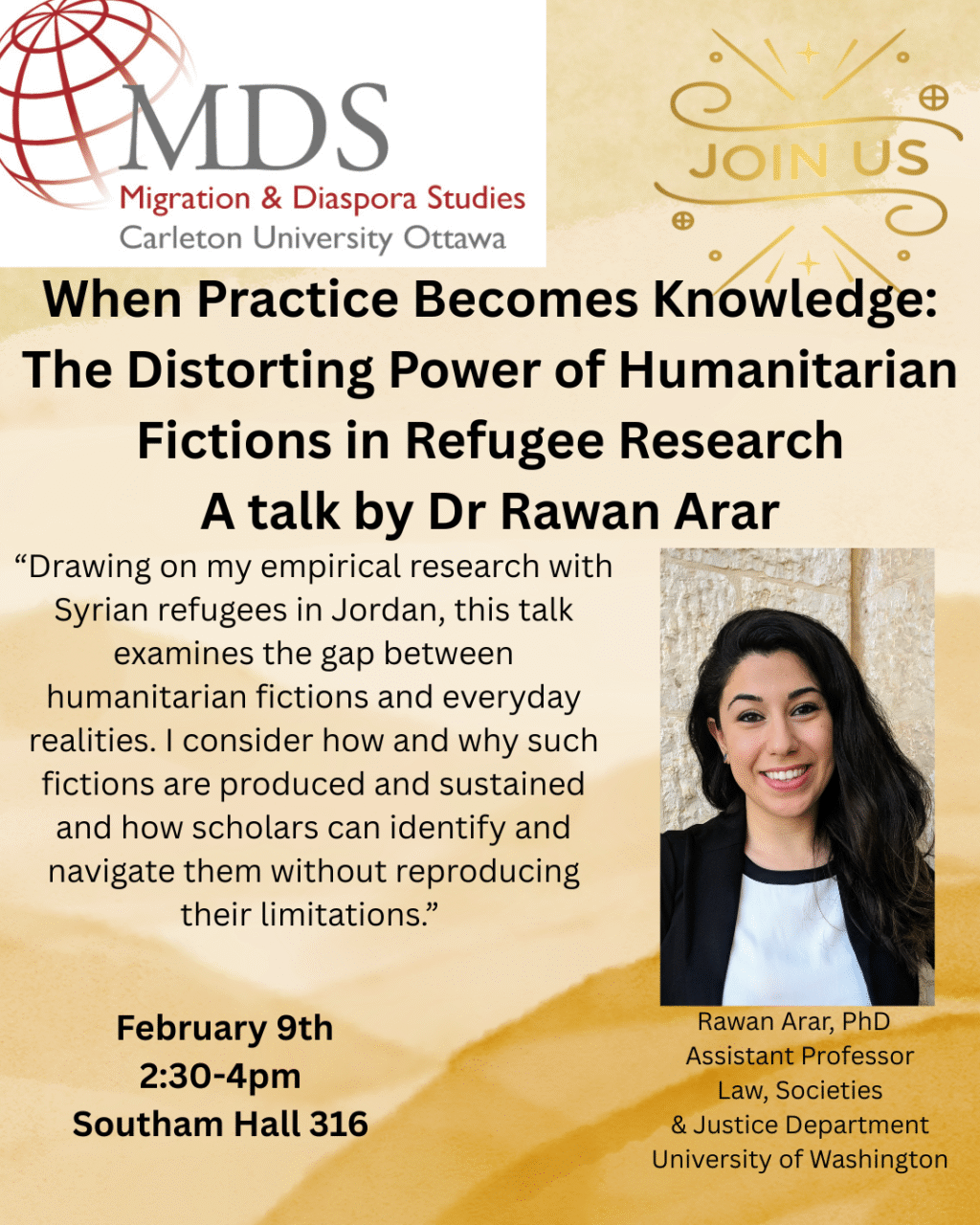
When Practice Becomes Knowledge: The Distorting Power of Humanitarian Fictions in Refugee Research. A talk by Dr Rawan Arar
Monday, February 9, 2026 from 2:30 pm to 4:00 pm
- In-person event
- 316, Southam Hall, Carleton University
- 1125 Colonel By Drive, Ottawa, ON, K1S 5B6
Scholars and practitioners rely on a shared vocabulary of displacement to describe forced migration and reception. This lexicon includes terms such as refugee, migrant, host or host community, humanitarianism, resilience, and refugee burden. While this language enables communication across legal, political, humanitarian, and empirical domains, it often prioritizes palatability over precision. Its deliberate vagueness makes coordination and governance possible, but it also risks obscuring lived experiences and flattening social and political complexity.
I introduce the concept of humanitarian fiction to explain how humanitarian responses to refugee displacement come to be understood as neutral descriptions of reality, even as they diverge from what can be observed on the ground. Humanitarian fiction draws attention to how power operates through labeling and recognition, legitimizing some practices while rendering others invisible. It refers to widely accepted narratives produced by governments, international organizations, and aid agencies that simplify complex political situations in order to make humanitarian action legible and manageable. These narratives foreground visible suffering, urgency, and generosity while downplaying the political causes of displacement, unequal power relations, and the limits placed on refugees’ rights.
Drawing on my empirical research with Syrian refugees in Jordan, this talk examines the gap between humanitarian fictions and everyday realities. I consider how and why such fictions are produced and sustained and how scholars can identify and navigate them without reproducing their limitations.