SAR Statements
Your resume must contain concise bullet points to describe your experiences. SAR statements effectively outline your accomplishments in a simple, informative way.
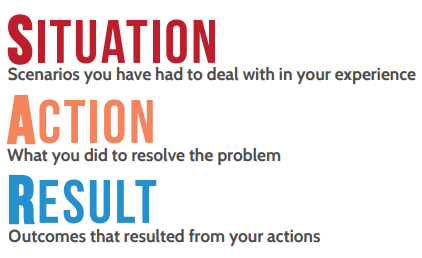
Situation: Scenarios you have had to deal with in your experience
Action: What you did to resolve the problem?
Result: Outcomes that resulted from your actions
Example:
Action: Reorganized a
Situation: cluttered office supply store,
Result: which led to a 20% increase in sales of merchandise
Note: Placing a strong verb at the start of the statement can grab the attention of the reader, and will convey important tasks and information to the employer quickly.
Questions to consider
- What tasks did you complete (what did you do and how?)
- What skills did you use when you took action on the problem?
- What obstacles were you required to overcome?
- What was the result, outcome, significance or conclusion?
Quantifying your results
When writing your SAR statements, try to incorporate numbers that show the frequency, scope, scale, or impact of your work. Ask yourself:
- Money: Did you save, generate, manage, or recover money? By how much?
- Targets: Did you meet or exceed a sales, performance, fundraising, or other target? By how much or what percentage?
- People: How many customers, clients, students, patients, or community members did you serve or support?
- Volume: How many orders, applications, files, projects, reports, or transactions did you handle?
- Frequency: How often did you perform the task? Per shift, day, week, month, quarter, semester, or year?
- Time: Did you save time or complete a process faster? How much time did you save?
- Growth: Did you increase participation, sales, engagement, membership, followers, or another metric? By how much?
- Quality: Did you improve accuracy, satisfaction, completion rates, or another measure? By how much?
- Scope: How large was the team, budget, event, caseload, audience, or project you worked with?
- Results: What measurable difference did your work make? Use a number, percentage, comparison, dollar amount, or other concrete evidence whenever possible.
Ranges and estimates
Don’t know the exact number? Use a reasonable range or approximation based on what you know. For example, write “supported 15-20 students per week,” “managed 10+ projects,” or “served approximately 50 customers per shift.” Estimates can still demonstrate scale and impact, as long as they are honest, conservative, and explainable in an interview.
Tip: Begin tracking data to incorporate stronger metrics (e.g., numbers, percentages, dollar amounts) into future SAR statements.
Writing SAR Statements based on industry
The following handouts are designed to help you brainstorm stronger, results-focused resume content using the Situation-Action-Result (SAR) method. Each handout is tailored to a specific industry and includes guidance for both early experience (e.g., co-ops, internships, placements, projects, clubs, and entry-level roles) and advanced experience (e.g., professional and leadership roles). Use these resources as a foundation for identifying relevant tasks, reflecting on your accomplishments, and developing tailored resume bullet points that align with your target opportunities. Remember to customize your resume for each application by incorporating keywords and priorities from the job posting.
- Architecture and Industrial Design
- Business-General
- Communications, Journalism, and Public Relations
- Computer Science and Information Technology
- Data Science, Artificial Intelligence, and Machine Learning
- Engineering-General
- Environmental
- Film and Entertainment
- Government and Public Affairs
- Graphic Design and Animation
- Human and Social Services
- International Affairs
- Legal, Criminal Justice, and Compliance
- Mental Health and Counselling
- Public History and Cultural Heritage
- Research-General
- Retail and Food Services
- Science, Laboratory, Research and Development
- Teaching and Learning
- User Experience and Web Design