How to Apply for A Study Permit from Outside Canada
Table of Contents
Kindly note that the information on this web site does not, and is not intended to constitute legal advice, and instead all information, content and material is for general information purposes only. Readers should contact and consult with an authorized immigration representative to obtain advice with respect to any particular legal matter. No reader should act or refrain from acting on the basis of information on this site without first seeking legal advice from an authorized representative in the relevant jurisdiction and with expertise in immigration law. Only your authorized representative can provide assurances that the information contained herein – and your interpretation of it – is applicable or appropriate to your particular situation. The content and information are provided “as is;” and no representations are made that the content or information is accurate, complete or error-free. Any liability is expressly disclaimed and Carleton University will not be liable for any losses, injuries or damages from the use or reliance on the information or content.
In most cases, international students must apply for a study permit before coming to Canada. The application is submitted to Immigration, Refugees and Citizenship Canada (IRCC), represented by Canadian visa offices around the world.
Official Government of Canada information about study permits and the application process is found at the IRCC website. The IRCC website also has a page of supplementary information for graduate students.
This webpage provides additional guidance and information specifically for international students who are new admissions to Carleton University. The information has been prepared by the licenced immigration advisors at Carleton’s International Student Services Office.
You may also wish to view the GO-ISSO’s video guides on Applying for a Study Permit.
Explanation of Terms
A study permit authorizes a temporary stay in Canada, study at a Designated Learning Institution (DLI, indicating a Canadian school authorized to host international students), and some work under certain conditions.
A Temporary Resident Visa (TRV) or an Electronic Travel Authorization (eTA) is Canadian travel authorization for International students (other than US citizens or permanent residents). Which type of authorization the student needs depends on the country that issued the passport used in the study permit application.
A visa office application for a study permit is automatically an application for the appropriate travel authorization as well.
For clarity, the term “study visa” is not used because:
- A study permit is a document showing the person named on the permit has temporary resident status in Canada. It does not authorize travel to Canada.
- A Temporary Resident Visa authorizes travel to Canada. It does not authorize study within Canada.
When to Apply for a Study Permit
New admissions should apply for their study permit as soon as possible after accepting Carleton’s offer of admission and paying a deposit to Carleton in order to receive their Provincial Attestation Letter (PAL) from either Carleton Undergraduate Admissions or Graduate Admissions.
IRCC publishes processing times for study permits on its website, but these are estimates, and not service guarantees.
How to Apply for a Study Permit
A study permit application is done online, using one of the two application systems at the IRCC website in an IRCC Secure Account
It is the applicant’s responsibility to ensure that they submit a complete and correct application that meets all of IRCC’s requirements. To be successful, the application must demonstrate to the immigration officer that the applicant is coming to Canada for a temporary purpose, that the purpose is to study, and that they can afford to pay their tuition and living expenses in Canada.
Get Started
IRCC Secure Account
Go to the Sign-in Page.
- Create an account.
- Once you are signed in, look for “Start an Application “, then “Apply to Come to Canada”. Choose the option “visit, study, work”.
- Answer the questionnaire. Your answers tell the system which forms and documents to include in your application list.
- Complete the application forms and upload documents as PDFs or graphic files.
- Pay application fees, electronically sign and submit the application.
Documents Required for a Study Permit Application
These documents are required for all study permit applications:
- IMM 1294 – Application for Study Permit Made Outside of Canada. This is a PDF form. Open and complete it using Adobe Acrobat Reader.
- Letter of Acceptance— Student Information for a Study Permit from Carleton University. See details below.
- Provincial Attestation Letter (PAL) — A PAL is required for most undergraduate applications (and for graduate student application until December 31, 2025) See more information about PALs below.
- Passport — Photocopy or scan of all pages that are not blank.
- Proof that the applicant has enough money to pay estimated tuition fees and living expenses. IRCC requires students in a multi-year program to pre-pay their tuition for the first year; and specifies the minimum required amount for living expenses. See additional information about the financial requirement below.
- Photo of the applicant
- Study Plan, sometimes called a Statement of Purpose – The ISSO recommends that all students write a study plan. If there is no application line for this item, the study plan can be uploaded to the line for optional documents called “Client Information”. See more information about study plans below.
Check Visa Office Instructions for Additional Requirements
It’s important to consult the visa office instructions for the applicant’s country of residence. Not following these instructions can lead to a refusal.
These instructions are found outside of the online application systems. To locate the visa office instructions for your country:
- Go to IRCC’s instructions for applying on paper.
- Select your country of residence from the pull-down menu.
- Click “Get Documents” to see the application package, including the visa office document checklist.
Depending on visa office requirements, you may need:
- Additional application forms
- Additional supporting documents, or documents that meet certain specifications
- A police certificate
- Results of an immigration medical exam
- Proof of English language proficiency
- Custodian declaration — For students under 18 years of age. Students of age 17 may not need a custodian, at the discretion of the immigration officer. Please note that Carleton University cannot act as a custodian or assist in finding a custodian in Canada.
If your online application does not list a particular document that you want to include, you can either:
- Merge it with electronically with a related document, or
- Upload it to the line called Client Information
Carleton Letter of Acceptance
A Letter of Acceptance from a Designated Learning Institution (DLI) is a required document for a study permit application. This essential Carleton document can be found in the Admissions section of your Carleton 360 account. The file name is “Visa Letter” if you are an undergraduate, and “International Students Letter” if you are a graduate student. The title of the document in both cases is “Student information for a Study Permit”. This one-page document meets IRCC’s requirement for a Letter of Acceptance from a Designated Learning Institution.
“Student information for a Study Permit” contains time-sensitive information and expires within your Carleton 360 account. It is strongly recommended that you download a copy for your records, as this document may be useful to you again in the future.
Please note that Carleton admissions offices verify Letters of Acceptance as required by Immigration, Refugees and Citizenship Canada (IRCC) several times a week as a routine practice. Students do not have to request LOA verification.
You should not include your entire admission package in your study permit application as the Letter of Acceptance. But if you have an entrance scholarship, you can include one of the following among your financial documents:
- Scholarship letter (undergraduate students)
- Statement of Standing on Admission (graduate students)
“Student Information for a Study Permit” includes Carleton’s Designated Learning Institution number, which is O19332687812 and is needed to complete IMM 1294.
Provincial Attestation Letter (PAL)
Undergraduate students: The PAL will be provided to newly admitted Carleton students in Carleton 360 once they accept their offer of admission and pay a $2000 deposit fee. For more details on how and when Carleton provides PALs, please consult International Undergraduate Admissions 2024-2025 Study Permit FAQs.
Graduate Students: As of January 1, 2026, students admitted to Masters and Doctoral degree programs do not need to include a PAL with their study permit applications. To claim the PAL exemption, write a note that refers to information about “Who doesn’t need a PAL or TAL” on the IRCC website.
Students in graduate diploma programs will need a PAL. See information on the Graduate Admissions website and direct questions about the PAL to graduate.studies@carleton.ca.
If a Student Qualifies for a PAL Exception
In specific cases determined by IRCC, students don’t need PALs. PAL exceptions are listed on the IRCC website. Look under the heading “Who doesn’t need a PAL/TAL”. IRCC may revise this list from time to time. Students whose situation appears on the list may indicate in their study permit application that they qualify for an exception, and then they will be required to provide proof of which exception applies to them.
Financial Requirement
A study permit application must satisfy the immigration officer that the student has the financial means to support themselves and any accompanying dependents during their time in Canada. The application should demonstrate that there are sufficient funds on hand to pay school fees plus living expenses (also called “room and board”) for at least the first year. Students in a multi-year program must provide proof that they have paid their first year of tuition in advance.
An immigration officer may also investigate whether enough money will be available to pay expenses during the entire program of study. This amount doesn’t necessarily have to be in the bank at the time of the study permit application, but financial documentation should satisfy the officer that there will be a continuing source of sufficient income, from employment or business, for example.
- Tuition – Carleton’s admission document will show a wide range for tuition. Use Carleton’s tuition and fee estimator to find actual tuition fees in the current academic year. If your first year in Canada goes into the next academic year, you can make a reasonable estimate of future fees by adding a small percentage to the current tuition. This estimate will be acceptable for your study permit application. Please consult the Carleton Student Accounts website for information about making payments and getting a receipt.
- Room and Board – As of January 1, 2024, required amounts for living expenses are specified by IRCC. They are based on Canada’s cost of living index and adjusted yearly: get the latest figures from the IRCC website.
Documents for Proof of Financial Means
This list is copied from the IRCC website. You do not need all of these documents. You should use documents that best explain your source(s) of funding.
- Proof of a Canadian bank account in your name, if you’ve transferred money to Canada
- A Guaranteed Investment Certificate (GIC) from a Canadian financial institution
- Proof of a student or education loan from a bank
- Your bank statements for the past 4 months (or those of your financial supporter)
- A bank draft that can be converted to Canadian dollars
- Proof you have paid tuition and housing fees
- Letter from the person or school giving you money, or
- Proof of funding paid from within Canada, if you have a scholarship or are in a Canadian-funded educational program
Documents should include complete contact information for account holders and financial institutions.
Your financial documents must satisfy the officer on each of these points:
- There is enough money available to you for your first year in Canada.
- The money is allocated to your education (meaning that it has been set aside for your education and no other purpose). If it is not your own money, your parent or other sponsor must demonstrate their ability and commitment to paying your expenses.
- The money is readily available, meaning not tied up in long term investments.
- The money was obtained legitimately through employment or business earnings.
- The money is available without the student having to work in Canada.
- If your country uses foreign exchange controls, you must prove that you’ll be allowed to export funds for all of your expenses.
Letter from a Financial Supporter
The person providing financial support should:
- Identify themself and provide complete contact information.
- State (and document) their relationship to the student. If they aren’t a parent, they should explain why they are supporting the student’s education.
- Attest that they will pay the student’s educational expenses in Canada.
- Mention the type of documentation that is provided as proof that they have the means to pay these expenses.
If the supporter is not the student’s parent, it is advisable to notarize the letter.
Pre-Paying Tuition
Carleton University does not require students to pay tuition fees in advance of the published dates and deadlines for payments. However, pre-paying a year of tuition is one way to show an immigration officer that sufficient funds are available.
If you wish to pay tuition in advance, please consult the Carleton Student Accounts website for answers to frequently answered questions about student money matters, including:
- How to make an international payment to a Student Account
- How to get a receipt
Study Plan (Statement of Purpose)
A study plan outlines why you want to study in Canada, and how your program of study will assist you to achieve your future goals. Your study plan should demonstrate to an immigration officer that your true purpose in coming to Canada is to study.
A study plan answers these questions:
- Why do you wish to study in Canada in the program for which you have been accepted?
- What is your overall educational goal?
- Why are you not pursuing a similar program in your country of residence/citizenship?
- What research have you done into studies in your country of residence/citizenship?
- How will this program enhance your employment opportunities in your country of residence/citizenship?
- What ties do you have to your country of residence/citizenship? This is especially important for mature students. Some examples of ties are: Parents, children and other family members, membership in groups or communities, home ownership, business ownership, letter from an employer.
While all study plans should address these questions, each student’s study plan should be personal and include specific details. General statements don’t contribute information the officer needs and make the statement less credible.
Graduate students should take extra care to show how their proposed program of study at Carleton connects their past activities with their future goals. They should demonstrate that they are knowledgeable about career or business opportunities in their home country.
One-page in length is a general guideline for an undergraduate study plan, but not a rule. Graduate students will probably need more space and are also advised to document points in their study plan.
Biometrics
Biometrics are fingerprints and a photo.
After you submit your application, you will receive instructions for giving biometrics. You must then make an appointment at a Visa Application Centre (VAC) or at an Application Support Center (ASC) in the United States (US). Find where to give biometrics.
If you gave biometrics as part of an application for a visitor visa, work or study permit within the past 10 years, you may not need to give them again. Find out if your biometrics are still valid by using IRCC’s Check Status Tool. Note that your study permit cannot be valid beyond the expiry date of your biometrics.
U.S. citizens are exempt from the requirement to give biometrics.
Medical Exams
You may need to undergo a medical exam, depending on where you currently live or have recently visited. If you have lived in a designated country for more than six months, you may need a medical.
Immigration medical exams must be done by doctors approved by IRCC, called panel physicians and listed on the IRCC website.
The doctor will send the full exam results to IRCC directly. The doctor will give you an “e-medical receipt”, which is the document you include in your study permit application.
Medical exam results are valid for one year.
Application Fees and Related Costs
You can expect to incur these costs in applying for a study permit:
- $150 application fee
- $85 biometrics fee (for a single student)
- Additional expenses that may include: photos, translations, notarization of documents, medical exam fees, educational credential assessment, police certificate(s), language tests, mail or courier, travel to complete biometrics, etc.
Accompanying Family Members
If you wish to have your spouse/partner and/or dependent children accompany you to Canada, answer “yes” to that question during the eligibility assessment part of the online application. You will then be prompted to answer questions related to each family member. The online system will create an application list for each person, below that of the principal applicant.
Family members may apply for visitor visas, study permits, or work permits, depending on their eligibility for these temporary resident programs. Note that only spouses/partners of graduate degree program students are eligible to apply for an open work permit.
Student Direct Stream No Longer Available
This IRCC option for expedited processing in some countries ended on November 8, 2024.
IRCC announcement about the end of the SDS and Nigerian Student Express.
After You Submit Your Application
Be alert for email notifications of new messages in your application account. The first message will be an acknowledgement of receipt (AOR) with your application number.
If IRCC requests you to take action, or supply additional documents, there will be a strict deadline for you to respond.
Processing Times
Immigration, Refugees and Citizenship Canada (IRCC) publishes processing times on its website. These are an estimate only and not a service guarantee.
Carleton University has no influence on IRCC’s processing times and cannot make an inquiry or request to IRCC on your behalf.
Approval
Once your application is approved, IRCC will call for your passport for insertion of the visa, if you need one. As a next step, they will issue a Letter of Introduction through your application account. This letter says that you have received initial approval for a study permit. You must travel to Canada while your visa and Letter of Introduction are valid.
Travelling to Canada
Infographic: Quick Travel Guide
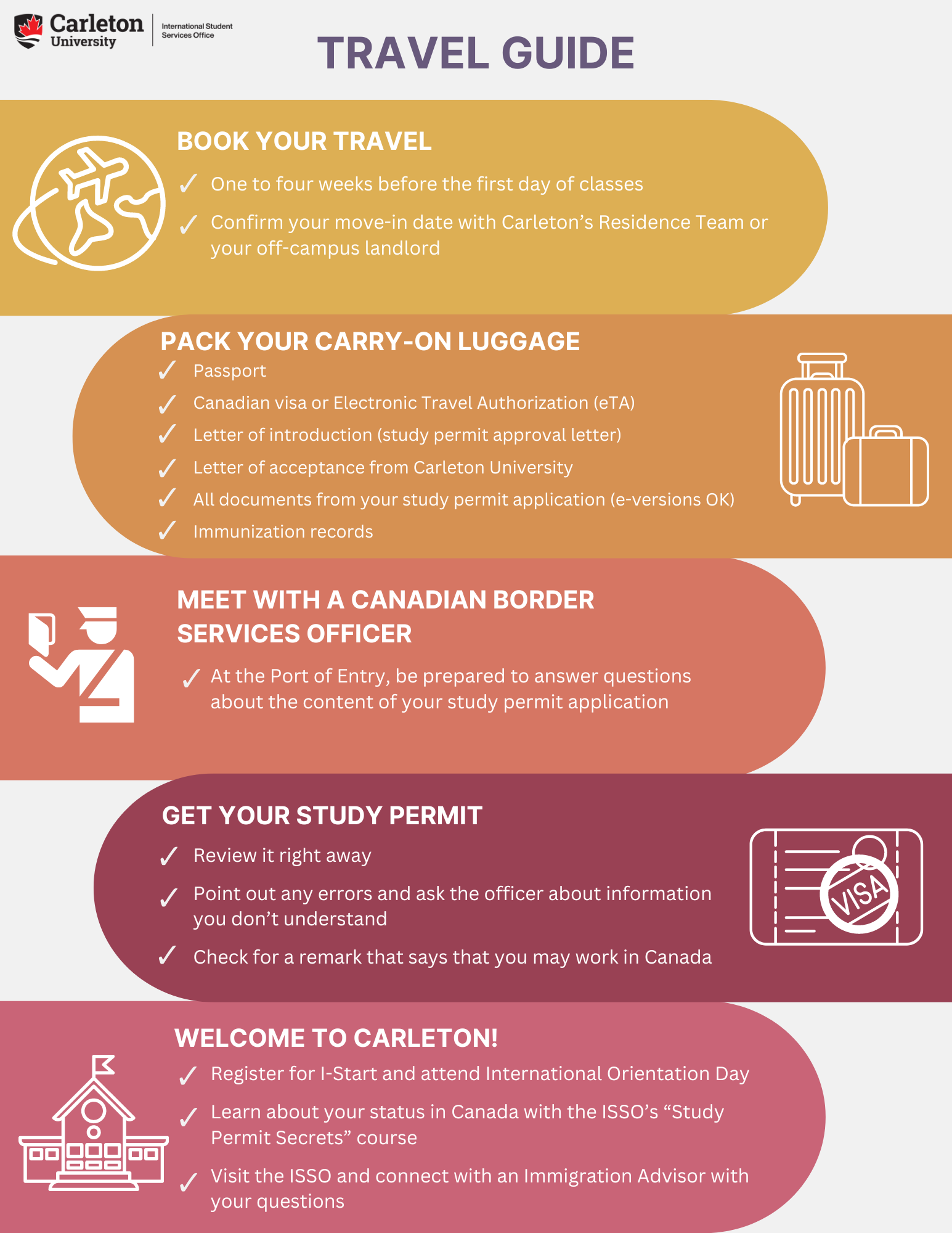
Travel Information for New Carleton Students
IRCC information about arriving in Canada
Canada Border Services Agency Travel Information for Students
ISSO Transition and Engagement Support for New Students
Applying for a Corrected Study Permit
If the CBSA officer makes a mistake on your study permit and you don’t notice until later, you can apply for a corrected document. There is no cost for this application.
Using a Lawyer, Consultant or Agent to Prepare Your Application
Many Carleton students prepare their own study permit applications. Members of the ISSO’s Immigration Advising Team are licensed immigration professionals and can provide information and advice based on general principles. We cannot complete your application for you, act as your representative, or make inquiries to IRCC on your behalf.
If you pay someone to do an immigration application for you, make sure they are an Authorized Representative under Canadian law: a lawyer, paralegal, Quebec notary, or Regulated Canadian Immigration Consultant. These professionals are members of regulatory bodies that work to protect consumers against fraud and unethical practices.
An Authorized Representative will always ask you to sign an IMM 5476 Use of Representative form to include with your application. Using an unauthorized or undeclared representative is illegal and may lead to a refusal of your application.
Applications prepared by Authorized Representatives don’t get faster processing times or other preferential treatment from IRCC.
Learn More About Study Permits
How to Apply for a Study Permit Extension from Inside Canada
Study Permit Terms and Conditions