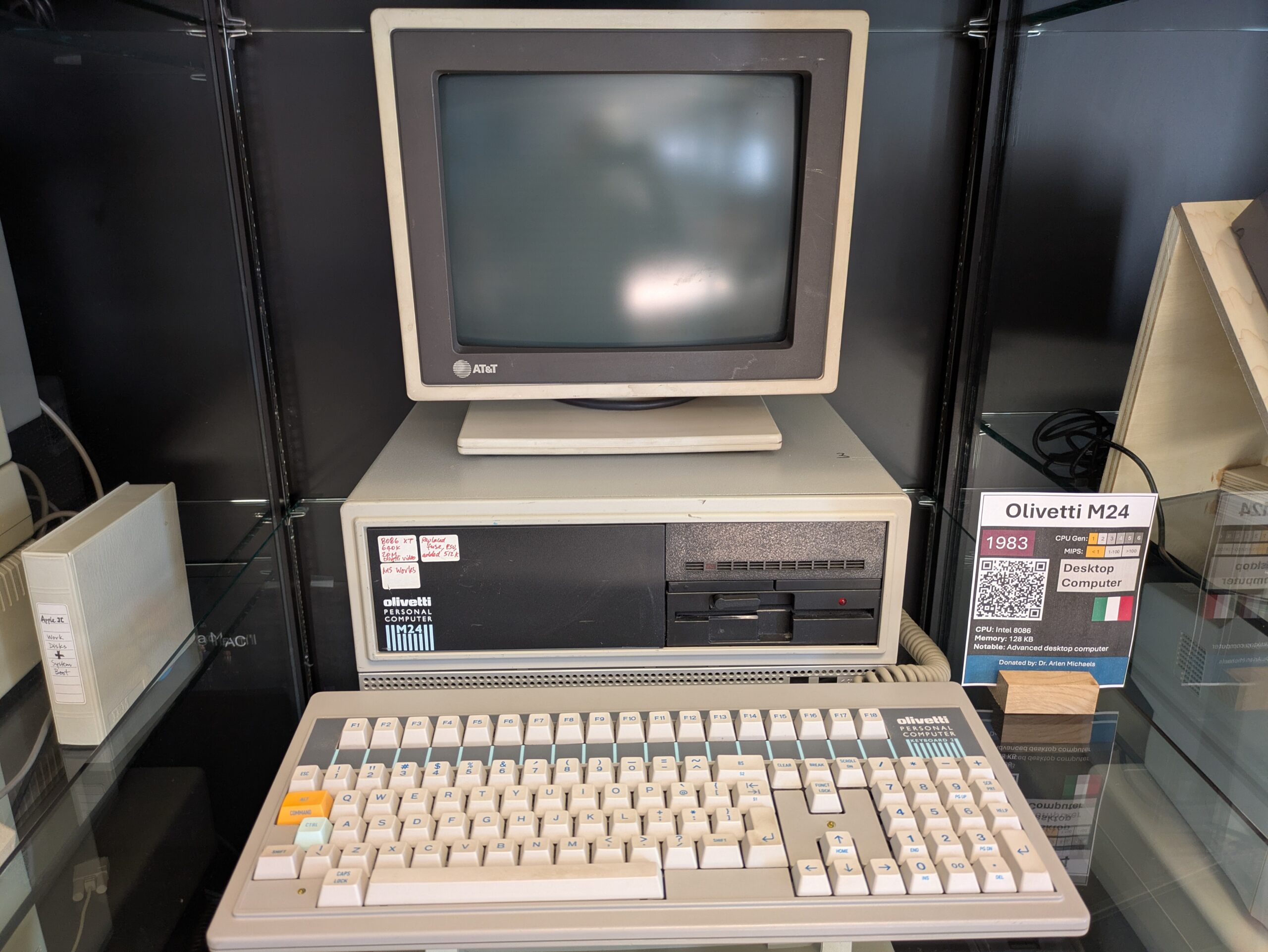
Olivetti M24
[vin37]
The Olivetti M24, introduced in 1983, was a landmark personal computer notable for its advanced Intel 8086 CPU running at 8 MHz, significantly faster than the IBM PC XT’s 4.77 MHz 8088 and its enhanced graphics capabilities, which included a proprietary video adapter supporting higher resolutions (up to 640×400 pixels) and a unique dual-sync monitor. Its claim to fame was its robust IBM PC compatibility paired with superior performance and graphics for its time, making it a strong alternative to IBM’s own offerings and propelling Olivetti to become the leading PC manufacturer in Europe by 1986 and the third largest worldwide. The M24’s importance lies in its role as one of the first successful European IBM-compatible PCs, helping to standardize DOS compatibility and expand the global PC ecosystem.
- Manufacturer: Olivetti, an Italian company known for its typewriters and later for its innovative personal computers
- Type: Desktop computer
- Release Date: 1985
- Cost at release: USD $1,991 (CAD ~$7,000 adjusted for inflation)
- Cost with Peripherals: USD $3,500 (CAD ~$12,000 adjusted for inflation)
- MIPS: 0.53 (530 KIPS)
- Hardware Specifications
-
- CPU: Intel 8086 at 8 MHz
- Memory: 128 KB RAM standard, expandable up to 640 KB
- Storage: Optional 10 MB or 20 MB hard disk
- Video: Proprietary video adapter supporting CGA and high-resolution (up to 640×400 pixels) graphics
- Olivetti dual-sync color monitor (proprietary connector)
- 8-bit ISA expansion slots (7 total)
- Parallel and serial ports
- Detachable keyboard with function keys
- Optional mouse and printer accessories
- Operating System & Programming Languages
-
-
Operating System: primarily ran MS-DOS 2.1 and later versions, but it also supported CP/M-86, UCSD-P, PCOS, and, on some models, Xenix and UNIX System V
- Supported Languages:
- GW-BASIC (bundled), BASIC, Pascal (via UCSD-P), C, Fortran, and assembly language.
- Its IBM PC compatibility allowed it to run most DOS-based programming tools and languages of the era, including compilers and interpreters for popular languages like BASIC, Pascal, and C.
- Notables
-
- The Olivetti M24 was sold under several names worldwide: as the AT&T PC 6300 in North America, Xerox 6060 in the US, and Logabax 1600 in France, highlighting its international reach and adaptability.
- Its 8 MHz Intel 8086 CPU made it nearly twice as fast as the IBM PC XT, and it was among the first IBM-compatible PCs to offer enhanced graphics (up to 640×400 resolution) with a proprietary dual-sync monitor.
- The M24 featured a unique split-level case design and a video card that doubled as a bridge between the motherboard and the ISA backplane, an unusual engineering solution for the time.
- Early models had function keys on the left side of the keyboard, a layout that later changed to the top row, and the mouse plugged directly into the keyboard—both quirks compared to standard IBM PC layouts.
- Its power supply was distinctive and complex, with a 24V design that made repairs difficult and even hazardous.
- The M24 was a major commercial success in Europe, becoming the continent’s top-selling PC in 1986 and helping Olivetti become the world’s third-largest PC maker that year.
- It is notable for being able to run graphical environments like Windows 3.0 (in real mode), Geoworks Ensemble, and GEM at higher resolutions than most contemporaries.
- The M24 played a pivotal role in establishing IBM PC compatibility as an industry standard and was a turning point for Olivetti after the earlier failure of its proprietary M20 model.
- There are no widely recognized nicknames for the Olivetti M24, but its North American branding as the AT&T PC 6300 is often referenced in vintage computing circles
Share: Twitter, Facebook
Short URL:
https://carleton.ca/scs/?p=20743