Intel SDK-85
[vin42]
The Intel SDK-85, introduced in 1977, was a pioneering single-board computer designed to showcase and develop for the Intel 8085 microprocessor, featuring a 6-digit LED display, a 24-key hexadecimal keyboard, and expandable RAM and ROM. Its claim to fame was making microprocessor technology accessible to engineers, students, and hobbyists, serving as both a learning platform and a prototyping tool during the early microcomputer revolution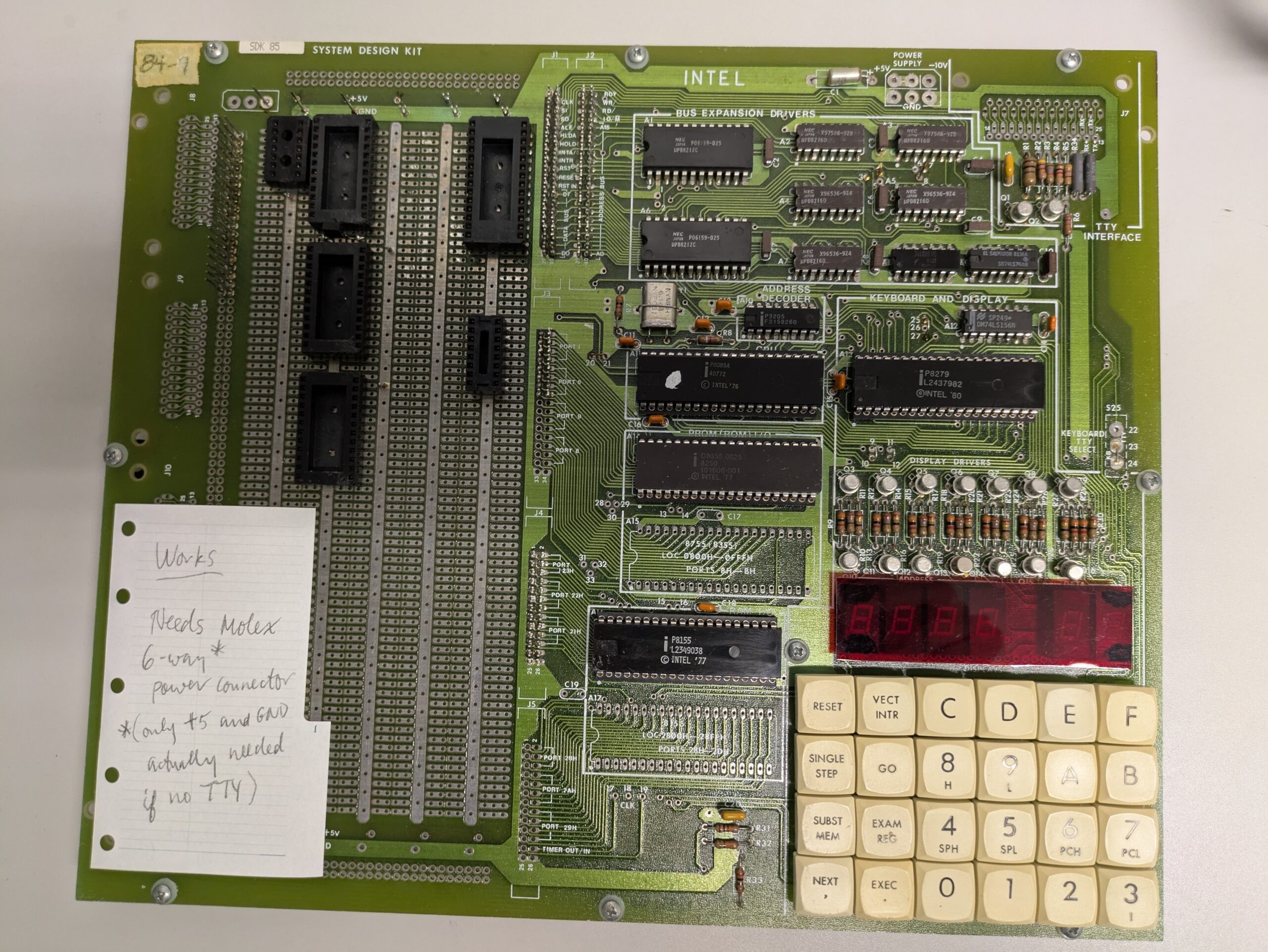
- Manufacturer: Intel
- Type: Single-board computer
- Release Date: 1977
- Cost at release: USD $250 (CAD ~$1,400 adjusted for inflation)
- MIPS: 0.77 (770 KIPS)
Hardware Specifications
- Processor: Intel 8085A running at 3 MHz with a 1.3 μs instruction cycle
- Memory:
- ROM: 2 KB expandable to 4 KB (using 8355 or 8755)
- RAM: 256 bytes expandable to 512 bytes (using 8155)
- I/O:
- 38 programmable parallel I/O lines (expandable to 76 lines)
- Serial interface through SID/SOD pins of 8085
- Display: 6-digit 7-segment LED display
- Input: 24-key hexadecimal keyboard
- Interfaces:
- TTL-compatible bus
- 20 mA current loop for teletype (110 baud)
Operating System & Programming Languages
-
Operating System: The Intel SDK-85 ran a built-in monitor program stored in ROM rather than a traditional operating system. This monitor provided basic system control, program entry, memory inspection, and I/O functions directly through its hexadecimal keypad or via a teletype interface
-
Supported Languages: The primary programming language for the SDK-85 was 8085 assembly language, as users wrote and entered machine code or assembly programs directly. Additionally, higher-level languages such as Intel PL/M could be used if cross-compiled on another system and then loaded onto the SDK-85
Notables
-
The Intel SDK-85 was nicknamed a “system design kit” and was notable for being a complete single-board computer aimed at education, prototyping, and development for the Intel 8085 microprocessor
-
It featured a rare 24-key hexadecimal keyboard and a 6-digit LED display for direct program entry-unusual for its era
-
The SDK-85 could interface directly with teletypes using a 20 mA current loop, rather than the more common RS-232, reflecting its roots in early computing labs and industrial environments
-
Despite only 256 bytes of RAM (expandable to 512 bytes), it was used to build games like Simon and for hardware experiments, showcasing the versatility of minimal hardware
-
The SDK-85 helped launch the era of hands-on microprocessor learning and rapid prototyping, influencing generations of engineers and hobbyists
Donated by: Arlen Michaels