RENDER – Volume Ten
Acknowledgements
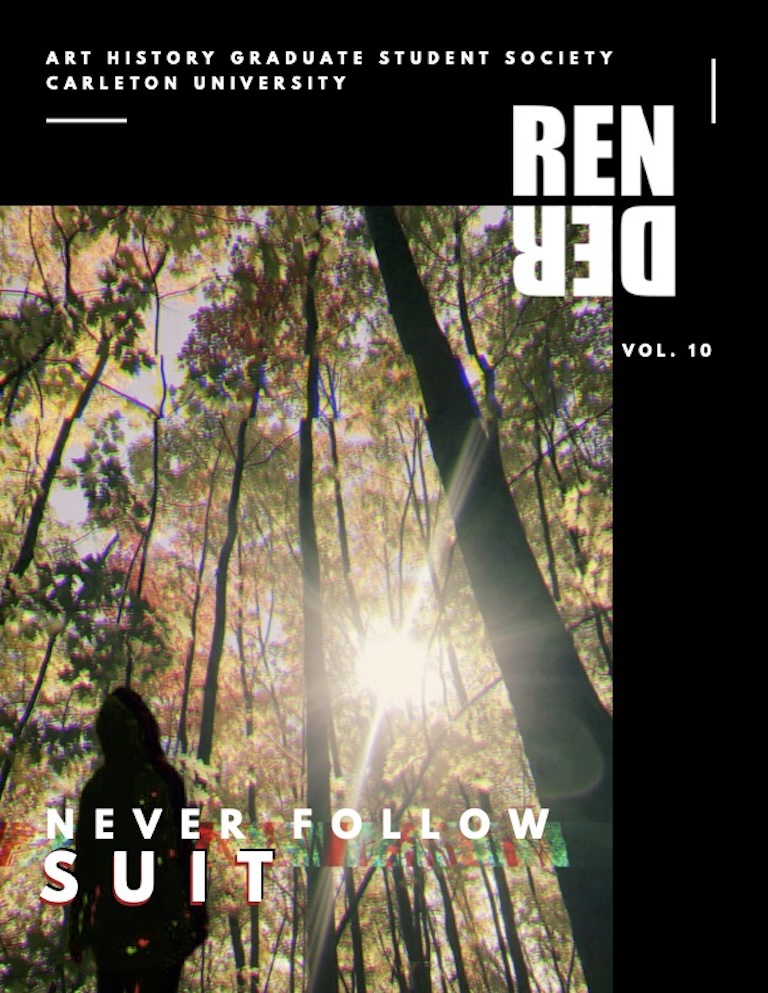
We are pleased to present the tenth edition of the RENDER Graduate Journal. The theme for the 2025-26 RENDER Journal is Never Follow Suit. This volume would not have been possible without the collaboration between the first- and second-year Art and Architectural History Graduate Students. The 2025-26 Graduate Student Society consists of many members, all of whom played an important role in making this year’s edition happen. Lujeen Aburawi and Sam Monastero served as Co-Presidents. Hope Hamilton, Alexander Zoubek, Moira Power, Heather Macnab, Samantha Monastero, and Rebekah Walker formed the Editorial Committee. Moira Power, Heather Macnab, and Samantha Monastero served as team members for Journal Art and Graphic Design. Theresa McAvoy acted as administrator, Rebekah Walker acted as treasurer, and Emily Critch provided consultation.
The 2025-26 RENDER Journal theme, Never Follow Suit, arises from global movements responding to ongoing crises. This edition embraces the radical spirit of political activism, critical reflection, and non-normativity. Inspired by a 2010 song by Swedish pop band The Radio Dept., Never Follow Suit encourages meaningful resistance to tradition and conformity. It challenges us to reconsider the cards we’ve been dealt and confront expectations shaped by world events. The works in this edition explore institutional critique, lived realities, creative refusal, relational practice, and worldbuilding.
We thank our supporters: the Faculty of Art and Architectural History, the Director of the School for Studies in Art and Culture, and the Carleton Dominion-Chalmers Centre.
We hope you enjoy this tenth edition of the RENDER Graduate Journal!
Warmly,
AHGSS, 2025-2026
Art and Architectural History MA Cohort, 2024-26 / 2025-27
Content Warning: This edition of RENDER will cover potentially triggering topics, including racism, sexism, colonialism, imperialism, violence, and destruction. Some readers may find this content distressing. Please remember to take care, seek support, and consult resources as needed.
* * *
Contents
“Hazem Harb: Worlding Through the (an)Archive” by Grace Lapp-Sullivan
Postcoloniality requires new methodologies to facilitate decolonial futurities. An anarchival practice becomes a necessary tool to imagine what deimperial potentials can be pragmatic in colonial worlds; memory, sensorial methods, oral traditions, etc., are central to expose the constructedness of neutrality and normativity and exercise pluriversal worlding. Hazem Harb, a Palestinian artist exiled between Rome and Dubai, arguably engages in an anarchival practice through his subversion of colonial archives and manipulation of extra-archival materials to produce possibilities redefined through Palestinian sovereignty of spatiality, temporalities, and bodies. Exploring artworks from three of Harb’s series, worlding occurs on three axes by constituting shared imaginaries undefined by borders, principles of waiting to deny imperial progress, and the self embodied with the collective.
“Exhibition Review: Grotto: The Bill Staubi Collection” by Heather Macnab
Grotto: The Bill Staubi Collection was an exhibition held at the Ottawa Art Gallery (OAG) that showcased a selection of artworks donated by Bill Staubi, a prolific Ottawa-based art collector. According to the OAG website, Grotto aims to highlight “Staubi’s unwavering support for queer artists and his deep-rooted commitment to Ottawa’s vibrant contemporary art scene.” However, in an exhibit that seeks to represent and celebrate marginalized artists and communities, it is vital that galleries like the OAG employ ethical practices that build public trust and foster connection with its diverse communities. In this review, I analyze the curatorial approach to this exhibit, paying special attention to the ways in which the OAG has implemented the ethics of care, community inclusion, and sensitivity through Grotto.
“Grinding the Stage: Permeable Choreography, Counterculture and Collective Politics in Mette Ingvartsen’s Skatepark” by Sam Monastero and Rebekah Walker
“Grinding the Stage: Permeable Choreography, Counterculture, and Collective Politics in Mette Ingvartsen’s Skatepark” examines how Mette Ingvartsen reimagines contemporary choreography by integrating skateboarding as both a movement practice and social system. Premiered in 2023 and staged across the globe, Skatepark reached the National Arts Centre in Ottawa, Canada, in November 2025. The work transforms the theatre into a functioning skatepark, exemplifying Ingvartsen’s concept of “permeable choreography,” an open framework that absorbs existing movement cultures and social relations. The piece shifts the focus from virtuosity to everyday acts of coexistence, while its scenography – developed with Pierre Jambe and Antidote Skateparks – creates a dynamic, heterotopic space. Engaging skateboarding’s tension between counterculture and institutionalization, Skatepark ultimately frames choreography as the collective negotiation of shared space.
“Outside(r) Ornamentation: Domestic Outdoor Spaces in Outsider Art” by Moira Power
This study examines outsider art environments created by George Cockayne, Fred Smith, and Reverend Howard Finster, arguing that these domestic outdoor installations function as intentional forms of vernacular public art rather than isolated “raw” expression. Through the analysis of Cockayne Farm, Wisconsin Concrete Park, and Paradise Garden, the study demonstrates how these artists merge sculpture, ornamentation, horticulture, and architecture to construct narrative spaces shaped by community relationships, local histories, and accessible visual languages. Challenging longstanding assumptions about outsider art’s detachment from culture, the paper positions these environments as socially engaged, intergenerational sites of storytelling, preservation, and spiritual teaching. Ultimately, it argues that outsider art environments transform private outdoor environments into public-facing spatial experiences that reshape viewer perception and engagement.
“Exhibition Review: Erica Rutherford: Her Lives and Works” by Elizabeth Spence
Erica Rutherford: Her Lives and Works, on display at the National Gallery of Canada from June 13 to October 13, 2025, unsettles boundaries of selfhood, nationality, gender, and sexuality. Rutherford was a multi-disciplinary, multi-national artist who lived according to her own values and desires, pursuing gender transition in the 1970s while continuously reshaping her artistic practice. The exhibition retrospects Rutherford’s life and career from early experimentation, a film career in South Africa in the 1940s, to self-portraiture in the 1970s, to a series of children’s illustrations of Prince Edward Island produced in the 1980s. Bringing visitors through Rutherford’s many worlds, curator Pan Wendt presents Rutherford’s story through her own words, quoting her in wall text and labels. The exhibition tells a story of fluidity, of transformation, identity, and a lifelong tension with belonging. The first solo exhibition of a transgender artist at the National Gallery, Her Lives and Works holds these tensions of Rutherford’s life while foregrounding the beauty and humanity of her self-expression.
“Unmaking as Refusal: Destruction, Care, and the Ethics of Institutional Devotion” by Juniper Todd
What does it mean to destroy rather than preserve? And who decides which forms of unmaking count as violence, carelessness, or crime? This essay argues that artistic destruction—particularly practices such as Gustav Metzger’s auto-destructive art, performance-based unmaking, and acts of iconoclasm—can operate as a form of devotion: an ethical attention to what dominant institutions demand be protected, stabilized, and made permanent. Drawing on feminist ethics of care, affect theory, and cultural criminology, the paper reframes destruction not as nihilism or loss, but as a refusal to “follow suit” within regimes of preservation, heritage, and aesthetic order. Through close engagement with auto-destructive art, performance works that stage vulnerability and disappearance, and contemporary acts of monument toppling, this essay traces how unmaking functions as a counter-aesthetic to neoliberal modes of care that prioritize comfort, continuity, and visual coherence. Destruction here becomes communicative: a way of exposing the violences concealed by smooth surfaces, curated memory, and moralized notions of cultural value. In refusing preservation as an unquestioned good, these practices insist on rupture as a mode of ethical relation. Destruction emerges not as the opposite of care, but as one of its most radical expressions; an act of fidelity to histories, bodies, and truths that cannot survive intact.
“Thinking Through Guyanese Women’s Art: Postcolonial Nation-Building, Relational Difference and Enactments of Fugitivity” by Xandr Vickers
As host of the first Caribbean Festival of Creative Arts (Carifesta) in 1972, Guyana was the location of a ground-breaking emphasis on the Caribbean as a site of cultural production situated within the context of Guyana’s tumultuous postcolonial consciousness. While several male Guyanese artists of this period gained international acclaim, less attention is given to their female contemporaries who also taught and practiced art, such as Marjorie Broodhagen (1912-2000), Stephanie Correia (1930-2000), and Bernadette Persaud (b. 1946). This essay explores the roles these women played in the mission for a Guyanese national culture through art as a form of resistance and critique, considered alongside the intersections of racialized and gendered power imbalances in Guyana. Focusing on the practices of Broodhagen, Correia, and Persaud, their presence in cornerstone cultural events illustrates Guyanese women’s cultural productivity and the pathways they paved for contemporary women artists. Guided by Caribbean feminist theories, such as “relational difference” and the Indo-Caribbean feminist praxis of “seeing difference,” both of which acknowledge the unique, incommensurable experiences of people across the Caribbean, Broodhagen, Correia and Persaud will be centred as integral agents in the emergence and expression of Guyana’s arts sector. Their practices are explored through fugitivity as a method, drawn from the Black radical tradition, to examine how both their actions and their artworks constitute a fugitive praxis. Despite the proliferation of women’s art practice during this time, scholarship considering the role of women in Guyanese artistic culture is limited, particularly as it relates to the wider political context of post-independence. It is important to acknowledge Guyana as an active art-producing body in the Caribbean that women are a part of, as well as exposing the residuals left by colonizing bodies and centring women’s creativity in the face of sexual and gender-based violence.