Canada, Spain, and The European Union in The Turbot War
 |
 |
| These are two of the Canada Patrol ships that seized Spanish and Portuguese fishing trawlers, the Cape Roger (left) and the Leonard J. Cowley (right). | |
What Happened?
One issue between the Spanish and Canadians was whether or not Canada had a legal right to seize foreign vessels outside the 200-nautical mile limit of its authority. Within this area, Canada exercises its full sovereignty; it can make laws and enforce them.
Click here to see a map showing the 200 nautical mile limit; note the “nose” and “tail” region off the coast of Newfoundland and Labrador.
The Spanish stated that the Estai was captured outside Canadian waters in the Grand Banks, or “nose and tail” region. Therefore, they said, the Canadian government had no legal right to seize foreign ships.
The Canadian government stated that it acted to conserve dwindling stocks of turbot. Find out what turbot or Greenland halibut or black halibut look like.
The main issue was that the Spanish were accused of catching more turbot than they were allowed to by the North Atlantic Fisheries Organization. (NAFO) Check out the NAFO website and find out how many countries are members. See if you can find fishing quotas for turbot or Greenland Halibut on their website.
Canada and the European Union concluded an agreement in early April 1995 that resolved the conflict between Canada and Spain and protected the turbot from over fishing.
If NAFO is the International Organization that sets fishing quotas, why was the European Union involved in a dispute between Spain and Canada?
The EU’s Role
 Why was the European Union involved in a dispute between Spain and Canada?
On March 9th, 1995, the Canadian Coast Guard seized the Spanish fishing trawler Estai off the coast of Newfoundland. The Canadian government accused Spanish ships of overfishing turbot off the Grand Banks. It seized the Estai and cut off the nets of other fishing trawlers from Spain and Portugal. NAFO was not directly involved in the dispute.
So why did Canada negotiate a settlement with the EU instead of with Spain and Portugal?
To answer that question, we must compare Canada and the EU.
Dare We Compare?
To understand why Canada negotiated with the EU rather than with Spain, we need to understand the relationship between the central and regional governments in the European Union.
The relationship between the regional and central governments in both Canada and the EU is extremely similar. See Lesson 3-Activity 2 in the politics section.
IN CANADA
In Canada, there is a central federal government as well as regional provincial and territorial governments. For example, Ontario has a provincial government, while the North-West Territories has a territorial government. If one of these regional governments becomes involved in any kind of dispute with another country, such as the United States or Spain, then the central government steps in to resolve the conflict.
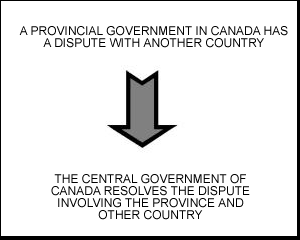
Okay, so the national government in Canada takes care of any disputes with the government of other countries.
What does this have to do with the EU?
So in Canada, the provinces are subordinate to the federal government when dealing with other countries. How is this similar to the EU?
IN THE EU
The EU is made up of regional Member States, such as Spain, Portugal, France and Ireland and a central government, called the European Union.
Member States and Provinces are both regional governments. The federal government in Canada and the European Union in Europe are both central governments.
However, there is an important difference between the central and regional governments in Canada and Europe.
The central government of the EU only represents the member states in disputes involving foreign trade and fishing. The EU does not represent the regional member states in the UN Security Council | FR or in NATO | FR. In Canada, the central government resolves all disputes with other countries.
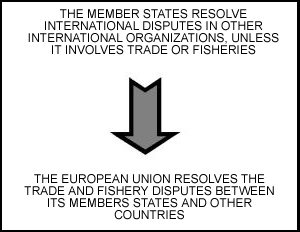
So, in the Turbot War, because a regional Member State of the EU, Spain, was involved in a fight over fishing rights with Canada, the EU had to resolve the dispute.
Check it out, Spain is not a member of NAFO, but the EU is a member.
 Resolving the Dispute
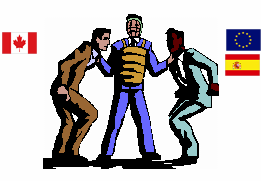
The European Union and Canada quickly reached an agreement through negotiation.
Although leaders from Spain, Portugal and other EU countries were present, only the European Commission had the power to reach a deal with Canada.
The final agreement set out some new rules to enforce fishing quotas, such as:
- Independent Observers to be placed on fishing vessels to ensure no over fishing takes place. Tracking fishing vessels using satellite. More inspections of fishing vessels.
- Bigger fines and other penalties for over fishing.
These new rules applied to both Canadian and EU fishing trawlers. To further protect against over fishing and conserve the turbot off the coast of Newfoundland, Canadian vessels were only allowed to catch 10 000 tonnes of turbot. EU vessels were only allowed total catches of 5013 tonnes of turbot.
And so ended the month-long Turbot war!