Undergraduate Studies
Economics is relevant to almost every aspect of our lives. At its core, it is the study of decision-making in the face of scarce resources and competing interests. The need to make these prudent choices pervades our day-to-day lives – as individuals, as a community, and as a society.
Table of Contents
Why Study Economics?
Economics is relevant to almost every aspect of our lives. At its core, it is the study of decision-making in the face of scarce resources and competing interests. The need to make these prudent choices pervades our day-to-day lives – as individuals, as a community, and as a society.
Economics provides causal insights into important social issues such as:
- Health Care
- Protecting the environment
- Reducing inequality, and the design of social programs and tax systems
While education in economics is relevant for business or management, its scope and rigour are much broader. Economics is a social science; as an intellectual discipline, economics seeks to measure, analyze, and understand a wide range of social phenomena using a rich set of technical tools and methods.
Hear more about why you should pursue Economics from Professor Hashmat Khan from the Department of Economics:
B.ECON Honours’ Offerings
Students can pursue a B.ECON Honours in Economics or specialize in the following concentrations:
- Advanced Economic Analysis
- Computational Analysis
- Economic Development
- Economic Data Science
- Financial Economics
- International Political Economy
- Mathematics and Quantitative Economics
- Natural Resources, Environment and the Economy
The Department also offers a less rigorous 15-credit General Bachelor of Economics Program. The program is restricted to internal applicants within Carleton.
Program Structure
Students in the Honour’s 20.0 credit Bachelors of Economics program are expected to complete the following courses in sequence.
Note about Course Structure
Below are courses listed that most students in the Honour’s program are required to take. Some concentrations within the program have alternative paths that may not require all of the core courses. Carefully look through each concentration and its requirements. If you have any questions about course planning within your degree, please email our department (economics@carleton.ca) or book an appointment with our Undergraduate Administrator, Sean Hall.
YEAR ONE
Students must successfully complete
ECON 1001: Introduction to Microeconomics
ECON 1002: Introduction to Macroeconomics
ECON 1401: Elementary Mathematics in Economics I
ECON 1402: Elementary Mathematics for Economics II
YEAR TWO
Students must successfully complete
ECON 2020: Intermediate Microeconomics I: Producers and Market Structure
ECON 2102: Intermediate Macroeconomics I
ECON 2210: Introductory Statistics for Economics
ECON 2900: Professional Practice of Economics
YEAR THREE
Students must successfully complete
ECON 3020: Intermediate Microeconomics II: Consumers and General Equilibrium
ECON 3102: Intermediate Macroeconomics II
ECON 3210: Introductory Econometrics
ECON 3900: Research Methods in Economics
YEAR FOUR
Students must successfully complete
ECON 4905: Honours Capstone Seminar [0.5 credit]
OR
ECON 4908 : Honours Essay [1.0 credit]
Pursuing an MA in Economics
Students in Carleton’s undergraduate economics programs who are interested in pursuing our MA in Economics prepare by taking the courses listed below with minimum grades of B+ or higher. If these courses (or equivalents from your university) have not been completed with minimum grades in the B+ range or higher or are not in progress by the time an MA application is submitted, the applicant may be required to complete or repeat any or all of the courses listed below which may be included in an offer of admission to Carleton’s Extended Masters in Economics (EMA), providing the applicant is meeting the other admission criteria, including the B+ CGPA requirement, calculated using a student’s grades in their last 20 courses completed.
- ECON 3001 – Mathematical Methods of Economics
- ECON 4001 – Mathematical Analysis in Economics
- ECON 4002 – Statistical Analysis in Economics
- ECON 4020 – Advanced Microeconomic Theory
- ECON 4021 – Advanced Macroeconomic Theory
- ECON 4706 – Econometrics I
Post-Baccalaureate Diploma in Economics
Our department offers a post-baccalaureate diploma to:
- Anyone who would like additional preparation for graduate education in economics
- People who have already completed an undergraduate degree in another discipline and would like a rigorous and structured introduction to economics
- Those with a degree from outside Canada, whether in economics or another discipline, who are looking for a one-year, recognized, Canadian qualification in economics
Important Pages for Undergraduate Students
Tutoring Assistance
Please email Ph.D. candidate, Ahmad Malgarai.
Registration Information for Undergraduate Students
Undergraduate Course Outlines
Choosing the Right Program
Carleton Undergraduate Economics Society (CUES)
B.ECON Student Ambassadors
Math & Writing: Tutorials & Preliminaries
Undergraduate Programs and FAQ
Professional and Academic Development
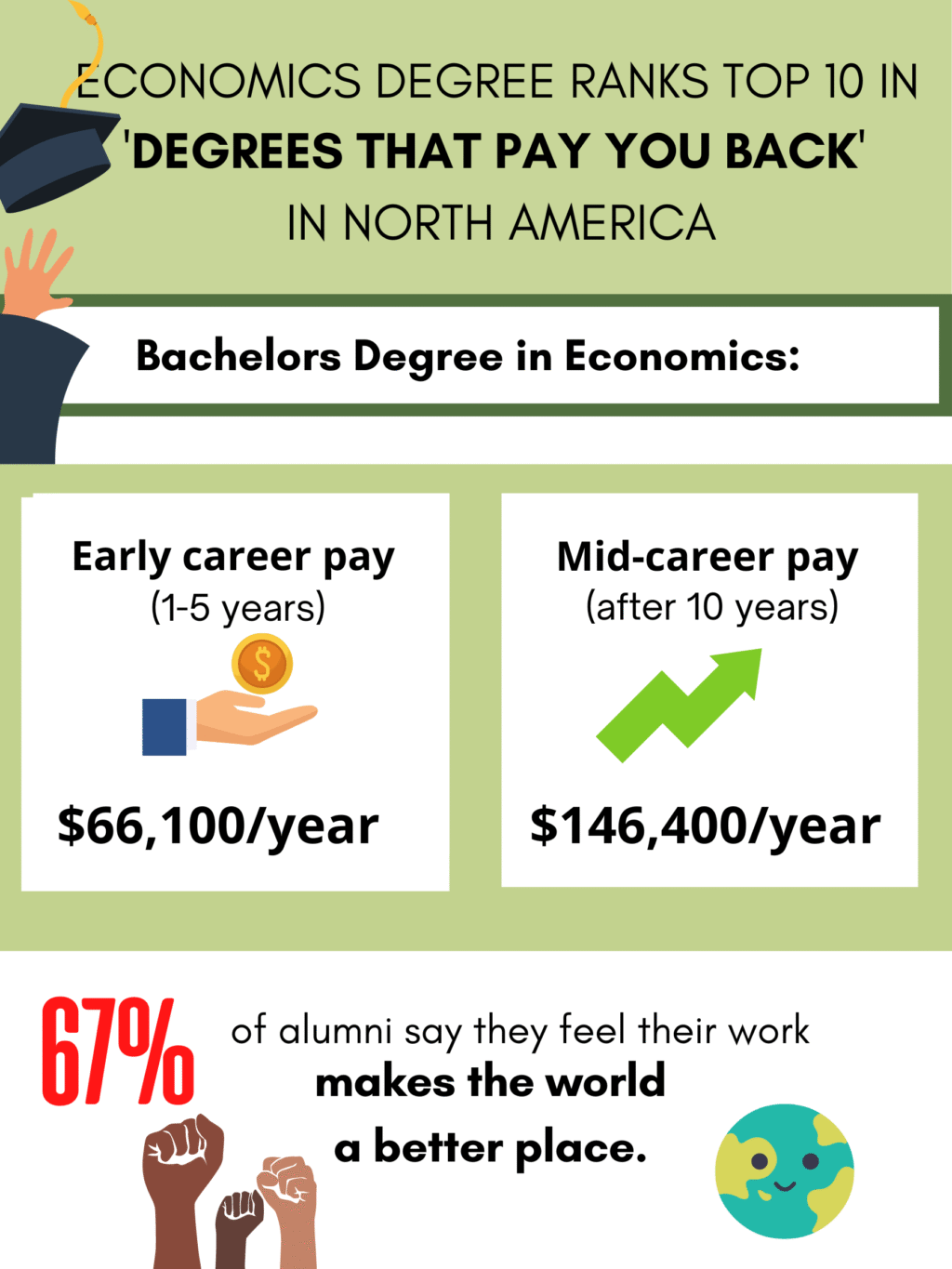
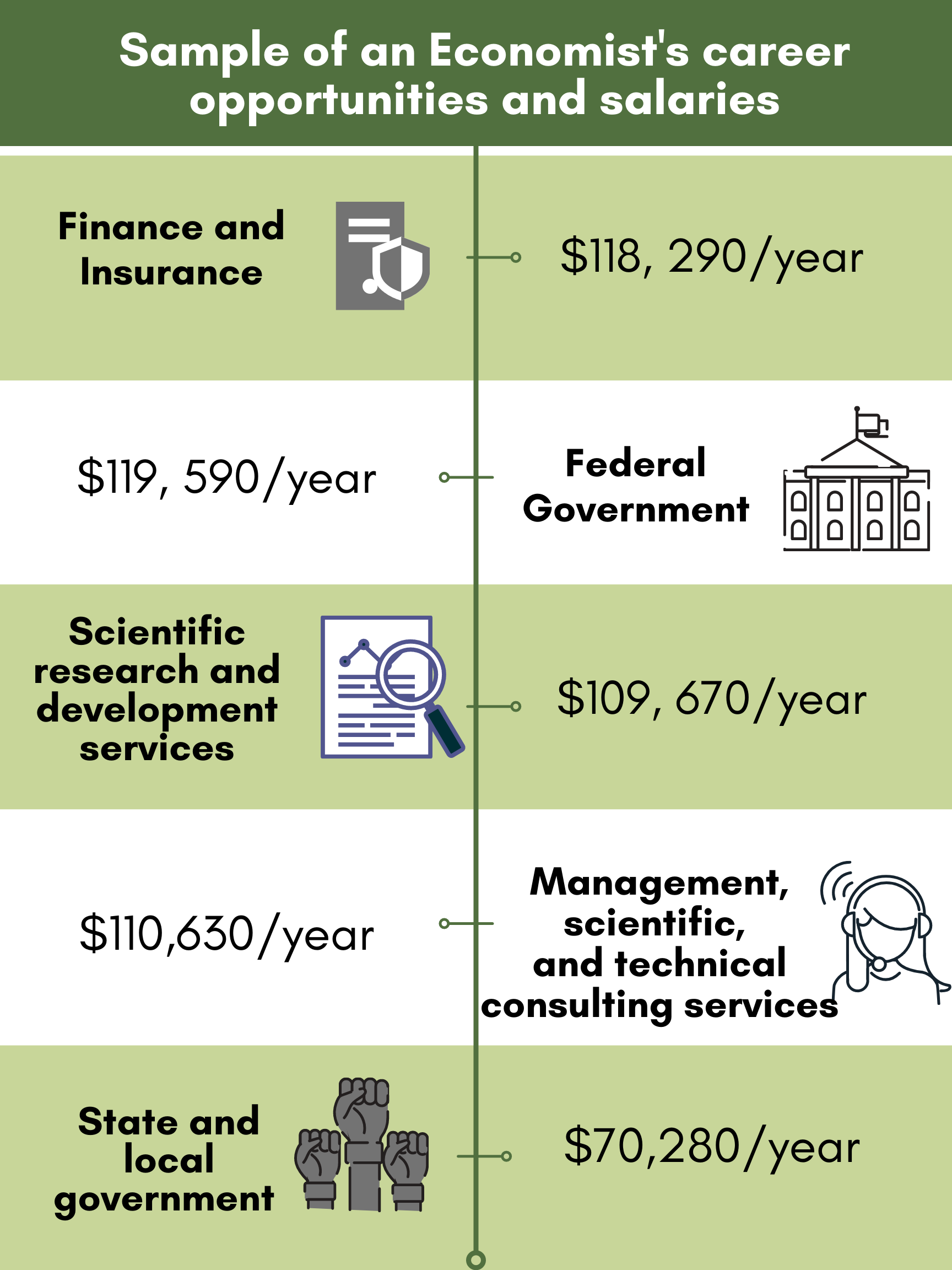
The focus of an education in economics is on intellectual growth and development. It fosters critical thinking which is one of the most valued skills for Canadian employers. This is also reflected in higher salaries and wages for economists in the job market relative to many other disciplines. It can also provide a unique leadership edge in your career.
Further, technical knowledge gained through the study of economics is portable and highly valued by employers in many areas including:
- The banking and financial sectors
- Development
- Labour Relations
- International Trade
- Entrepreneurship
- Corporate and climate finance
Students in our program often inquire about job opportunities. We strongly recommend to regularly check your emails. Our department sends out emails regarding any networking events for potential employment and research opportunities for students. The CUES (see below) also prepares important workshops and events throughout the year that help students in the program fine tune their skills suited for future employment.
We also recommend checking job bank sites such as the Government of Canada Jobs page.
Our faculty specialize in an array of research fields that might be of interest for your future academic or employment opportunities.
See recent CO-OP placements here.
Carleton Undergraduate Economics Society (CUES)
The Carleton University Economics Society (CUES) is dedicated to enhancing students’ engagement with economics. Their society organizes various events throughout the academic year, fostering connections among students enrolled in the B.Econ program and enabling them to network with their peers. These events provide unique opportunities for students to interact with faculty members, attend informative presentations, and expand their knowledge of economics. For additional details about our upcoming events, we invite you to visit our Instagram page.
Student Testimonials
“One of the best things about studying Economics at Carleton is that the professors have so many contacts in the field. The department hosts events throughout the year featuring world-class guest lecturers talking about current economics issues. They help connect real world situations to the theories learned in class.”
– Frohan Foroutan
Hear from recent graduate, Tayssir Benchoubane, who double majored in Economics and Political Science and his plans post-graduation, the importance of research, and what he has learned from the program.
Carleton’s Capital Advantage
Carleton’s location in the nation’s capital, Ottawa, gives you unique access to a wide range of resources in the public service. You will benefit from a wealth of research facilities and libraries in the city as well as the departments and agencies of the federal government, including: Agriculture and Agri-Food Canada, Bank of Canada, Competition Bureau, Environment Canada, Finance Canada (Department of Finance), Foreign Affairs, Trade and Development Canada, Health Canada, and Industry Canada.
Learn more about our Capital Advantage
Undergraduate Program Advising and Course Queries
Email Correspondence
Our staff aim to respond to inquiries as promptly as possible. We constantly monitor our inbox (economics@carleton.ca). However, in accordance with Carleton University’s guidelines, please allow 3–5 business days for a response before following up. We appreciate your patience and understanding.
| Contact | |
|---|---|
| Economics Department | economics@carleton.ca |
| Undergraduate Administrator | Sean Hall |
| Undergraduate Supervisor | Professor Carolina Czastkiewicz |