From problems to solutions
The refreshed Bachelor of Environmental Engineering strengthens the program’s focus on climate change and complex environmental challenges
By Ty Burke
From thawing permafrost to hundred-year floods that seem to happen every few years, climate change poses all kinds of engineering problems. And environmental engineers are at the forefront in solving them.
“Environmental engineers are the people who deliver a solution,” says Cole Van De Ven, an Assistant Professor of Environmental Engineering at Carleton University.
Carleton’s Bachelor of Environmental Engineering equips students to tackle emerging environmental issues. And this year, the program has been refreshed to focus more strongly on the engineering challenges the modern world faces.

“Climate change has made the problems environmental engineers work on even more complex,” says Van De Ven. “For example, ten years from now, the amount of rain we get could be very different than it is today. And we need to be thinking about what things will be like a hundred years into the future. The challenge is evolving, but environmental engineering is evolving too.
Carleton’s Bachelor of Environmental Engineering is one of only a few dedicated environmental engineering programs in Canada. And the program’s refresh modernizes course content and hones in on the core aspects of the field.
Moving forward, the Climate Change and Engineering course will be a central course in the program, in which students learn about the complex and dynamic climate changes and their impact on engineered systems. Also, environmental impact assessment will be brought in earlier in the program, which will allow students to bring these perspectives to their upper-year courses. The Department of Civil and Environmental Engineering developed these changes with input from students, faculty, alumni and stakeholders — including some of the technology and engineering firms that hire Carleton environmental engineering graduates.
“Our courses all have the goal of allowing us to have clean water, clean air, clean soil and to manage the waste we generate,” says Van De Ven. “A lot of our students go on to become municipal engineers, and will work on things like managing wastewater, treating drinking water and designing landfills.”
Alumna readies Ottawa’s infrastructure for severe weather events
Amanda Lynch is the Program Manager of the City of Ottawa’s Stormwater Master Planning Unit. She completed her Bachelor of Environmental Engineering in 2011, and now leads a team of five that is responsible for the city’s storm water infrastructure and natural hazard mitigation to enable new development in growth areas of the city.
Ottawa is built on the banks of the Ottawa and Rideau Rivers, and threaded with waterways. It has many smaller streams, ponds, lakes and marshes. Most of the ground underfoot is either clay or rock, and neither one absorbs water very well. So, some parts of the city are prone to flooding, and though major floods don’t happen every year, they do happen frequently enough to be a hazard to development in certain areas. Lynch works with local conservation authority partners to determine what those areas are, and how they could be affected by floods.
“I was always very passionate about the environment, and I idolized women like Jane Goodall,” says Lynch. “But environmental science wasn’t the right fit for me. Engineering is the problem-solving piece, and I knew that was what I wanted to do.”
In Ontario, flood plain mapping is based on 100-year storms. Areas that are flooded by 100-year storms have a 1% chance of flooding in any given year. But she’s also working to identify the risks associated with larger climate change flood scenarios, such as a one-in-350-year event.
“Most major water courses have been mapped, and some smaller ones too,” says Lynch. “But the city’s last official plan pushes for greater urban intensification, and we’ve been working with the Rideau Valley Conservation Authority to generate floodplain mapping for urban water courses that we didn’t map in the past.”
Many of these waterways weren’t mapped because they were already developed. But denser development could add to the pressures on existing water management systems, and existing flood hazard areas need to be identified to develop new areas safely.
“We need to know the risks for these areas,” says Lynch. “We are working with the conservation authorities to map these areas and trying to understand things like where emergency vehicles could safely access in a flood scenario.”
For Lynch, this is exactly the type of tangible application that drew her to environmental engineering in the first place.
Co-op option provides pathways to employment
For graduating student Sara Johnson, the Bachelor of Environmental Engineering’s co-op option was a stepping stone to post-graduate employment. She completed co-op terms with a number of consulting firms, and appreciated the high level of responsibility that private sector work provided.
At Ottawa-headquartered BluMetric Environmental, Johnson sampled groundwater and soil, analyzed data and wrote reports for clients. She’ll be joining the firm as a full-time employee after she graduates.
“My work with BluMetric is a mix of field work and office work—and I love both,” says Johnson. “I am really excited to start working there. I really like the company and the people.”
It’s a career path that began five years ago, when Johnson enrolled in the program, drawn to it through her love of the natural world. During her time at Carleton, she was a founding member of the Environmental Engineering Society. As she looks to the future, she knows she chose the right path for her career.
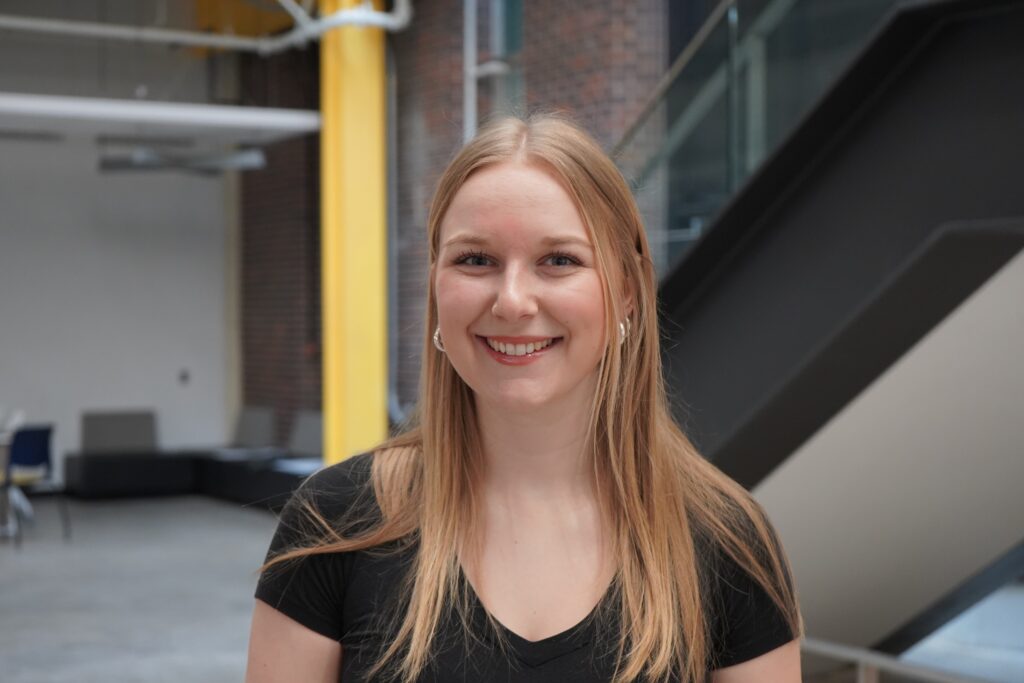
“I love learning about nature and biology,” says Johnson. “But I didn’t only want to learn more about the environment. I wanted to make a difference.”