Getting to know Dean Ron Miller
A Q&A with Carleton University Faculty of Engineering and Design’s (not so) new leader
For now, the walls of his office in the Minto Centre are bare. But the space offers a pleasant view of the O-Train station, with its steady supply of lively student foot traffic and the routine ‘clang’ of the bell marking the train’s arrival and departure. In time, a framed family photo may find its way onto his desk, or perhaps a new plant will be placed on the windowsill. He gestures to the wall where he’s planning to position a big red couch.
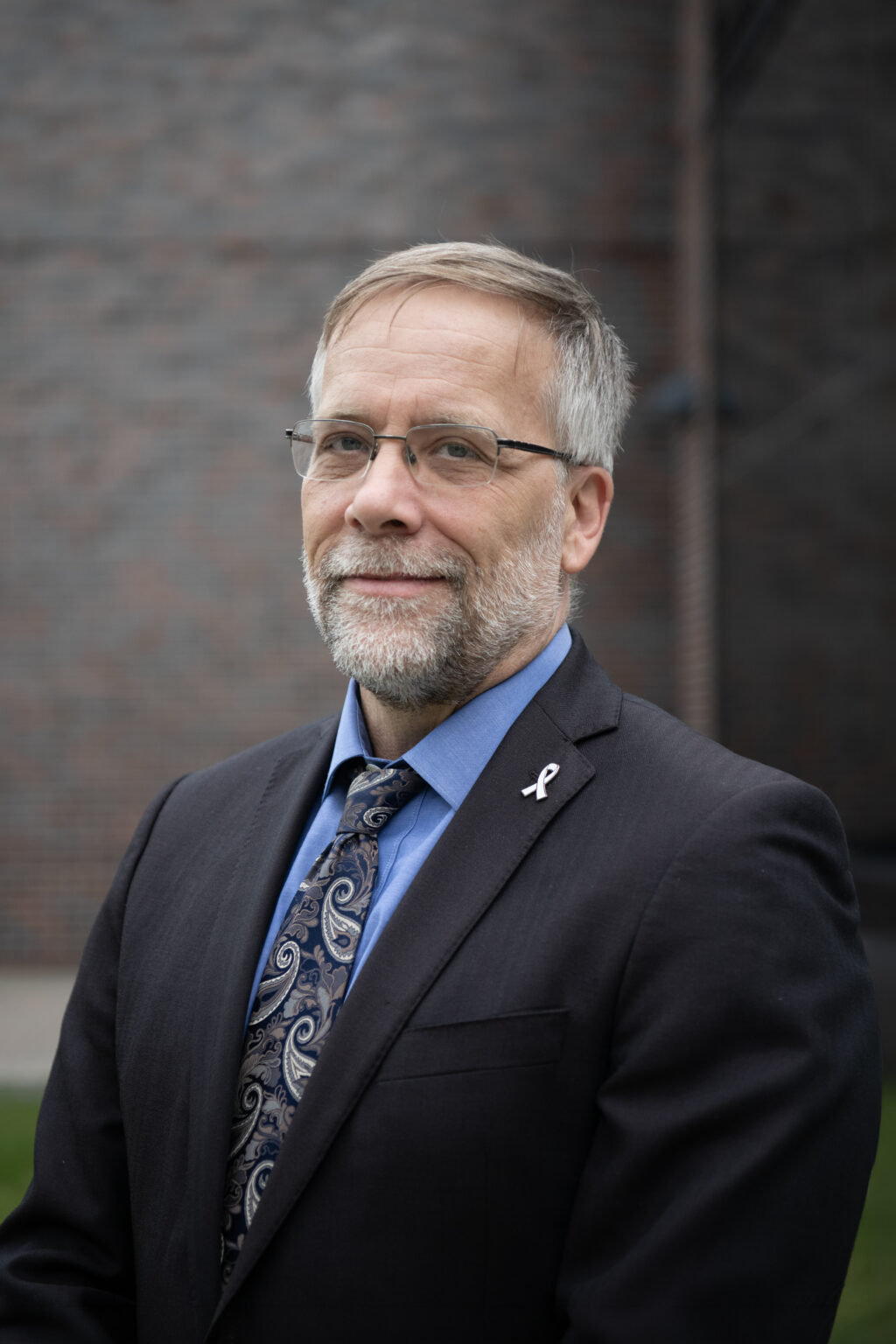
On July 1, 2026, Ron Miller will begin his five-year term as Dean of the Faculty of Engineering and Design (FED) at Carleton University. He’s been acting in the role, as Interim Dean, since August 2025 and has been with Carleton University’s Department of Mechanical and Aerospace Engineering for 25 years.
Replete with his signature humility, insightful observations about himself and his community, and two somewhat surprising nods to local theatre, we’re pleased to share the following thoughts from Dr. Miller, who was kind enough to answer our questions in these final days before commencing the next chapter of his career.
Hi, Ron. Congratulations, and thanks in advance for answering these questions. Let’s dive right in! You now lead one of the largest communities of students, professors, instructors and professional employees at Carleton. What does community mean to you?
It means different things in different contexts. For the Faculty of Engineering and Design, I think it means something that we are all excited and energized to be a part of, whether it’s to work or study or do research. More generally, it’s meeting someone at the grocery store wearing a Carleton sweater and sharing a laugh about a memory of their time here. Or when the “Where do you work?” question comes up at a dinner party and you get to hear about sons or daughters in our programs, or husbands or wives that graduated from Carleton. Maybe community boils down to connections that you are proud to have, and with whom you are eager to engage.
You’re a proud Winnipegger, but do you also identify as an Ottawan? What are some of the strengths of this city, and where do you think Carleton’s Faculty of Engineering and Design fits within its fabric?
I left Winnipeg at 22. If you subtract the two years I was on sabbatical, I’ve lived in Ottawa for 23 and a half years, so Ottawa has just recently surpassed Winnipeg as the place I’ve been the longest. While my daughter was born in Saskatoon, she only remembers Ottawa as home, and my son has essentially lived here his whole life, so Ottawa is pretty much home for us.
Both Winnipeg and Ottawa are great places for similar reasons. They are sort of quiet, unassuming places that aren’t massive tourist attractions with crazy housing markets, but really nice places to live and work. Ottawa is a safe and stable city, and that makes it a great place to raise kids. And I don’t buy its reputation as “boring”. I find the cycling infrastructure great, I love the Rideau Canal, the rivers and Gatineau Park. And then there’s great music festivals, the Fringe Festival, the Great Canadian Theatre Company. And Carleton plays a part here, too, through its sports teams and summer camps and as a hub for community events.
Ottawa is also a great city because it is a really smart city. The nature of the city’s economy means there are lots of highly educated, creative and innovative people across government agencies, government research labs and the tech and cultural sectors. So obviously, Carleton plays a big part in that, and FED particularly as it relates to training students to work in places like the Kanata tech park, or in city planning, heritage or government labs and agencies.
What are you most excited about this fall? What are you looking forward to in the first year or two?
Every year, the first week of September energizes me. I am always happy to see the new students arrive and meet up with a few familiar faces from upper year classes. This year will be FED’s largest first-year intake ever, and while I am excited that our programs are remaining in high demand, this will not be without its challenges.
We are moving ahead with some exciting plans to repurpose several spaces to enhance the student experience. Labs and offices in Mackenzie Building will be converted into student-friendly study space and maker spaces to help students collaborate and work on their projects and extra-curricular teams. I think it will be a great upgrade and will feel like an expansion of the Engineering Design Centre and the existing student spaces. We’re grateful that the funds for this investment in FED students were made available to us.
FED research continues to grow and thrive, and I am looking forward to the exciting new directions we are taking. I hope we can create the conditions for more interdisciplinary work by encouraging researchers to team up in ways they hadn’t considered in the past. This will help us better leverage our strengths and maximize our impact, which is so important for our reputation and rankings on the world stage.
What are some of the big opportunities for engineering, design and IT education and research right now at Carleton?
The elephant in the room is obviously AI. While there is a lot of concern about how AI will change the workforce, will change how we teach and learn, and create unknown threats and risks, we must look to our students as the people who will ultimately harness and guardrail this new technology. There is an opportunity for us to incorporate the tools of AI into our programs, making sure students are prepared for how AI will change the future of STEM and the future of design.
On the research front, there are so many opportunities for FED right now that I am hesitant to try to list them all. AI development comes to mind again, but that is far from the only space where FED is strong and well-positioned to contribute. An opportunity that comes to mind is quantum computing and quantum sensors, where our researchers are already experts. Similarly, autonomous systems and mechatronics are areas where we have been strong for a long time and where interest and opportunities are growing rapidly. New directions in telecommunications, networking and photonics are exciting for FED. Health-related research, including biomedical devices, assistive devices and accessibility will continue to be in high demand as the population ages and the healthcare system seeks innovative solutions to limited resources. Finally, the whole question of sustainability, whether it’s smart grids, renewable energy, emissions reduction, efficient buildings or smart, community-centred urban environments, remains as critical as ever.
You know a lot of people around here. Who are you looking forward to getting to know better, or in new ways?
I suppose I do know a lot of people, but the Carleton community is so big that I don’t really feel like I know that many at all. I am a mechanical engineer, and I spent most of the last 25 years of my life focused on teaching and research in that field, as well as on managing the Department of Mechanical and Aerospace Engineering. So, I am keenly aware of my ignorance about other programs, notably Architectural Studies and Industrial Design. I have tried hard over the past year to learn more about our Design schools, joining in their capstone shows and reviews and celebrations, to get the perspective I need to make sure that all the very different kinds of scholarship in FED can thrive. I am looking forward to continuing to get to know the students, faculty and other employees in the schools, while of course continuing to tend to the engineering programs.
I also look forward to getting to know our alumni better. I feel like we lost touch a bit during Covid, and we haven’t yet fully recovered. I am keen to create ways that we all can engage more with our alumni, to learn about their successes and to keep them up to date on exciting developments in FED.
What motivates you in your work?
Being a first-generation university student in a working-class family was transformational for me. Great opportunities came my way because I was able to access a top-notch university education despite my modest beginnings. Working to keep university education accessible, affordable and high-quality motivates me, and is bolstered by my belief in education’s essential role as a tool for social mobility and opportunity for young people. This core belief extends to research, which is not only about creating new knowledge but also about mentoring graduate students to be innovative and curious, and thereby equipping them to do great things in the future.
Are there lessons learned from your 25-year career at Carleton that have shaped the leader you’ve become today? Does a dean learn more each day?
I have always been motivated and guided by two principles in any leadership role I have taken: fairness and transparency. I think people would have seen those principles applied by me 10 years ago, and they would still see them today. On the other hand, a charitable observation 10 years ago might have been “driven and focused.” A more critical lens might have been “impatient and arrogant.” I think my time as Chair taught me the need to be more patient, and to be much more willing to listen to others and defer to ideas that are better than my own.
Transparency doesn’t mean carelessly sharing everything (it can be making sure people understand why some confidential information needs to be contained), and fairness doesn’t mean equal treatment in all things when other factors like equity and opportunity are also important. But I believe that leaders in academia succeed when they have the support of their faculty, professional employees and students, and this support is earned when people see you are true to these two fundamental principles.
A common observation made about leaders is that they appear to believe they are the smartest person in the room. What I have learned is that in academia, the room is always filled with smart people, and many are smarter than me. It also doesn’t matter who the smartest person in the room is—this misleadingly implies that we will have to defer to them. What matters is to recognize all the talent in the room, and to harness it by engaging everyone’s ideas until the best ones emerge.
What’s something people might be surprised to learn about you?
Although I haven’t done much of it lately, I used to be involved with a lot of community theatre. I mostly built sets, but I have also been on stage in six or seven shows with Lakeside Players, Kanata Theatre and the New Edinburgh Players. I was also in the first Carleton Engineering musical in 2012. I was the Narrator in their version of Rocky Horror. I sang and danced. But I wasn’t very good at either.
So you won’t be quitting your day job, then?
Nope.