Inside CUonOrbit: Carleton’s Student Team Reaches New Heights
By: Alejandra Fernandez
From building Carleton University’s first student-led CubeSat to attending milestone moments in modern lunar exploration, Carleton’s CUonOrbit student club is proving that hands-on learning and ambitious extra-curricular engagement can open doors beyond the classroom.
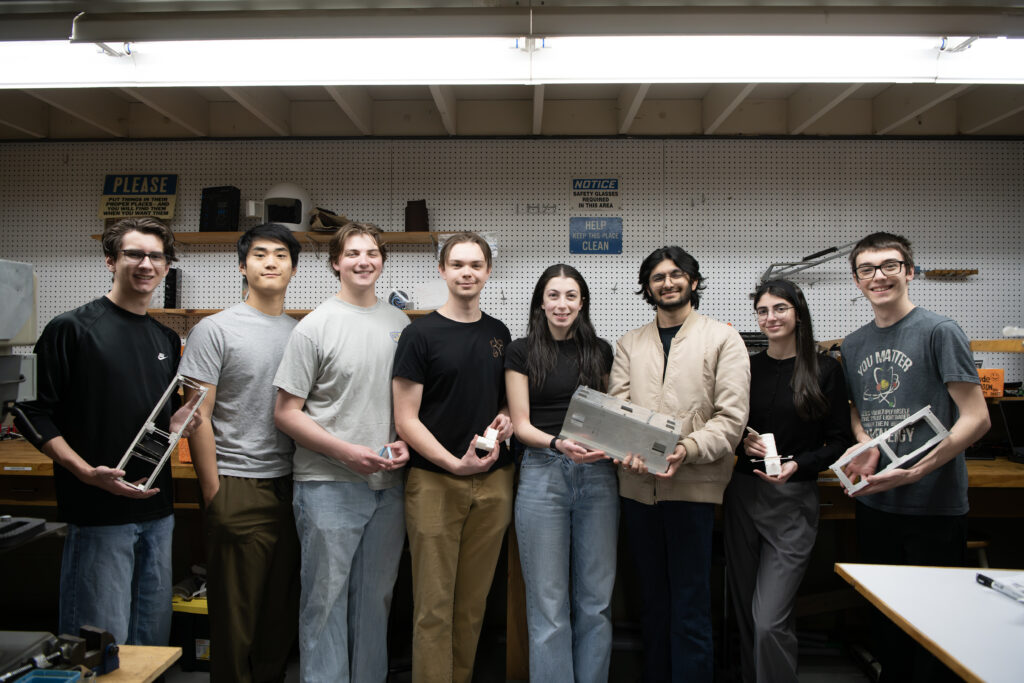
The club brings together more than 50 students passionate about aerospace, astrophysics and space technology. Through technical projects, outreach initiatives and industry engagement, the team has built a growing presence within Canada’s space sector while giving students direct experience in mission design, systems engineering and research collaboration.
Today, the team is working on one of its most ambitious initiatives yet: the development of Carleton’s first student-led 3U CubeSat focused on wildfire detection. Alongside the CubeSat mission, CUonOrbit has also completed three high-altitude balloon launches, with a fourth mission planned for summer 2026.
“Our projects are designed to give students real engineering and mission experience,” says Daphne Papadatos, co-president of CUonOrbit. “Every subsystem we design, every late night we commit, and every test we run is part of a larger journey.”
Building experience through real missions
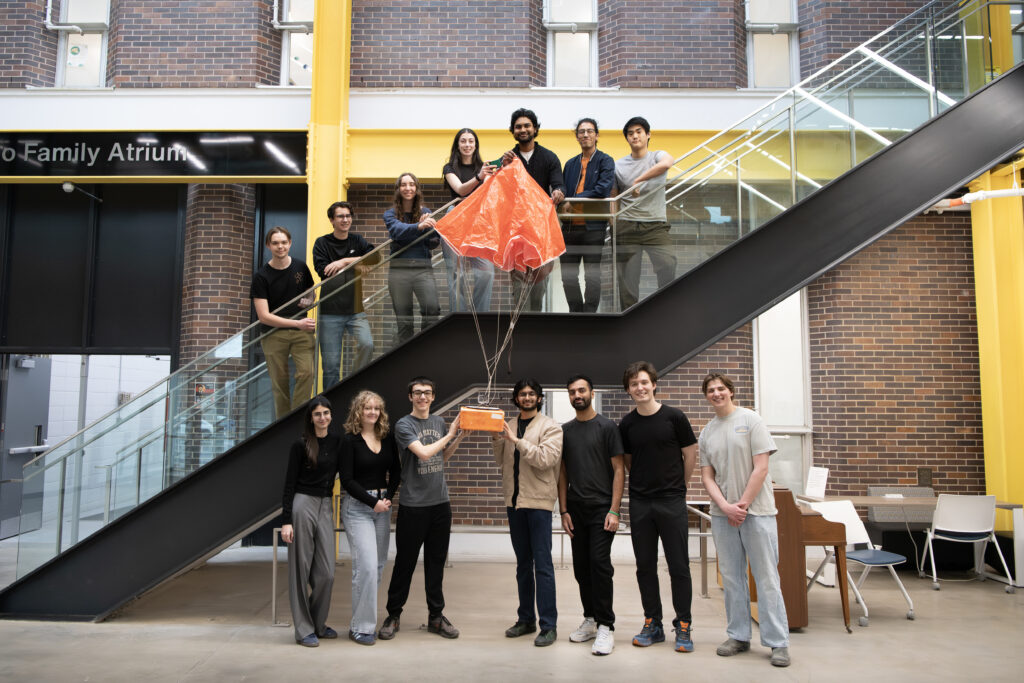
One of the club’s most recent milestones was the launch of High-Altitude Balloon 3 (HAB-3) in February 2026. The mission focused on validating onboard systems and environmental testing capabilities in near-space conditions.
HAB-3 carried atmospheric sensors into the stratosphere to collect temperature, pressure and altitude data while also testing a student-built termination system.
The mission reached approximately 10 kilometres in altitude and successfully validated the onboard system exactly as planned.
Beyond the technical achievements, the launch gave students hands-on experience and new skills in system integration, manufacturing, launch operations and post-flight analysis. Now the team is preparing for HAB-4, expected to launch this summer, with the goal of reaching between 26 and 30 kilometres in altitude. The larger balloon and expanded payload will allow the team to capture new atmospheric data and, they hope, another stunning view of Earth’s horizon.
Creating opportunities through community and collaboration
The team’s growing reputation and involvement within Canada’s space community also led to two unforgettable opportunities this year connected to the historic Artemis II mission.
In April 2026, nine CUonOrbit members were invited by Space Canada and the Canadian Space Agency to attend a live Artemis II launch viewing event at the Canada Aviation and Space Museum. The event brought together industry leaders, students, researchers and members of Canada’s aerospace sector to witness Canadian astronaut Jeremy Hansen become the first Canadian to participate in a lunar mission.
For the student team, the experience represented more than simply watching a launch.
“With our mission objective in designing and launching a CubeSat into Low Earth Orbit, moments like this are a powerful reminder of why we do what we do,” Papadatos explains.
Just days later, 11 CUonOrbit members received another invitation, this time from the Embassy of the United States in Ottawa to attend the Artemis II splashdown reception at the U.S. Ambassador’s residence in Ottawa.
Gathered alongside diplomats, industry professionals and members of Canada’s space and government communities, the students watched the Orion capsule safely return to Earth after travelling more than one million kilometres during the first crewed lunar mission in more than 50 years.

“What stayed with us most was the way both events brought people together so naturally,” Mayura Satheeskumar, VP Media at CUonOrbit, reflects. “There was something powerful about seeing so many individuals from across the industry in one place, all sharing the same anticipation for the launch, and later, that quiet, collective focus during the splashdown,” she adds.
The invitations were a direct reflection of the relationships and visibility the club has built through its work, outreach and active participation within Canada’s aerospace ecosystem.
Inspiring the next generation
Beyond technical missions, CUonOrbit has also focused heavily on outreach and education. Over the past year, members have hosted space-focused learning events with elementary schools, high schools, Air Cadets, industry groups and the broader Carleton community, directly engaging more than 6,000 people.
Club members have also presented and attended conferences across Canada and internationally, including opportunities to collaborate with the European Space Agency through educational training in Belgium.
As CUonOrbit continues preparing for future launches and its long-term CubeSat mission, the team hopes its work will inspire more students to see themselves as part of the future of space exploration.
“These are moments our generation has never truly experienced before,” Papadatos says. “There was a real sense that we weren’t just watching history but stepping closer to being part of it.”