Two Journeys, One Commitment: Volunteering that Transforms Engineering
Written by: Alejandra Fernandez
Since its creation in 2012, the annual Adrian D. C. Chan Award for Volunteer and Community Service has recognized undergraduate and graduate students from the Faculty of Engineering and Design who demonstrate outstanding commitment to both the university and the broader community. This award recognizes that engineering is practiced not only in classrooms and laboratories but also wherever knowledge is put to work in the service of others.
This year, the award was presented to two students whose paths reflect purpose-driven leadership, social awareness and a deep dedication to building community.
“It was a privilege and a joy to review the applications and learn about the many wonderful things our engineering students are doing. Giving out only one award can be challenging when you have folks like Emily and Imshaad,” says Dr. Adrian D.C. Chan, who established the award.
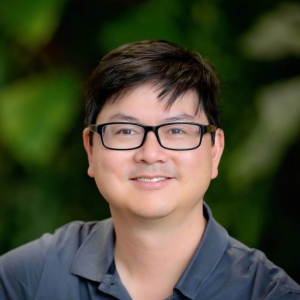
“Both Emily and Imshaad are outstanding members of the Carleton University Faculty of Engineering and Design community. They both have enormous gratitude for those around them and also have been enormous contributors,” he adds.
Finding Community and Then Building It
For Imshaad Naaz, a fourth-year Biomedical and Electrical Engineering student, volunteering began as a way to seek calm and connection. She started her program in 2021 during the COVID-19 pandemic, far from her home country and at a time when campus life was still rebuilding.
It was during this time that Imshaad first connected with the Carleton University Muslim Students’ Association. Joining that community became a turning point.
“Coming from a Middle Eastern background, finding that familiarity felt pretty good for me, because they went through similar experiences. They came to Canada from a completely different country. I felt a good sense of community over there. I saw that the MSA does and knew I could contribute and be a part of that,” she says.
She soon understood that the university experience extends beyond maintaining a strong GPA; it is also about participation, connection and contribution.
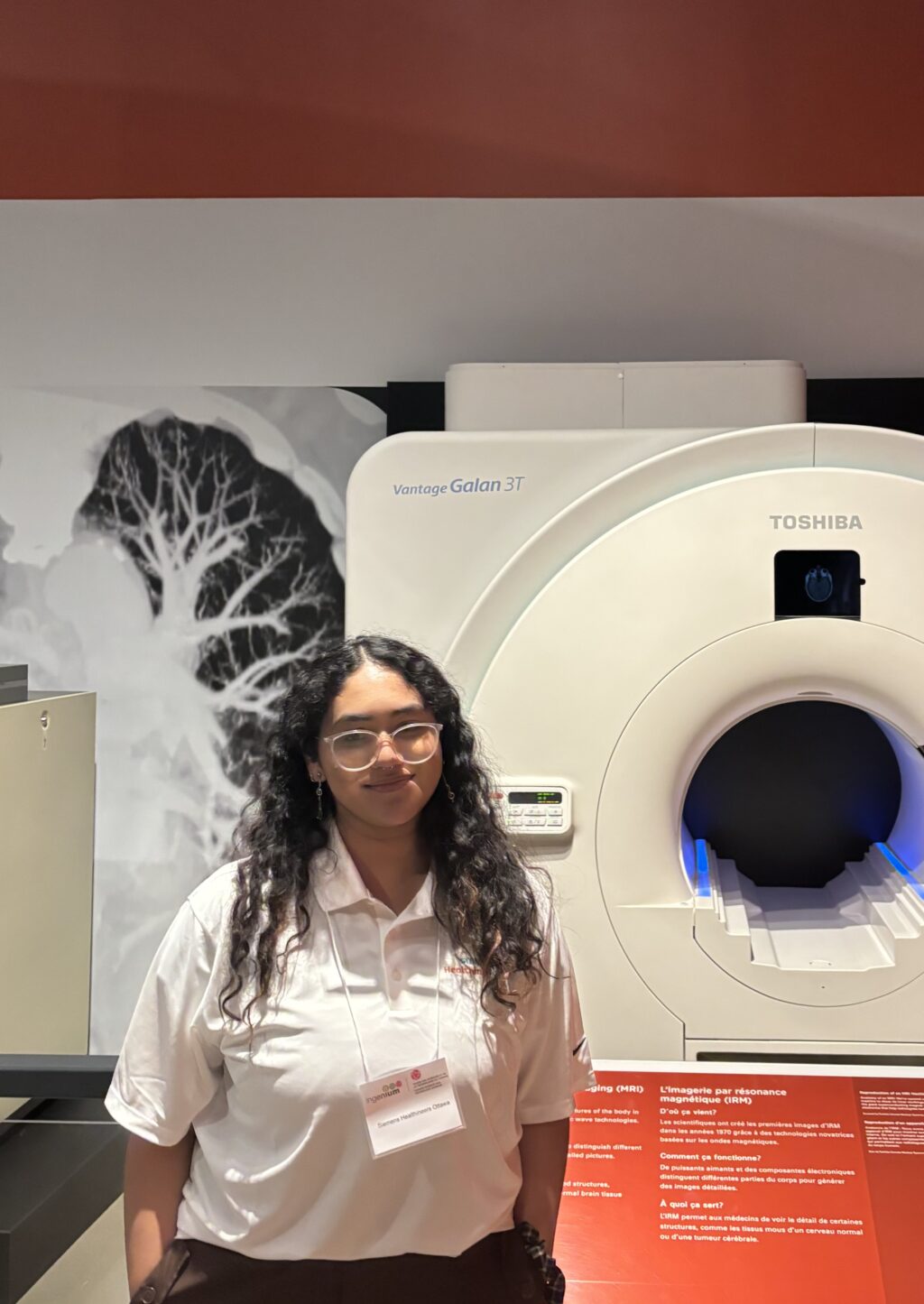
Over four years, she has volunteered with more than ten different organizations. Her first formal experience was at the Canada Science and Technology Museum, where she led technology demonstrations for children of various ages.
“In engineering, you need strong technical knowledge, but real success comes from being able to explain it clearly,” Imshaad adds.
She later volunteered with Dress for Success, an organization that supports women facing employment barriers by providing professional attire and access to interview spaces.
“Their main goal is to help women who might be struggling in succeeding in job interviews,” says Imshaad. “As a woman, I know how challenging it can be and the fact that I can do any, even the smallest thing possible, to help them through that, easing that up, it meant a lot to me.”
One of her most demanding periods came when she balanced coursework, an internship and volunteer commitments. During that time, she joined the Tetra Society of North America as a technical volunteer, to help design assistive devices for individuals with disabilities. There were weeks when she considered stepping back.
“They reminded me that this is volunteer work. If you need to take a break, you can. The best part about volunteering is the people that you work with. They all understand that we have other commitments, too.”
Now in her fourth year, she has developed a clear sense of balance. She recognizes that focusing solely on academics can obscure the bigger purpose.
“If I just graduated with a great GPA, that would be so impressive, but I would have wondered, what else did I do in school? And I don’t know how that would feel, but I’m happy to say I don’t think I’m going to have to wonder about that,” says Imshaad.
Leading from the Foundation
For Emily Knobel, a student in Sustainable and Renewable Energy Engineering, community engagement began before university, during her high school years, and she knew it was something she wanted to continue at Carleton University. From her first year, she became involved in multiple initiatives, including the Carleton Engineering Musical Club.
Despite never having performed on a university stage, she auditioned and earned a lead role, as the only first-year student in the cast during a time still marked by the pandemic. She later became the group’s Vocal Director.
Her involvement expanded to the Carleton Student Engineering Society (CSES), where she initially worked on publications for the student newspaper The Iron Times. Over time, she assumed increasing responsibility and is now serving as President.
“When it comes to leadership, I am not the figurehead, but I am the foundation, so that I can uplift the people around me. I’m not meant to be the top of the pyramid. I’m supposed to be at the bottom so that I can help get the people who need to go up to the top,” she says. “Every engineering student is a member of CSES. And so, it’s not me who should be taking the spotlight, it’s me guiding the spotlight to the people who deserve it the most.”
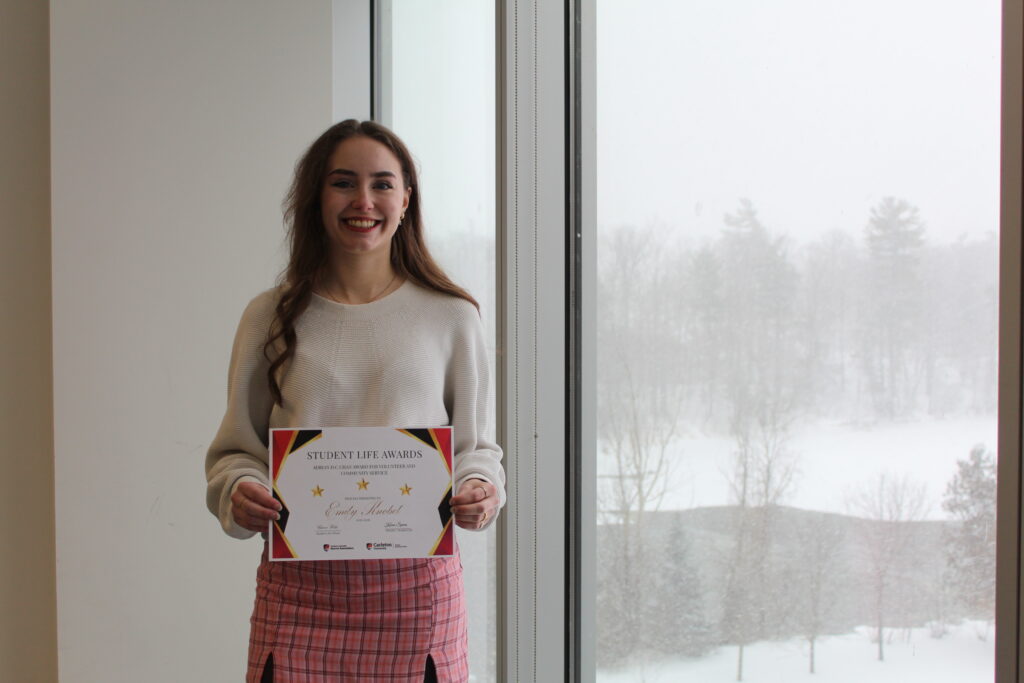
In her leadership role, she engages with academic administrators and advocates for students who may feel underrepresented.
Among the initiatives she is most proud of is the creation of the Carleton Academic Mentorship Program for Engineering and Design (CAMPED), pairing first-year students with mentors to support their transition into university life.
“If I was in first year again tomorrow, I would have loved to have someone that could have kind of held my hand. And so, starting this program was really important to me, especially because I felt like I could actually create something where someone like me would have outlets and resources and someone to ask for help,” Emily says.
Receiving the award is meaningful, she says, though recognition was never the goal.
“It felt like a recognition for a lot of time and effort that I put into doing this. I know that the impact that I’ve left behind is something that I can be proud of no matter what, but having some validation is always nice,” she adds.
More Than Engineers
Both students agree that volunteering does not compete with academic excellence; it strengthens it. Through their involvement, they have developed communication, leadership and empathic skills that will be essential in their professional careers.
Both Imshaad’s and Emily’s message to students who hesitate is simple: be willing to try.
Engineering not only transforms systems and technologies but also transforms communities. And for the past fourteen years, this award has recognized that this, too, is central to its mission.