Reshaping Research, One Story at a Time
Dr. Kahente Horn-Miller‘s research centres Indigenous storytelling as a form of knowledge, research, and community responsibility
This story was originally published in the 2026 Faculty of Arts and Social Sciences Research Review.
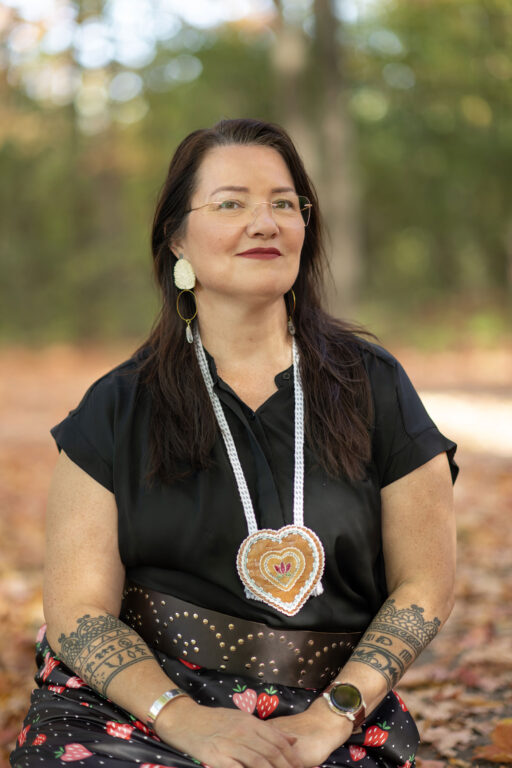
Dr. Kahente Horn-Miller approaches research as something lived, not separate from practice. As an Indigenous woman, mother, grandmother, educator, and longhouse knowledge keeper, her work is grounded in community, relationship, and lived responsibility.
“It’s my form of activism,” she says. “Through education, through research, through storytelling.”
As Carleton’s Associate Vice-President of Indigenous Teaching, Learning and Research, and a professor in the Institute of Interdisciplinary Studies, Horn-Miller is steadily redefining what research can be. Her work centres Indigenous storytelling not only as a mode of knowledge, but as a rigorous, embodied methodology, one that opens new forms of scholarly inquiry while insisting on care, interdependence, and self-authorship.
Her current book project and long-term research trajectory trace back to her 2009 PhD dissertation, “Sky Woman’s Great Granddaughters: A Narrative Inquiry into Kanien’kehá:ka Women’s Identity.” Grounded in the stories of eight women from the Kahnawake Mohawk community, the dissertation examined how colonial systems, the Indian Act, liberal state frameworks, and even certain strands of socialism and feminism shape and constrain Indigenous identity. Through critical reflection, the women in her study reclaimed self-authorship, grounding their identities in community, kinship, and Kanien’kehá:ka ways of knowing.
At the heart of that work was Horn-Miller’s reimagining of the Sky Woman creation story, an origin narrative from Haudenosaunee oral tradition in which a woman falls from the Sky World and helps bring the earth into being. Horn-Miller voiced the story in the first person, embodying Sky Woman as both an ancestral figure and a methodological intervention that challenged dominant academic conventions around voice, authority, and distance.
What began as a narrative method in her doctoral research has since evolved into a powerful solo performance piece that Horn-Miller presents in academic and community spaces. “It’s not just about telling our stories,” she says. “It’s about telling them our way, on our own terms.”
The performance deconstructs the boundaries between theory, story, and self, demonstrating how Indigenous storytelling can function simultaneously as research, pedagogy, and an assertion of intellectual sovereignty. Speaking from within the story, rather than about it, laid the foundation for Horn-Miller’s broader research, which asks how Indigenous narratives can reawaken relationships to the natural world and shape a different kind of academic practice, one rooted in responsibility, reciprocity, and resonance.
“Resonance,” she explains, anchors much of her current thinking. Drawing on the work of German sociologist Hartmut Rosa, Horn-Miller explores how people in modern societies have become disconnected from land, memory, and one another, and how certain stories, ceremonies, and experiences can help reattune those relationships.
“When people experience our stories, they feel it. I’ve had people cry after Sky Woman performances. Something gets remembered. A connection to the land, to their grandparents, to being in the backyard.”
Horn-Miller is now extending that work through immersive technologies designed with the same ethic of care. Recent pilot projects, including Wa’ötši’gwa:tó, a 360-degree longhouse experience, and Tsi tewateriweiastákwa, a virtual reality Indigenous learning space, invite participants into stories in multisensory ways. “Faculty who’ve experienced them say things like, ‘I felt it,’” she says. “And just like with the Sky Woman story, that’s the point. When done with care, and in a safe, intentional way, VR can enable that same resonance. It can help us remember what we already know.”
This commitment to care, especially for future generations, runs through everything Horn-Miller does. Her work is guided by the Haudenosaunee principle of the Coming Faces, often expressed in Algonquin communities as the seven generations. The philosophy urges long-term, forward-looking decisions rooted in intergenerational accountability. “Whether it’s pedagogy, research, policy, or technology,” she says, “I’m always thinking: how will this benefit our children’s children’s children?”
That principle also shapes her institutional leadership. From her role in developing Carleton’s Collaborative Indigenous Learning Bundles to her contributions to the university’s 41 Calls to Action, Horn-Miller works across disciplines and structures to bring Indigenous knowledge into the academy on its own terms.
She is also clear-eyed about the tensions that mark contemporary academic and public conversations around Indigenous identity and appropriation. At recent conferences, she has observed the pain, mistrust, and call-out culture that can dominate these spaces. Her response has been to create room for dialogue and applied thinking. In fall 2025, her office hosted the Ojigìjowewin Legal Symposium, a gathering focused on applying Indigenous legal traditions in contemporary contexts. “I want to bring people together to talk about Indigenous law not just conceptually, but practically,” she says. “How do our traditions guide us through conflict, belonging, and adoption? What does it mean to move with compassion and diplomacy?”
That same approach informs her next community-based project, a new mapping initiative at Kitigan Zibi modeled after the Mohawk Atlas. Through a series of workshops, Algonquin youth will be supported in gathering place names, stories, and ecological knowledge, often in their own language. “These tools aren’t just maps,” she says. “They’re invitations for young people to ask their parents and grandparents, ‘Can you tell me about this place? What do you remember?’ They’re also a way to preserve the language that describes those spaces, and to make sure that knowledge isn’t lost.”
For Horn-Miller, the work is not only about recovering what was disrupted, but about forward-facing remembering. Her research weaves contemporary tools such as VR, cartography, and curriculum design with ancestral knowledge to create continuity across generations. In doing so, it challenges linear models of innovation, showing that some of the most future-ready forms of research are rooted in the oldest relationships, between people, land, language, and story.
With each project, she asks how we might carry what matters most into futures we cannot yet see, but that we are nevertheless responsible for shaping.