Modular Micros Zorba GC-200
[Vin101]
Introduced by Modular Micros (a Modcomp subsidiary) as one of the last “luggable” CP/M portables, the 22 lb Zorba GC-200 featured a Z80A CPU, a detachable full-stroke keyboard, twin 5.25-inch floppy drives and terminal-emulation firmware that let it read a remarkable range of rival disk formats: Kaypro, Osborne, Xerox 820 and more. Its claim to fame was arriving at the very end of the CP/M era with unusually broad compatibility, positioning itself as a universal bridge machine just as MS-DOS portables (e.g., Compaq Portable) were taking over; consequently only about 6,000 units were ever built and sales were short-lived before surplus stock was liquidated.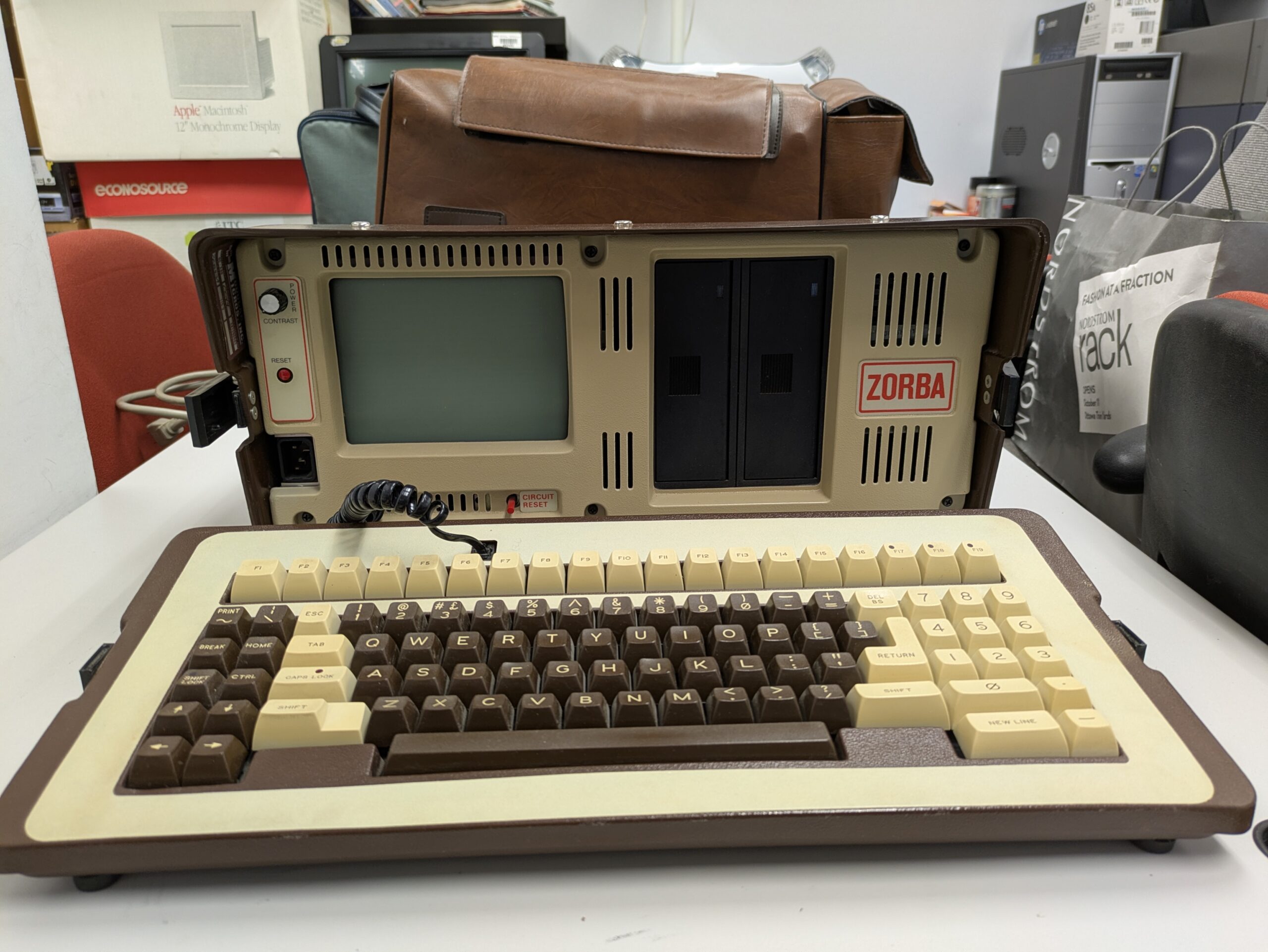
- Manufacturer: Modular Micros
- Type: Luggable (portable) computer
- Release Date: 1983
- Cost at release: $1,595 (~$5,500 adjusted for inflation)
- MIPS: 0.1 (100 KIPS)
Hardware Specifications
- CPU: Zilog Z80A microprocessor running at 4MHz
- RAM: 64K bytes
- ROM: 4K bytes (expandable to 16K)
- Screen: 7-inch green CRT monitor
- Resolution: 80 characters × 25 lines text-only display
- Graphics: 64 graphics characters available
- Floppy drives: Two internal 5.25-inch floppy disk drives with a capacity 410K bytes per drive
- Serial ports: 2 full asynchronous RS-232 ports
- Parallel port: 1 Centronics-compatible parallel port
- IEEE-488 port: 1 IEEE-488 interface port
- Detachable 95-key keyboard
Operating System & Programming Languages
-
Operating System: CP/M 2.2
-
Supported Languages:
- BASIC: Multiple BASIC interpreters and compilers were available for CP/M
- Pascal: CP/M Pascal implementations
- COBOL: Business-oriented programming language
- FORTRAN: Scientific and engineering applications
- C: C compilers were available for CP/M systems
- Assembly Language: Z80 assembly language programming
- PL/M: Intel’s programming language (CP/M itself was originally written in PL/M)
Notables
- The Zorba was one of the very last CP/M portable computers ever manufactured, arriving at the market just as MS-DOS and the IBM PC compatible era was beginning. It represented the end of an era for 8-bit portable computing, making it historically significant as a “last of its kind” machine.
- The Zorba’s most remarkable feature was its ability to read and write an unusually wide variety of CP/M disk formats, including Osborne 1, Kaypro II, Xerox 820, Cromemco 520, DEC VT 180, IBM PC, Compaq, and TeleVideo 802 formats. This made it a universal “bridge machine” between different CP/M systems – an extremely rare capability for the time.
- The computer had a turbulent ownership history: originally manufactured by Telcon Industries, then sold to MODCOMP for $5 million, and finally liquidated through surplus dealer Gemini Electronics for just $799 (down from the original $1,595 price). This represents one of the most dramatic price drops in vintage computing history.
- Only approximately 6,000 total units were ever manufactured across all variants, making it one of the rarest commercially produced portable computers of the 1980s
- The Zorba arrived “too late to the party” – by the time it launched in late 1982/early 1983, the Compaq Portable running MS-DOS was already dominating the portable market, sealing the fate of CP/M portables. This timing makes it a perfect example of how quickly the personal computer market was evolving in the early 1980s.
Donated by: Arlen Michaels