Tandy TRS-80 Model II
[Vin109]
The Radio Shack TRS-80 Model II, launched in October 1979, was a notable vintage computer designed specifically for the small-business market rather than personal or hobbyist use. It featured a high-speed 4 MHz Z80A processor, Direct Memory Access (DMA), vectored interrupts, a built-in 12-inch 80×25 text display, and a unique architecture with a detachable keyboard and multiple expansion slots, making it well-suited for business tasks like accounting and word processing. Its claim to fame was being a professional-grade business machine from a company known for hobbyist computers, offering advanced features at a lower price compared to contemporaries like IBM systems. While it was respected for its design and expandability, it remained less popular than the earlier TRS-80 Model I in home and hobbyist markets, partly due to its focus on business and a smaller software library.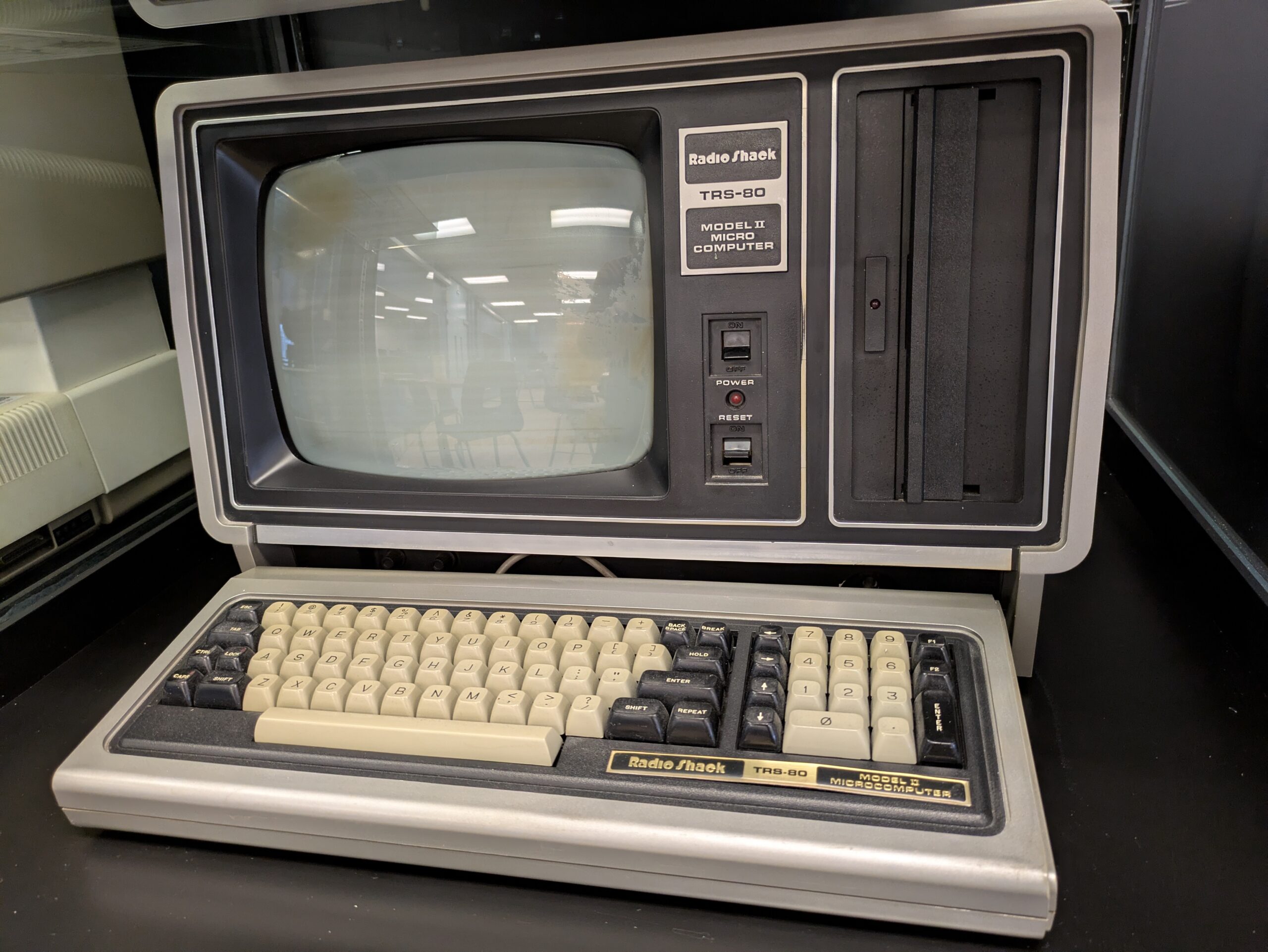
- Manufacturer: Tandy Corporation (sold through Radio Shack stores)
- Type: Personal computer
- Released: 1979
- Cost at release (base price): USD $3,450 (CAD ~$16,000 adjusted for inflation)
- Cost at release (with peripherals): USD $4,898 (CAD ~$23,000 adjusted for inflation)
- MIPS: 0.33 (330 KIPS)
Hardware Specifications
- CPU: Zilog Z80A running at 4 MHz
- Memory: Standard 32 KB or optionally 64 KB RAM
- Display: Built-in 12-inch CRT monitor with 80×25 character text display
- Storage: Used 8-inch floppy disk drives (dual floppy drives common)
- Keyboard: Full-stroke detachable keyboard with numeric keypad
- Expansion: Multiple internal expansion slots for peripheral cards
- Input/Output: Serial and parallel ports for printers and other peripherals
- Additional features: Direct Memory Access (DMA), vectored interrupts
- Weight: ~13.6 kg (30 lbs)
Operating System & Programming Languages
- O/S: primarily ran the operating system called TRSDOS-2, a disk-based OS designed specifically for business use. Later, it also supported CP/M
- Programming Languages: BASIC (Business BASIC was common for business-related programming), BASCOM (a form of BASIC compiler), COBOL (used widely for business applications), FORTRAN, Assembly language (Zilog Z80 assembly) for more advanced and performance-sensitive programming, Pascal was also available through third-party vendors
Notables
- The TRS-80 Model II was the first TRS-80 designed specifically as a small-business computer, not a hobbyist machine.
- It featured Direct Memory Access (DMA) and vectored interrupts, advanced features uncommon in early personal computers.
- Nicknamed sometimes as the “business TRS-80,” it was positioned to compete with more expensive systems like IBM PCs but at a lower cost.
- It was among the earliest microcomputers to include a built-in 80-column by 25-line text display, suited for professional applications.
- Unlike the original Model I, the Model II had a detachable keyboard, which was unusual for its time.
- It helped popularize business use of microcomputers before the IBM PC’s dominance.
- The Model II’s architecture paved the way for more advanced Tandy business systems such as the TRS-80 Model 12 and 16.
- The Model II was not as popular as the Model I among hobbyists, but highly respected in business computing history and vintage computing museums for its professional focus and technical innovations.
Donated by: Engineer working for National Defense and worked on the Avro Aero and also worked on some rocket engines and used this computer during his time at National Defense.