Motorola MEX68KDM
[Vin115]
The Motorola MEX68KDM is a vintage educational development board designed around the Motorola 68000 microprocessor, introduced in 1979. This 16/32-bit processor featured a 24-bit address bus and a 16-bit internal data bus, with 32-bit registers, allowing it to handle complex instruction sets efficiently for its time. The MEX68KDM board was used primarily for teaching and demonstration purposes in computer architecture and microprocessor design, making it historically significant as an early platform for understanding the powerful 68000 CPU architecture. Its design influenced many personal computers and embedded systems in the 1980’s, such as the Apple Macintosh, Commodore Amiga, and Atari ST, highlighting the importance of the 68000 series in the evolution of computing technology. The MEX68KDM represents an early and accessible hands-on example of a pioneering microprocessor system that bridged 16-bit and 32-bit computing eras, embodying a key step in microprocessor development history.
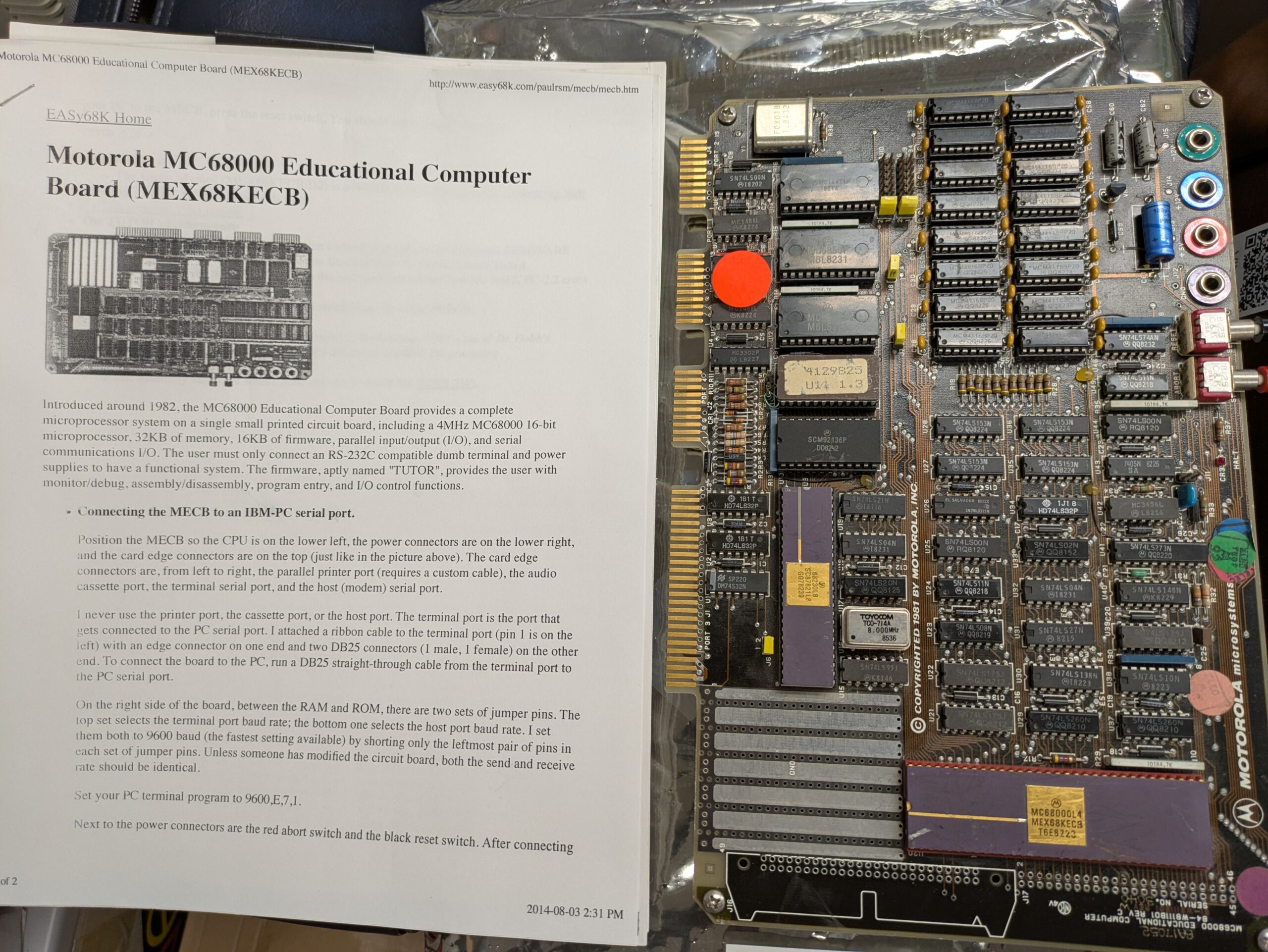
- Manufacturer: Motorola
- Type: Single Board Computer
- Release Date: 1979
- Cost at release: USD $120 (CAD ~$550 adjusted for inflation)
- MIPS: 0.7 (700 KIPS)
Hardware Specifications
- CPU: Motorola 68000 16/32-bit CISC microprocessor
- Clock Speed: 4 MHz (XC68000L4 variant used)
- Data Bus: 16-bit external
- Address Bus: 24-bit, enabling up to 16 MB of addressable memory
- Memory: Support for up to 1 MB RAM via modules, parity checked
- I/O Ports: Parallel printer port, RS-232C terminal port, downline load RS-232C host port
- Firmware: MACSbug 8K monitor/debugger firmware included for development
- Expansion: Supports various memory and I/O modules for education and development
Operating System & Programming Languages
- Operating System: The Motorola MEX68KDM typically ran without a full-fledged operating system as it was primarily an educational and development board. Instead, it used a built-in monitor/debugger firmware known as MACSbug, which allowed low-level machine interaction, debugging, and memory examination.
- Supported Languages: Higher-level languages that were available and could be cross-compiled or run on companion systems such as: C, Fortran, BASIC (via cross-development or external tools). During its era, the typical workflow involved writing assembly or higher-level language source code on a host system, cross-compiling it, and then downloading and debugging on the MEX68KDM.
Notables
- The Motorola MEX68KDM was among the first educational and development boards built around the groundbreaking Motorola 68000 microprocessor, introduced in 1979.
- The 68000 CPU was the first to combine 16-bit external data bus with 32-bit internal registers and a 24-bit address bus, enabling up to 16 MB of memory, pioneering hybrid 16/32-bit architecture.
- It played a key role in shaping the personal computer and workstation markets of the 1980’s, powering iconic machines such as the original Apple Macintosh, Commodore Amiga, and Atari ST.
- The MEX68KDM facilitated hands-on learning and debugging with its MACSbug firmware, making it a vital tool for engineers and educators exploring the new architecture.
- Motorola’s 68000 was nicknamed “the first truly modern processor” due to its advanced architecture and widespread adoption in diverse systems.
- It was part of Motorola’s MACSS (Motorola Advanced Computer System on Silicon) project, marking a leap forward in computing power and instruction set design.
- Despite its innovation, the 68000 lost the IBM PC market to Intel’s 8086 due to marketing and design decisions but found lasting success elsewhere.
- Notable for introducing a powerful, general-purpose CPU affordable enough for education and emerging computer enthusiasts.
- The MEX68KDM’s place in computing history is as a foundational teaching and prototyping platform for a family of CPU’s that powered an entire generation of influential computers.
Donated by: Dr Arlen Michaels