Motorola 68HC11 Evaluation Module
[Vin117]
The Motorola MC68000 Educational Computer Board (MEX68KECB), introduced in 1981, is a historically significant vintage computer development board designed to provide students and engineers hands-on experience with the then-advanced 16/32-bit Motorola 68000 microprocessor. It featured 32KB RAM, 16KB ROM, serial and parallel ports, and educational monitor/debugger software called TUTOR in ROM. Its purpose was to teach assembly programming and microprocessor concepts in colleges and training settings, making it one of the earliest accessible 68000 development platforms. Priced affordably for its time at $495, it helped foster understanding of a CPU architecture that powered key personal computers like the Apple Macintosh, Amiga, and Atari ST, thus marking a foundational role in microprocessor education and early computing history.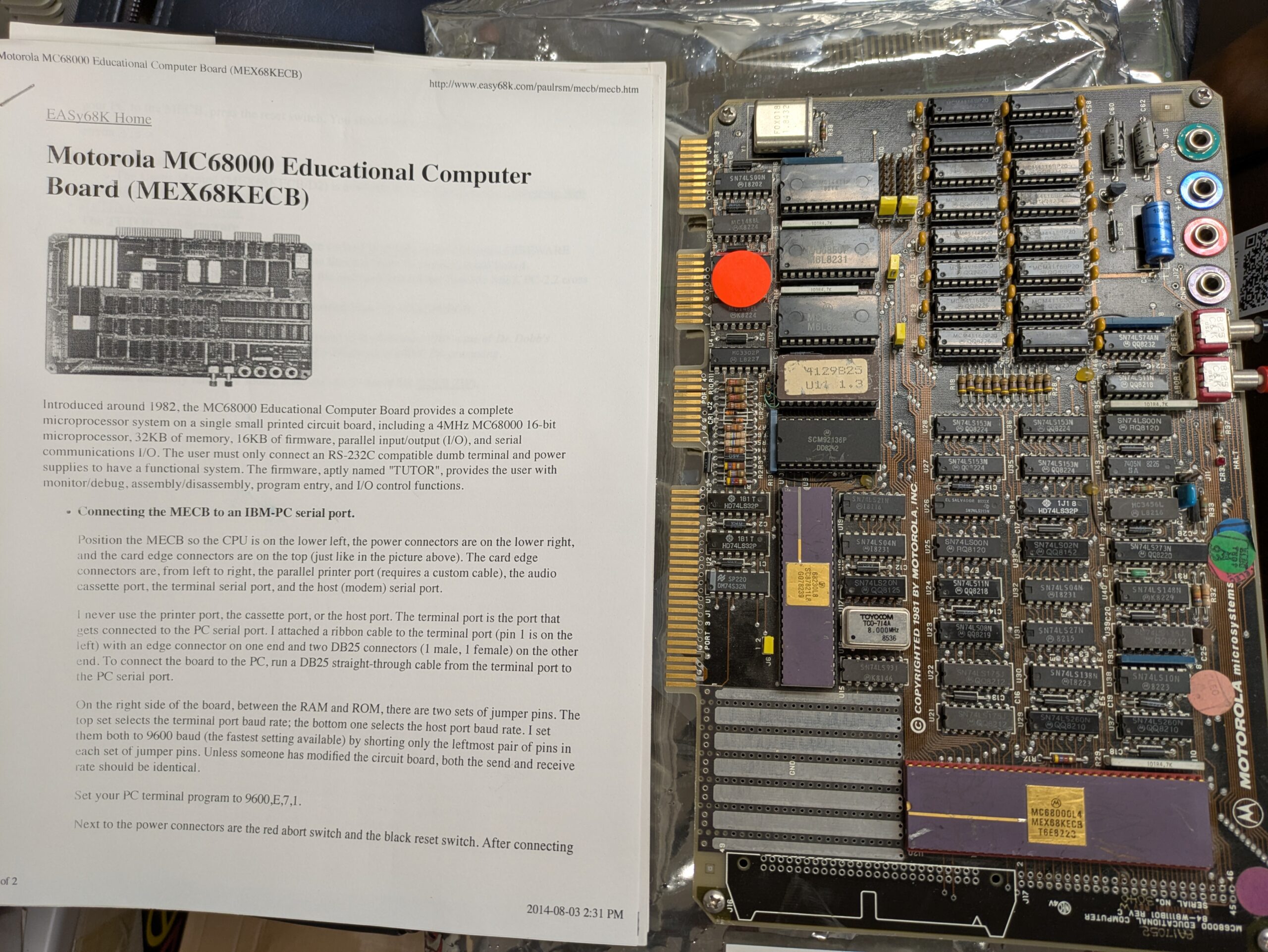
- Manufacturer: Motorola Microsystems Division
- Type: Development Board
- Release Date: 1981
- Cost at release: USD $495 (CAD ~$2,000 adjusted for inflation)
- MIPS: 0.3 – 0.5 (300-500 KIPS)
Hardware Specifications
- CPU: Motorola 68000 16-bit microprocessor running at 4 MHz
- RAM: 32 KB dynamic RAM
- ROM: 16 KB monitor/firmware ROM containing the TUTOR software
- Serial ports: Two RS-232C compatible serial ports, individually selectable baud rate from 110 to 9600 bps (one for dumb terminal, one for host computer)
- Parallel port: MC68230 parallel interface/timer chip providing three 8-bit parallel ports with handshaking, Centronics-type printer port
- Audio output: Cassette tape interface for data storage
- Power requirements: External power supply providing +5V at 750 mA, +12V at 100 mA, and -12V
- Physical size: 165 mm x 267 mm ( 6.5″ x 10.5″ )
- Weight: ~0.7 kg (around 1.5 pounds)
Operating System & Programming Languages
- Operating System: The Motorola MC68000 Educational Computer Board (MEX68KECB) runs firmware stored in a 16KB ROM called TUTOR. This software is a command-line monitor/debugger that provides assembly/disassembly, stepping, and program control features. It is not a traditional operating system but a monitor program for development and debugging.
- Supported Languages:
- Motorola 68000 assembly language, directly supported by the TUTOR assembler/disassembler.
- Machine code programs written in 68000 assembly.
- Some users purchased and experimented with the FORTH language interpreter for the 68000 (available separately).
Notables
- Introduced in 1981 by Motorola Microsystems Division, it was aimed at students and engineers for hands-on experience with the then-advanced 16/32-bit Motorola 68000 CPU.
- The 68000 CPU powered iconic systems like the Apple Macintosh, Amiga, Atari ST, and Sega Genesis, making the educational board a key early platform for learning this influential architecture.
- It was relatively affordable at $495 USD, making advanced CPU education accessible in colleges, fostering widespread 68000 assembly programming skills.
- The board featured innovative built-in educational/debug software called TUTOR for assembly instruction stepping and debugging via serial terminal.
- It has no formal nickname but is well known in vintage computing circles as one of the earliest and most successful 68000 training boards.
- This model helped propel the adoption of the 68000 series, pivotal in transitioning computing from 8-bit to 16/32-bit architectures.
- Its simple, open design allowed for experimentation and custom interface wiring, ideal for education and prototyping.
- It was not heavily advertised in flashy campaigns; rather, Motorola targeted academic and engineering markets directly.
- One of the first low-cost 16/32-bit microprocessor educational kits available with an integrated debugger.
- It demonstrated foresight in microprocessor education coinciding with the 68000’s significant impact on personal and professional computing.
Donated by: Arlen Michaels