Nascom-1
[Vin118]
The Nascom-1, launched in 1977 in the UK, was notable for being one of the earliest single-board computer kits based on the Zilog Z80 processor, featuring a rare inclusion at the time of a full keyboard and video display interface rather than a hexadecimal keypad and 7-segment display. Its claim to fame was its accessibility to hobbyists who could assemble the kit themselves, leading to impressive popularity with over 12,000 units sold in the first 18 months, making it the UK’s fastest-selling microcomputer by 1978 and more popular than contemporaries like the MK-14 and Acorn System 1. This popularity and innovative design made it an important milestone in the history of personal computing, especially significant in the academic and vintage computing museum context for illustrating early microcomputer kit culture and accessibility.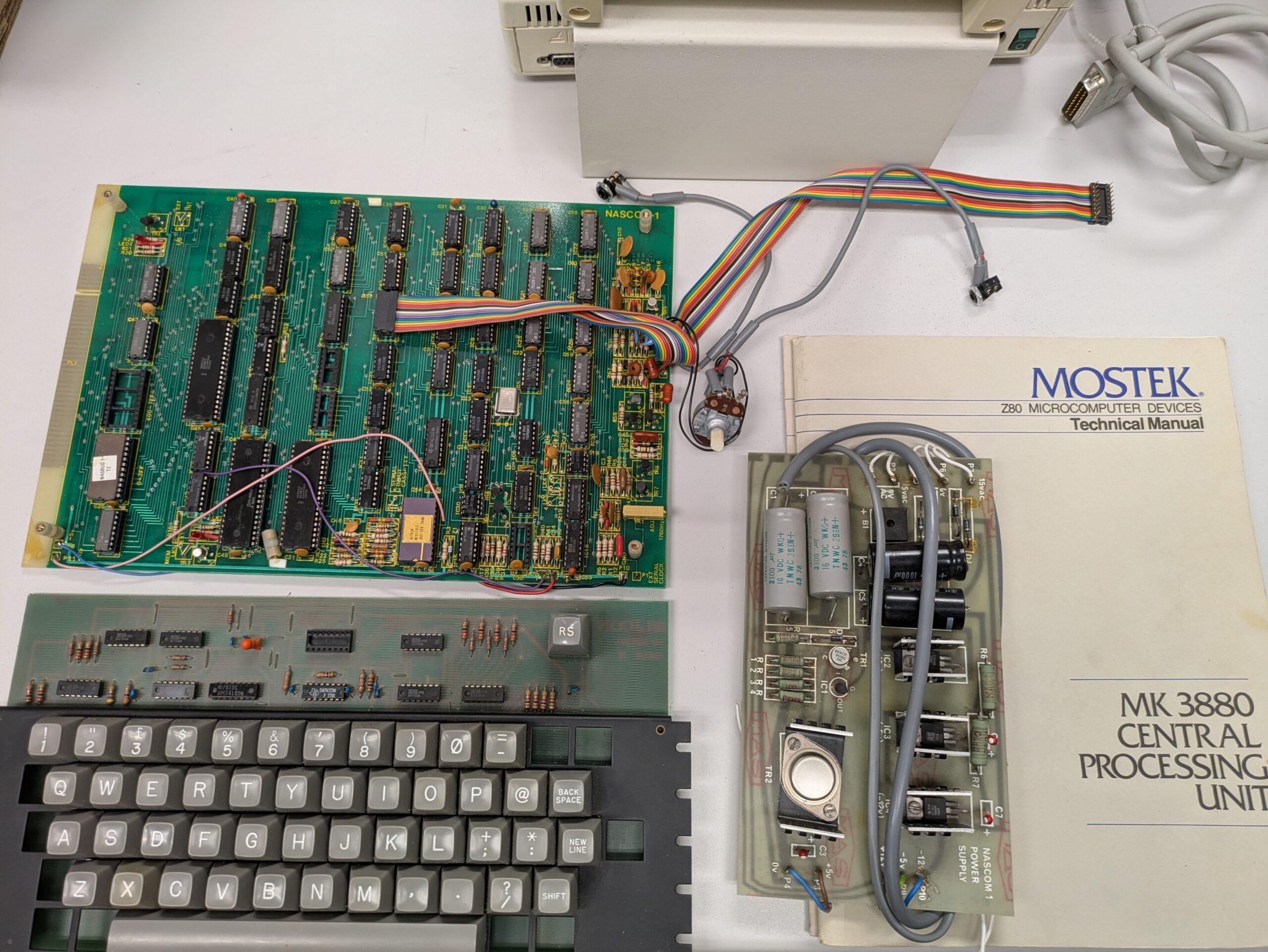
- Manufacturer: Nascom Microcomputers
- Type: Single Board Computer
- Release Date: 1978
- Cost at release: £197.50 plus VAT (CAD ~$1,900 adjusted for inflation)
- MIPS: 0.05 (50 KIPS)
Hardware Specifications
- CPU: Zilog Z80 microprocessor running at 1 or 2 MHz
- RAM: 2 KB installed (about 850 bytes available to user), expandable up to 64 KB
- ROM: 1 KB initially, later 2 KB with extended monitor programs
- Display: Memory-mapped video with 16 rows of 48 characters (monochrome text only, no graphics)
- Keyboard: Full typewriter-style keyboard (unusual for kit computers of its time)
- I/O: Serial port for cassette storage (Kansas City standard), RS232, two 8-bit parallel ports (PIO)
- Storage: Data stored/loaded via cassette tape at 300 baud (wow!)
- Monitor/Operating system: Included simple debug monitors (NAS-BUG variants) and later CP/M support via external ROMs
- Dimensions: Main board approximately 8″ x 10″ (203 mm x 254 mm)
- Assembly: Kit form requiring hand soldering of approx. 1,310 joints on a single circuit board
Operating System & Programming Languages
- Operating System: NAS-BUG monitor program initially, later NAS-SYS 2 KB OS on Nascom-1 and Nascom-2
- Supported Languages: Z80 assembly language and Microsoft BASIC (on certain versions/ROMs). Software entry largely manual in early versions, with monitor commands facilitating debugging and program execution.
Notables
- The Nascom-1 was designed on an airline serviette during a transatlantic flight, conceived by John Marshall after attending a microprocessor seminar and amateur computer club in California.
- It was one of the first UK microcomputer kits to include a full typewriter-style keyboard and video output instead of just a hex keypad and seven-segment display.
- The Nascom-1 was initially priced at £197.50 plus VAT in kit form, making it affordable for hobbyists relative to other computing options at the time.
- It became the fastest-selling microcomputer in the UK by mid-1978, outselling competitors like the MK-14 and Acorn System 1.
- The kit required users to hand solder over 3,000 joints, reflecting the DIY ethos of early microcomputing enthusiasts.
- The system’s operating environment used a rudimentary command set called NAS-BUG based on single-letter commands for debugging and memory manipulation.
- Nicknamed by some enthusiasts as the “N-1,” it spawned an active user community supported by newsletters such as INMC NEWS, which was user-run.
- The Nascom 1’s design included a memory-mapped video display with unusual line-scrolling characteristics unique for the era.
- Expansion and peripherals, including a full colour PAL video support and built-in Microsoft BASIC ROM, came later with the Nascom-2.
Donated by: Dr Arlen Michaels