Apple IIe
[Vin123]
The Apple IIe is renowned for its role in popularising personal computing, especially in educational settings, due to its affordability, expandability, and user-friendly features. Its claim to fame lies in being the most long-lived Apple computer, produced and sold for nearly 11 years with minimal changes, and it introduced critical features such as uppercase and lowercase support, 80-column text display, and more reliable, integrated hardware that made it a staple in schools and homes during the 1980’s and early 1990’s. Its importance in computing history stems from democratising computer access, fostering early software development, and contributing to the PC revolution, making it a beloved and highly influential machine in the evolution of personal computers.
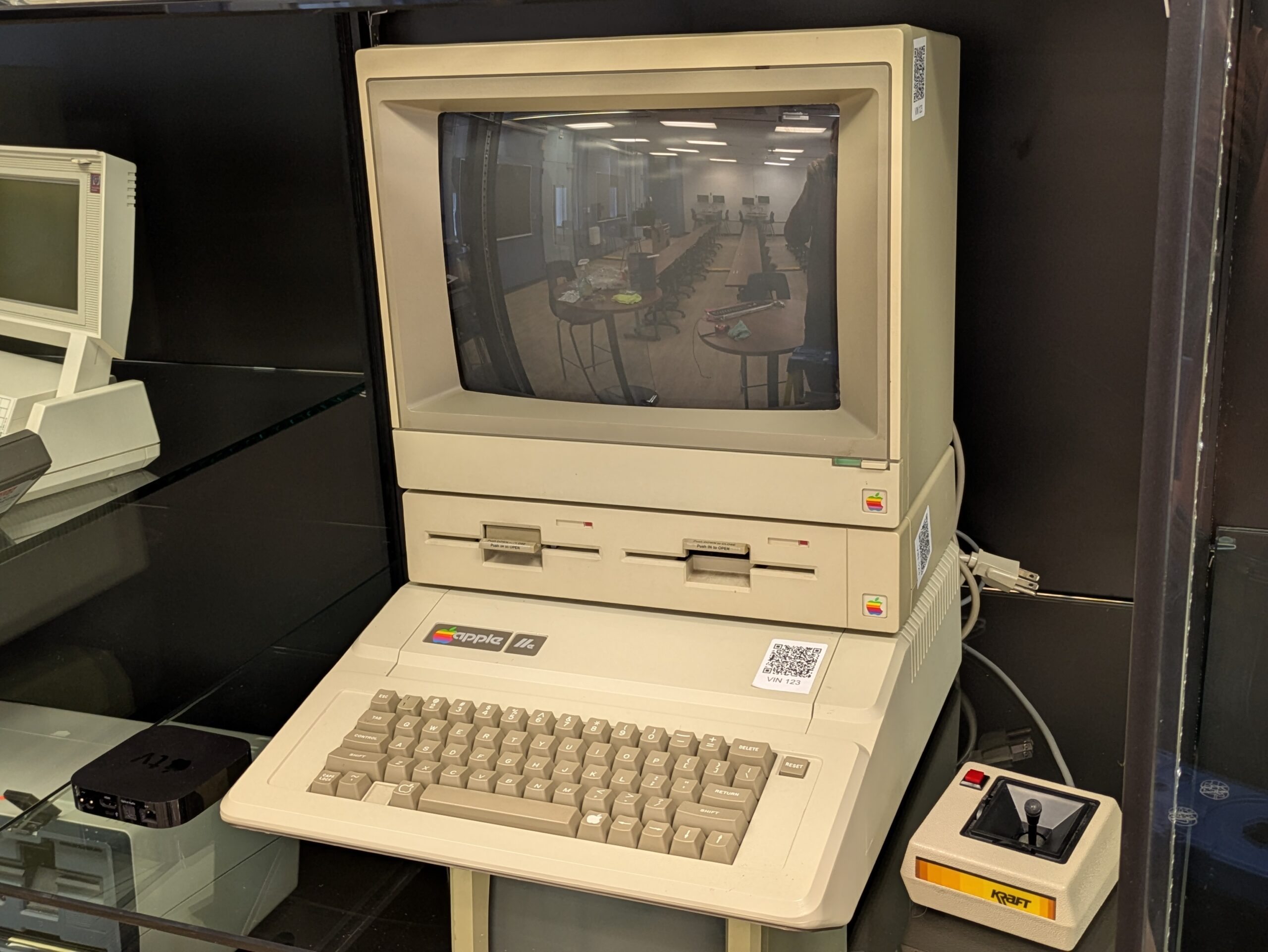 <
<
- Manufacturer: Apple Computer Inc.
- Model: IIe
- Released: 1983
- Type: Personal Computer
- Cost at release: USD $1,395 (CAD ~$4,800 adjusted for inflation)
- Cost with peripherals: $10,000 (adjusted for inflation)
- MIPS: 0.1 (100 KIPS)
Hardware Specifications
- CPU: MOS Technology 6502 or 65C02 running at 1.023 MHz (8-bit data bus)
- RAM: 64 KB RAM built-in, expandable up to 1 MB or more via bank-switching auxiliary slot
- ROM: 16 KB built-in
- Video Modes:
- Text: 40 and 80 columns, 24 lines, white-on-black
- Graphics: Low-Resolution 40×48 (16 colors), High-Resolution 280×192 (6 colors), Double-Low-Resolution 80×48 (16 colors), Double-High-Resolution 560×192 (16 colors)
- Audio: Built-in speaker (1-bit toggling), cassette interface with 1-bit toggle output and zero-crossing input
- Expansion Slots: Seven Apple II Bus slots (50-pin card-edge) plus auxiliary slot (60-pin card-edge) for memory and peripherals
- Connectors: Game I/O (16-pin DIP), RF modulation output, numeric keypad (11-pin Molex), NTSC composite video output, cassette in/out (1/8-inch mono phono jacks), joystick (DE-9)
- Keyboard: Full ASCII character set with upper/lowercase support, auto-repeat, four-way cursor control, standard editing keys
- Weight: ~6 kg
Operating System & Programming Languages
- O/S: ProDOS operating system
- Programming Languages: Applesoft BASIC (in ROM), Integer BASIC (via software or cartridges, though less common on the IIe), Assembly language (6502 assembly programming), Pascal (Apple Pascal and third-party versions), Logo, Forth, Other language implementations available via floppy disk or cartridge such as FORTRAN and COBOL
Notables
- First Apple II with built-in lowercase and 80-column text support standard
- Most successful and longest-lived Apple computer: produced continuously for nearly 11 years (1983-1993)
- Most popular model in the Apple II series
- Became the dominant computer in American classrooms throughout the 1980s, displacing the Commodore PET through aggressive educational discounts
- Outlasted its intended successor (Apple III) and was saved from discontinuation when the Apple III failed
- 95% of all Apple II software ran on the enhanced IIe, making it more compatible than even Apple II clones
- The “e” officially stands for “enhanced”
- First Apple computer with a custom ASIC chip, reducing discrete IC count from ~120 chips to just 31
Donated by: Dr. Arlen Michaels