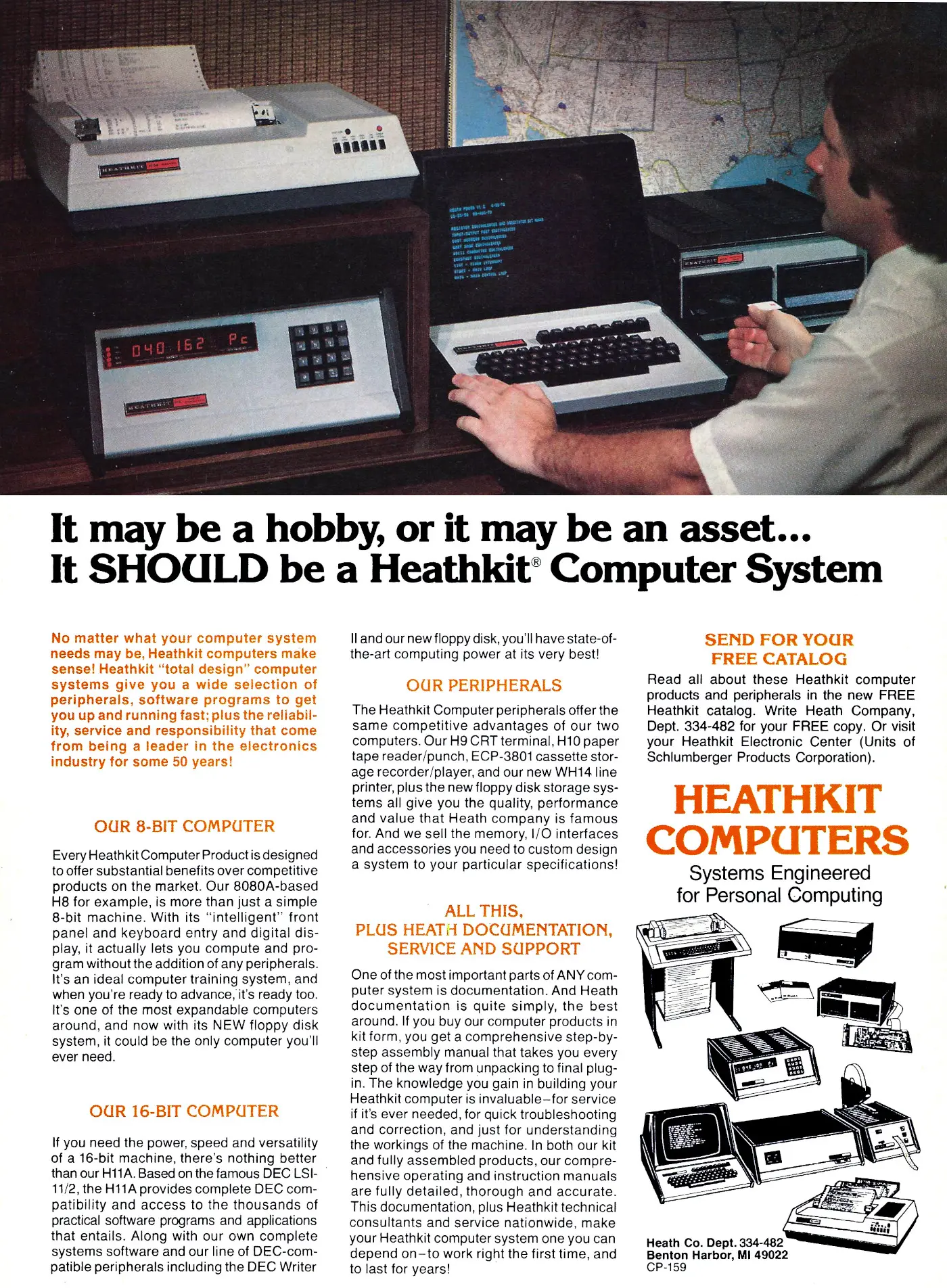
Heathkit H8
[Vin131]
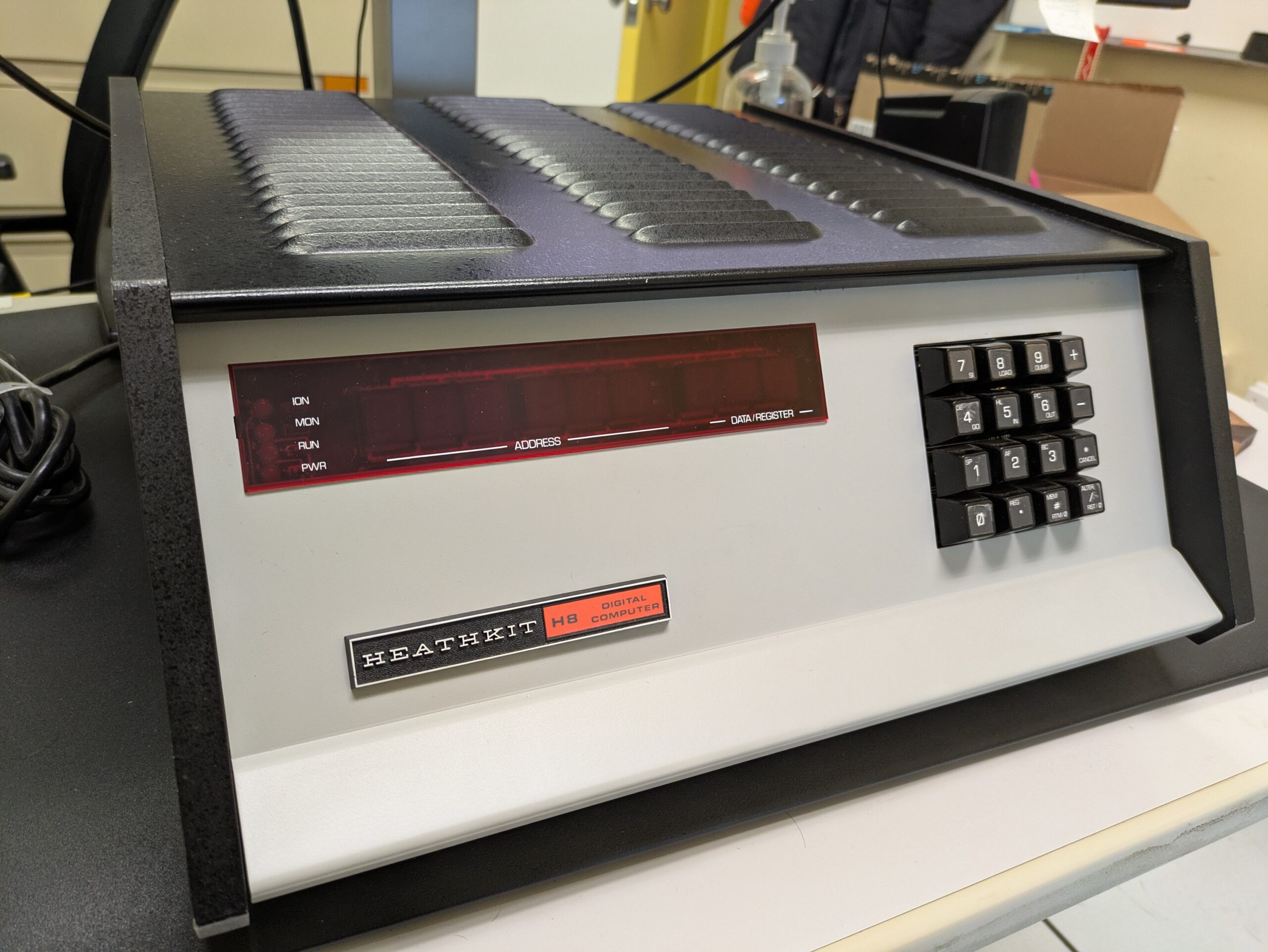
The Heathkit H8 is notable as one of the earliest examples of a desktop computer, introduced in 1977 as a kit-based system built around the Intel 8080A CPU. Unlike the common S-100 bus architecture of the era, it featured the proprietary “Benton Harbor Bus,” emphasizing electrical robustness. It sported an unusual octal keypad and 7-segment LED display for input, reflecting the kit-hobbyist nature of early computers.
- Manufacturer: Heathkit
- Release Date: 1977
- Type: Desktop Computer
- Cost at release: USD $379 (CAD ~$2,000 adjusted for inflation)
- MIPS: 0.05 (~50 KIPS)
Hardware Specifications
- CPU: Intel 8080A microprocessor running at 2 MHz
- Memory: Configurable from 4 KB to 64 KB RAM (typically 4 KB included)
- Bus architecture: Proprietary 50-pin “Benton Harbor Bus” with 10 card slots (8 full-length usable)
- Display: 9-digit 7-segment LED display on front panel
- Input: 16-button octal keypad on the front panel; optional full keyboard terminals available
- Storage: Optional cassette tape interface; optional floppy disk drive (e.g., WH17 floppy controller with 102K bytes capacity)
- Power: Built-in heavy-duty power supply distributing unregulated +8V and ±18V to cards which individually regulate to needed voltages (+5V, ±12V)
- Expansion: Slots for memory and I/O expansion cards; serial and parallel I/O options
- Physical dimensions: Approximately 406 mm (W) x 445 mm (D) x 165 mm (H)
- Weight: Approximately 9.5 kg (about 21 lbs)
Operating System & Programming Languages
- Operating System: HDOS (Heath Disk Operating System), a proprietary disk operating system developed by Heath Company specifically for the H8.
- Supported Languages:
- Assembly Language for Intel 8080, allowing low-level hardware control and efficient code
- BASIC, a widely used high-level language for beginners and rapid development
- FORTRAN, used for scientific and mathematical programming
- Pascal, for structured programming practices
- CP/M programs were still available and runnable on the H8 because the platform could be expanded and configured to support CP/M as well, given certain hardware modifications.
Notables
- Proprietary “Benton Harbor Bus”: Unlike the widespread S-100 bus, the H8 used a unique 50-pin bus named after Heathkit’s hometown of Benton Harbor, Michigan, designed to correct electrical flaws in the S-100 design.
- The H8 featured an unusual octal keypad and 7-segment LED display rather than binary switches or hexadecimal input, requiring three digits (0-7) for each 8-bit value entry.
- The H8 was Heathkit’s first computer kit, announced in July 1977 at the first annual PC Show in Atlantic City and released that fall.
- Modular design: The front panel itself was a plug-in card inserted into the first bus slot, making the H8 almost entirely modular.
- Gordon Letwin connection: HDOS, the H8’s operating system, was written by Gordon Letwin, who later became chief architect of Microsoft’s OS/2.
- “Love H8 Relationship”: The H8 earned this punny nickname among enthusiasts due to its challenging assembly and quirks.
- Golden Age: Released during the “Golden Age” of personal computing (late 1970s-1982), competing with the Apple II, TRS-80, and Commodore PET.
- SEBHC preservation: The Society of Eight-Bit Heath Computerists (SEBHC) actively preserves and upgrades H8 systems, including modern enhancements like speech synthesis boards and expanded memory.
- Bridging early homebrew microcomputers and more user-friendly desktop systems, surviving as a pioneer during the “Golden Age” of personal computing alongside early all-in-one desktop rivals like the Apple II and TRS-80. The H8 garnered a loyal following with nicknames like the “Love H8 Relationship,” due to its assembly challenges.
Donated by: Arlen Michaels