DEC Rainbow 100
[Vin133]
The DEC Rainbow 100 was a versatile dual-processor vintage computer featuring both Intel 8088 and Zilog Z80 CPUs, enabling it to run multiple operating systems and bridge legacy and emerging software platforms. Its importance lies in exemplifying how manufacturers addressed the market uncertainty of the early 1980s by supporting both leading processor architectures, making it significant in computing history despite not achieving mass-market dominance. It remains an important artifact for university collections illustrating early personal computing’s diverse landscape.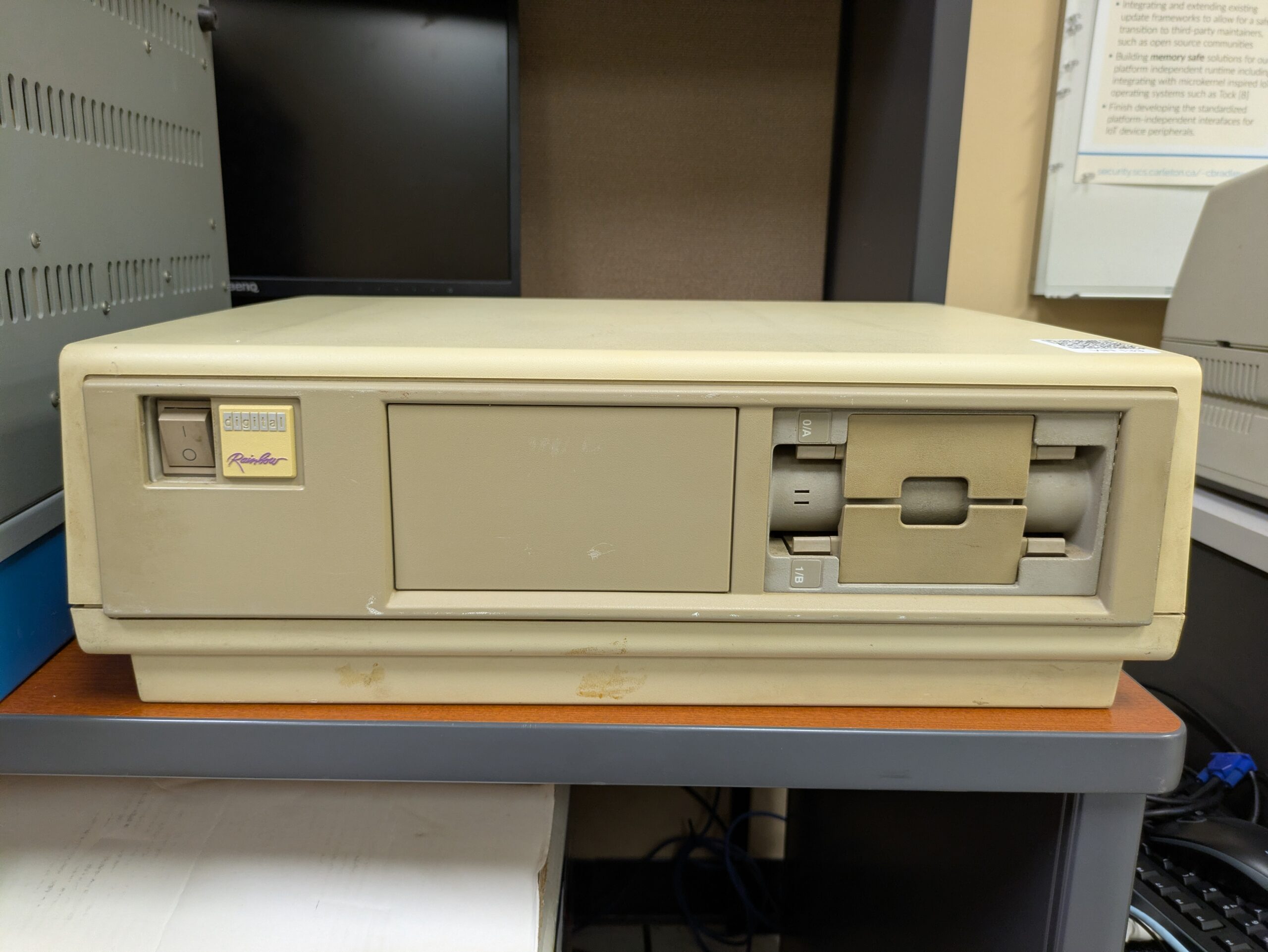
- Manufacturer: Digital Equipment Corporation (DEC)
- Type: Desktop
- Release Date: 1982
- Cost at release: CAD ~$18,000 (adjusted for inflation)
- Cost with peripherals: CAD ~$36,000 (adjusted for inflation)
- MIPS: 0.33 (330KIPS) for the Intel 8088 / 0.14 (140 KIPS) for the Z80
Hardware Specifications
- CPU: Dual CPUs — Intel 8088 at 4.77 MHz and Zilog Z80 at 4 MHz
- Memory: Typically 64 KB to 128 KB RAM (expandable)
- Storage: Supported 5.25-inch floppy drives and optional hard drives
- Display: Monochrome or color CRT monitor options; 8-bit graphics capability
- Keyboard: Full-sized mechanical keyboard integrated with the system
- Expansion: Internal slots for additional peripherals and memory
- I/O Ports: Parallel and serial ports for printers, modems, and terminals
- Weight: Approximately 30 pounds (13.6 kg)
Operating System & Programming Languages
- OS. The DEC Rainbow 100 supported multiple operating systems due to its dual-processor architecture. It could run:
- MS-DOS on the Intel 8088 processor
- CP/M and CP/M-86 on the Zilog Z80 and 8088 processors, respectively
- Programming Languages:
- Assembly language specific to the Intel 8088 and Zilog Z80 processors
- High-level languages common on these platforms such as BASIC, FORTRAN, and Pascal, depending on the operating system and software available
Notables
- It was one of the first PCs to use a dual-processor design (Intel 8088 & Zilog Z80), reflecting market uncertainty over dominant CPU architectures in the early 1980s.
- The Rainbow’s support for multiple operating systems (MS-DOS, CP/M, CP/M-86) made it a versatile but complex machine bridging legacy and emerging software environments.
- Although it never achieved mainstream success due to partial IBM PC incompatibility and high cost, it sold about 183,000 units and became a niche favourite in business and university research settings.
- Nicknamed sometimes as “DEC’s triple-boot machine,” the Rainbow was notable for its ability to “boot” into different OS environments.
- It holds a unique place in computing history as an example of transitional PC design aiming to unify incompatible software platforms before the IBM PC standard prevailed.
- DEC’s advertisements highlighted the Rainbow’s flexibility and powerful multi-processing capabilities but struggled against the rising dominance of IBM-compatible PCs.
Donated by: Dr. Arlen Michaels