Morrow Designs Micro Decision MD-3
[Vin134]
The Morrow Designs Micro Decision MD-3, released in the early 1980s, was a Z80A-based CP/M microcomputer designed to offer affordable, quiet, and user-friendly desktop computing. The MD-3 distinguished itself with two double-sided, half-height 5.25-inch floppy drives, providing a total storage capacity of 400 KB—an upgrade over earlier MD models. It featured a single-board design with 64 KB RAM, two RS-232 serial ports, a parallel port, and convection cooling, resulting in near-silent operation. The MD-3 shipped with bundled software and a menu-driven interface to make CP/M accessible to novices, and it was often paired with a dedicated terminal such as the Freedom-100. Its compact, RF-shielded metal case and lack of a noisy fan made it stand out among contemporaries, while its design reflected a transitional period just before the dominance of IBM PC compatibles.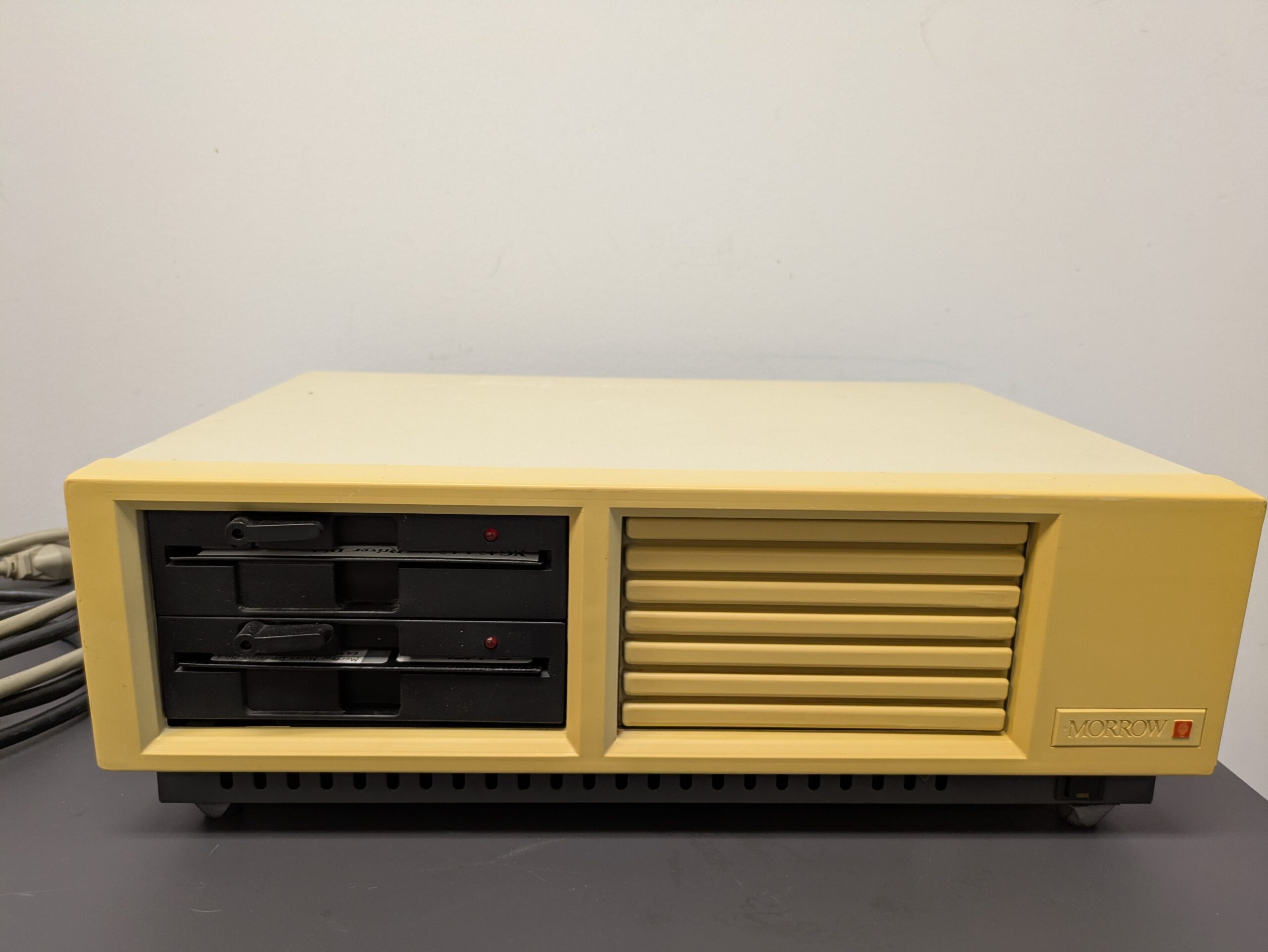
- Manufacturer: Morrow Designs, Inc.
- Type: Desktop
- Release Date: 1982
- Cost at release: USD $1,790 (CAD ~$6,500 adjusted for inflation)
- MIPS: 0.58 (580KIPS)
Hardware Specifications
- CPU: Z80A running at 4 MHz
- Memory: 64 KB dynamic RAM
- Storage: Two 5.25-inch double-sided, double-density floppy drives (400 KB total storage)
- Single-board computer design (no S-100 bus)
- Two RS-232C serial ports (for terminal and printer/modem)
- One parallel port (for printer)
- Convection-cooled, fanless operation (very quiet)
- RF-shielded metal case
- Dimensions: ~16.7″ wide x 11.3″ deep x 5.3″ high
- Weight: ~6 kg
Operating System & Programming Languages
- OS: CP/M 2.2 operating system, enhanced with a user-friendly menu system called Micro Menu.
- Programming Languages: Microsoft BASIC-80, Morrow’s own BaZic, PILOT, and other CP/M-compatible languages such as FORTRAN, COBOL, and assembly language.
Notables
- George Morrow was a key innovator in early personal computing, best known for his work in standardizing the S-100 bus (IEEE-696), which enabled broad hardware compatibility and expansion in microcomputers. He founded Morrow Designs and introduced affordable, reliable memory boards, S-100 floppy disk controllers, and complete systems that bundled CP/M, BASIC, and business software. Notably, Morrow Designs offered branded 8-inch floppy drives and hard disk systems, making high-capacity storage accessible to small businesses and hobbyists at a reasonable price.
- The Morrow Micro Decision MD-3 was one of the last popular CP/M business computers before the IBM PC era, known for its quiet, fanless operation and compact, all-in-one design.
- The MD-3 was praised for its reliability and expandability, with users often modifying systems to add more drives or RAM.
- The MD-3 was featured in creative advertisements highlighting its quietness and value, and it was used in small businesses, schools, and even early BBS systems.
- Its place in history is as a transitional machine—bridging the gap between hobbyist S-100 systems and the dominance of IBM PC compatibles, and representing the end of the CP/M era in business computing.
Donated by: Dr. Arlen Michaels