Apple Macintosh IIci
[Vin 138]
The Apple Macintosh IIci holds a significant place in vintage computing history as one of the earliest modular and expandable Macintosh machines, recognised for its powerful 25 MHz 68030 CPU and support for up to 128 MB of RAM, which was exceptional at the time. Its compact design with multiple NuBus slots allowed for versatility in professional environments, making it popular in higher education and creative industries for graphics, publishing, and research. From a museum perspective, the IIci represents a pivotal shift toward scalable desktop computing, bridging the gap between early Macintosh simplicity and more advanced, performance-driven workstation-class systems, reflecting Apple’s strategic emphasis on flexibility and expansion in the late 1980’s. Its popularity stemmed from this balance of power, expandability, and relatively compact footprint, making it a beloved icon in the evolution of personal computing.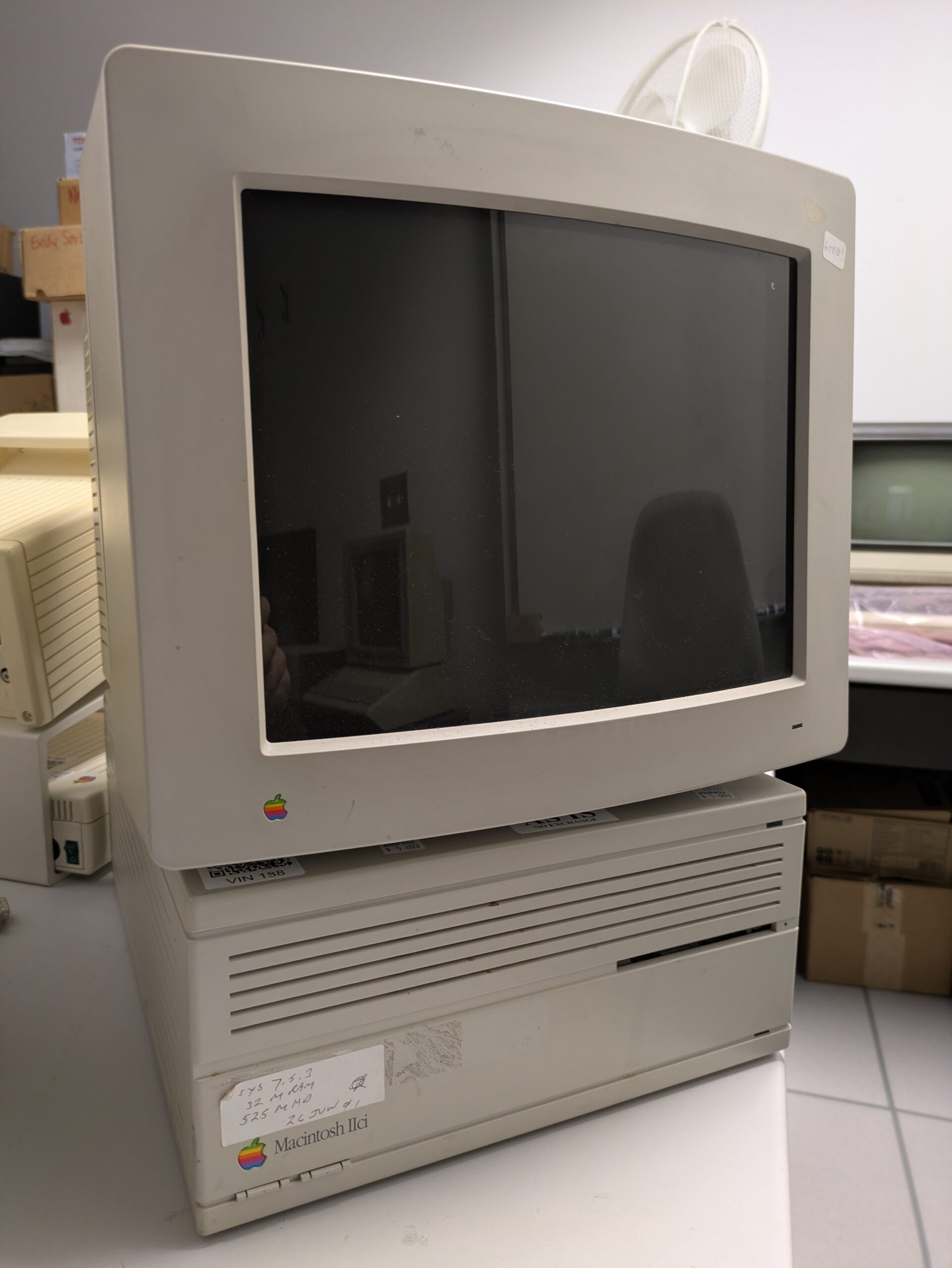
- Manufacturer: Apple Computer Inc.
- Released: 1989
- Type: Personal Desktop Computer
- Cost at release: CAD ~$9,000 adjusted for inflation
- MIPS: 5-8
Hardware Specifications
- CPU: Motorola 68030 running at 25 MHz
- Floating Point Unit (FPU): Motorola 68882 at 25 MHz
- Memory: 1 MB standard, expandable to 128 MB using 8 slots of 30-pin SIMMs (80 ns)
- Onboard Video: Integrated video using system memory for framebuffer (32 KB to 320 KB of RAM used), supporting 512×384, 640×480, and up to 640×870 resolutions with 8-bit color
- Cache: Optional L2 cache, initially 32 KB (later made standard)
- Expansion Slots: 3 NuBus slots and 1 Processor Direct Slot (PDS)
- Storage: SCSI hard drive (40 or 80 MB options), 1.44 MB floppy drive
- Ports: 2 ADB (Apple Desktop Bus), 2 RS-422 serial ports, SCSI DB-25 connector, DB-15 video port
- Power: 100-240V AC, 50-60 Hz, max 159 watts
- Weight: Approximately 13.6 pounds (6.2 kg)
Operating System & Programming Languages
- O/S: System 6.0.4 and officially supported Mac OS versions up to 7.6.1, including the important transition to 32-bit clean memory addressing introduced with System 7. This allowed more advanced memory management and paved the way for modern Mac OS features.
- Programming Languages: Pascal (such as THINK Pascal and Borland Turbo Pascal), C and C++ (primarily using Apple’s Macintosh Programmer’s Workshop and later IDEs like CodeWarrior), HyperTalk for scripting via HyperCard, AppleScript for automation, and BASIC variants including Real Basic. Developers could also use languages like Perl through ports available for the Mac OS platform at the time. This range made the IIci a versatile platform for both system software development, educational programming, and creative applications.
Notables
- It was one of the first Macintosh models to feature a modular design with separate CPU, memory, and video components, making it highly expandable for its time.
- The IIci introduced Apple’s transition to 32-bit clean memory addressing with System 7, paving the way for modern Mac OS developments.
- The machine was among the first to support an optional L2 cache, significantly boosting performance.
- The IIci was the first compact Macintosh with support for three NuBus expansion slots plus a Processor Direct Slot, enabling diverse hardware add-ons.
- Its launch marked Apple’s commitment to powerful, professional desktops distinct from consumer models.
- Vintage ads highlighted the IIci’s speed (“Desktop Power at a New Level”) and modularity, aimed at creative professionals.
- The IIci’s longevity and popularity helped solidify the Macintosh line in business and academia during the late 1980s and early 1990s.
Donated by: Arlen Michaels