Silicon Graphics Indy
[Vin143]
The Silicon Graphics Indy, introduced in July 1993 and discontinued in 1997, was historically significant as the first computer to include a digital video camera (IndyCam) as standard equipment, positioning it as a groundbreaking multimedia workstation that pioneered the convergence of desktop computing with video conferencing and digital media production capabilities at an accessible price point ($5-6k) compared to SGI’s high-end offerings. The Indy achieved moderate commercial success in academic institutions, film production studios, and multimedia content creation environments, with SGI initially projecting $1 billion in sales, though its popularity was limited by its Unix/IRIX operating system and niche positioning between high-end Mac systems and PC workstations. From a museum perspective, the Indy exemplifies early 1990s efforts to democratize professional graphics computing and represents a pivotal moment when integrated multimedia capabilities including ISDN networking, composite/S-Video inputs, CD-quality audio, and real-time 2D graphics transitioned from specialized equipment to standard desktop features, making it an essential artifact for demonstrating pre-internet video communication technology and the evolution of content creation workstations.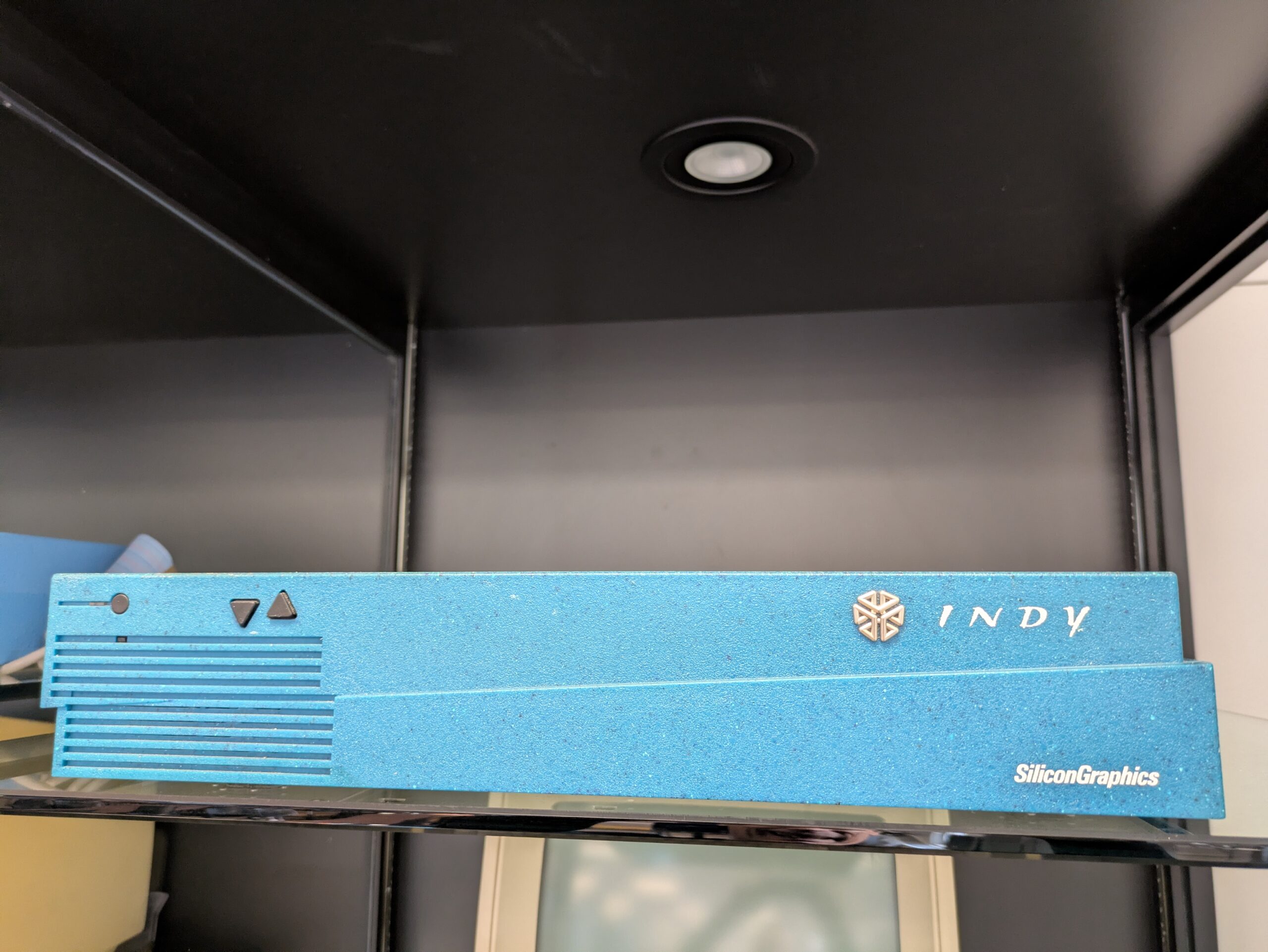
- Manufacturer: Silicon Graphics
- Released: 1993
- Type: Desktop Computer
- Cost at release: USD $5,000 (CAD ~$12,000 adjusted for inflation)
- MIPS: 130
Hardware Specifications
- CPU options: MIPS R4000, R4400, R4600, or R5000 processors, typically 100 MHz models; R4600 with or without L2 cache (512 KB)
- Memory: 16 MB standard, expandable up to 256 MB using 72-pin SIMMs
- Graphics: Options included 8-bit XL, 24-bit XL, and 24-bit XZ graphics with up to 1280 x 1024 resolution at 76 Hz
- Storage: Supports two internal 3.5″ SCSI drives (max height 1 inch), including hard disks and floptical drives
- Video: Built-in video subsystem with composite and S-Video inputs; first SGI system with digital video camera (IndyCam)
- Audio: Built-in digital audio subsystem with four analog and two digital channels, CD-quality sound digitizing
- Networking: 10Mbps Ethernet and ISDN ports standard
- Expansion: Two GIO32 slots for SGI cards
- Physical dimensions: 40.6 cm width, 7.6 cm height, 35.6 cm depth
- Weight: ~7.27 kg (16 lbs)
Operating System & Programming Languages
- O/S: IRIX
- Programming Languages: C and C++ (with MIPSPro compilers), Fortran, Python (including Python 3 ports), Java (early versions, e.g. Java 1.4), Ruby, Tcl/Tk, PHP
Notables
- It was the first computer to include a digital video camera (IndyCam) as a standard accessory.
- First SGI machine to have standard video inputs (composite, S-Video, digital).
- Known for its distinctive Bondi Blue “pizza box” case, standing out in an era dominated by beige computers.
- Marketed as a low-end but powerful multimedia workstation targeting CAD, desktop publishing, and multimedia markets.
- Often described by insiders as “An Indigo without the ‘go’ ” due to some performance and expansion limitations compared to higher-end SGI models.
- Competed with Intel x86, Windows, and Macintosh platforms with emulation capability.
- Early adopter of ISDN networking onboard, enabling experimental interactive video-on-demand services.
- Discontinued in 1997 but supported until 2011.
- Seen as a pioneering computer for early video conferencing and digital multimedia production.
- It held historical significance as a more affordable 3D-capable workstation that helped bring such technology closer to desktop users.
- An interesting marketing angle included making its way into early internet service providers’ offices to promote SGI branding.
- Its “pizza box” design was unique among SGI’s usually larger workstations and echoed the form factor popular among Sun Microsystems’ workstations during the 1990’s.
Donated by: Dr. Jörg-Rüdiger Sack