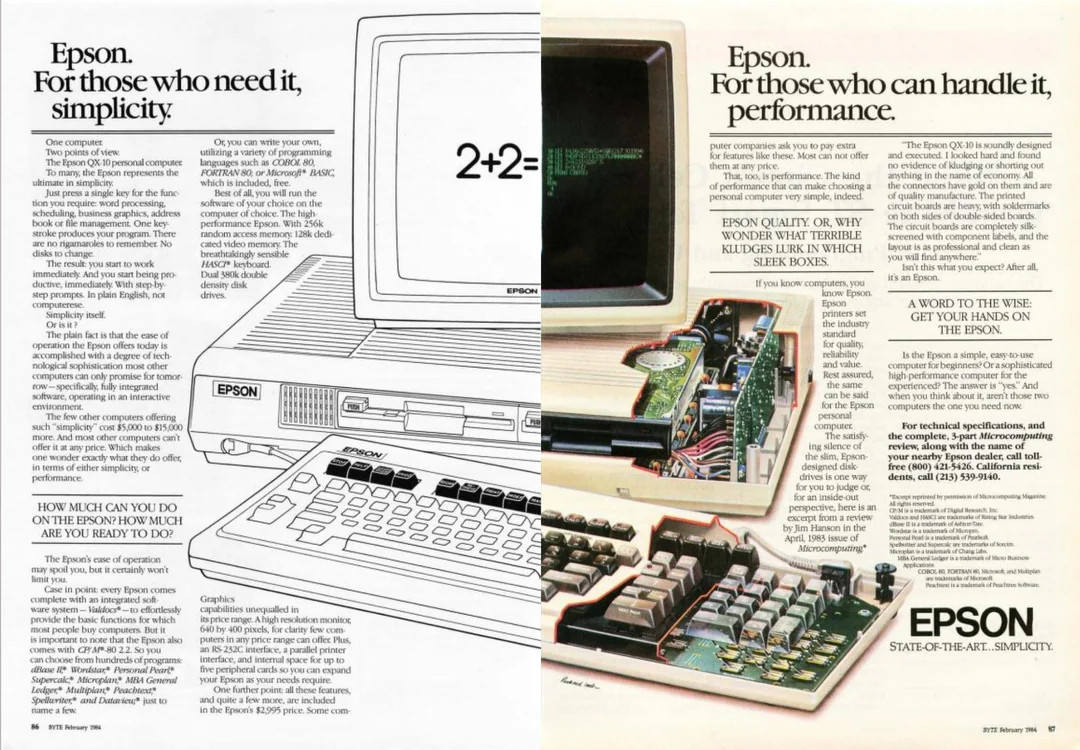
Epson QX-10
[Vin146]
The Epson QX-10, introduced in 1983, was notable for running CP/M or the enhanced TPM-III operating system on a Zilog Z80 processor with up to 256 KB of RAM and advanced graphics driven by a separate NEC graphics processor. Its claim to fame lies in its bundled office suite, Valdocs, which was among the first to offer a WYSIWYG word processor integrated with spreadsheets and other productivity tools, catering specifically to business users and making it a pioneering “appliance” computer with user-friendly software. It had moderate popularity, especially in North America, but was limited by performance issues and the rise of IBM PC compatibles, making it significant in computing history as an early attempt at graphical office environments and robust business-oriented microcomputers without proprietary chips, valuable for vintage computing museums in illustrating early graphical microcomputing and software innovation.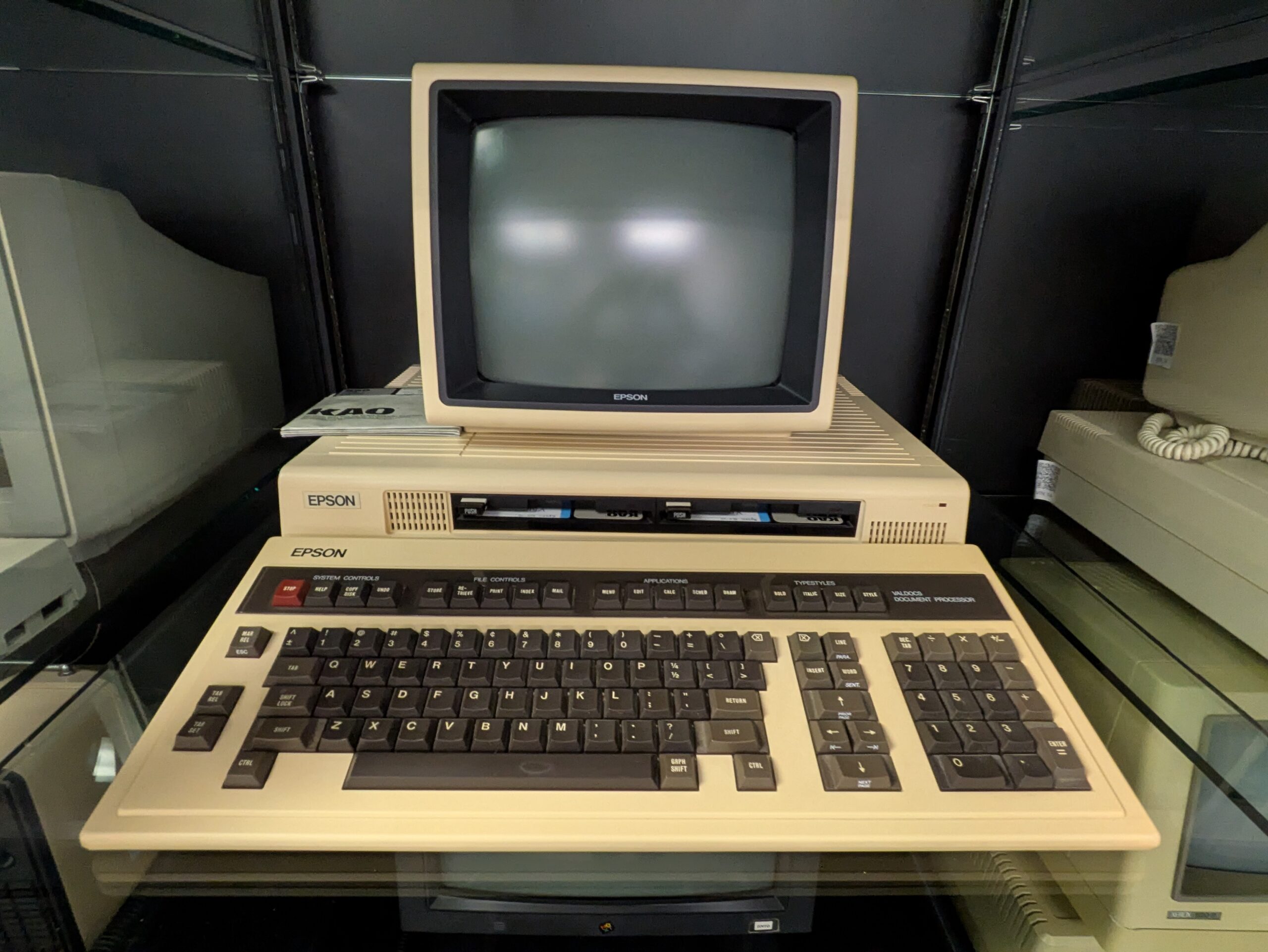
- Manufacturer: Epson Corporation (Japan)
- Type: Personal Computer
- Model: QX-10
- Release Date: 1983
- Cost at release: CAD ~$10,000 (adjusted for inflation)
- Cost with peripherals: CAD ~$17,000 (adjusted for inflation)
- MIPS: 0.3 (300 KIPS)
Hardware Specifications
- CPU: Zilog Z80 CPU running at 4 MHz
- Memory: 64 KB to 256 KB RAM
- Graphics: NEC µPD7220 graphics controller for advanced bitmap graphics
- Display: Monochrome CRT monitor with 640×400 pixel resolution
- Storage: Dual 5.25-inch floppy drives standard; optional hard drives via IDE adapter
- Keyboard: Full-stroke QWERTY keyboard with function keys
- Connectivity: Serial and parallel ports for printers and modems
- Weight: ~14 kg
Operating System & Programming Languages
- Operating System: CP/M
- Supported Languages:
- BASIC (typically Microsoft or interpreter variants)
- Assembly language for the Zilog Z80 processor
- FORTRAN (via third-party compilers)
- Pascal
- COBOL
Notables
- It was one of the first microcomputers to integrate a sophisticated graphical user interface with the Valdocs suite, pioneering early WYSIWYG office software on CP/M.
- The Epson QX-10 used the NEC µPD7220 graphics chip, one of the earliest graphics controllers, enabling advanced bitmap displays uncommon in 8-bit machines.
- The Epson QX-10 featured a unique keyboard called the HASCI (Human Application Standard Computer Interface) keyboard, specifically designed to enhance productivity with the Valdocs software suite. It included:
- 10 programmable function keys for quick access to system and software commands.
- Special keys organized into four groups: system control, file control, applications, and typestyle keys, allowing single-key activation of many computer functions.
- A dedicated UNDO key, a notable early convenience feature for text editing.
- A numeric keypad for data entry.
- The keyboard was connected by a curled cord and designed to work closely with the integrated software, emphasizing ease of use in business environments.
- Nicknamed the “friendly computer,” it targeted business users needing integrated word processing and spreadsheets before IBM PC dominance.
- Unique among CP/M machines, it bundled a GUI-like environment, making it a forerunner to later graphical business systems.
- Although moderately popular, it was somewhat overshadowed by IBM PC compatibles and the Apple Macintosh but remains a notable transitional system.
- Its advertisements emphasized ease of use and graphical capability, pitching it as a productivity tool for professionals rather than hobbyists.
- Historically, it illustrates the era’s experimentation beyond pure text interfaces, helping bridge the gap from command-line systems to modern GUIs.
Donated by: Dr. Arlen Michaels