Alpha Micro AM-1042E
[Vin153]
The Alpha Micro AM-1042E was a mid-range multi-user business microcomputer from Alpha Microsystems’ 1980s lineup, built around a Motorola 68000 series CPU with the proprietary AMOS/L multi-user, multitasking operating system, and typically configured with substantial RAM and hard-disk storage to support dozens of simultaneous users in offices and labs, making it notable example of early shared-computing beyond single-user PCs. It’s claim to fame was delivering mini-computer-like time-sharing and business application power at a relatively lower cost than traditional minicomputers, helping transition small organizations toward multi-user microcomputer systems; though it never achieved mainstream household name status, it was modestly popular in vertical markets such as medical and professional services where multi-user capacity mattered.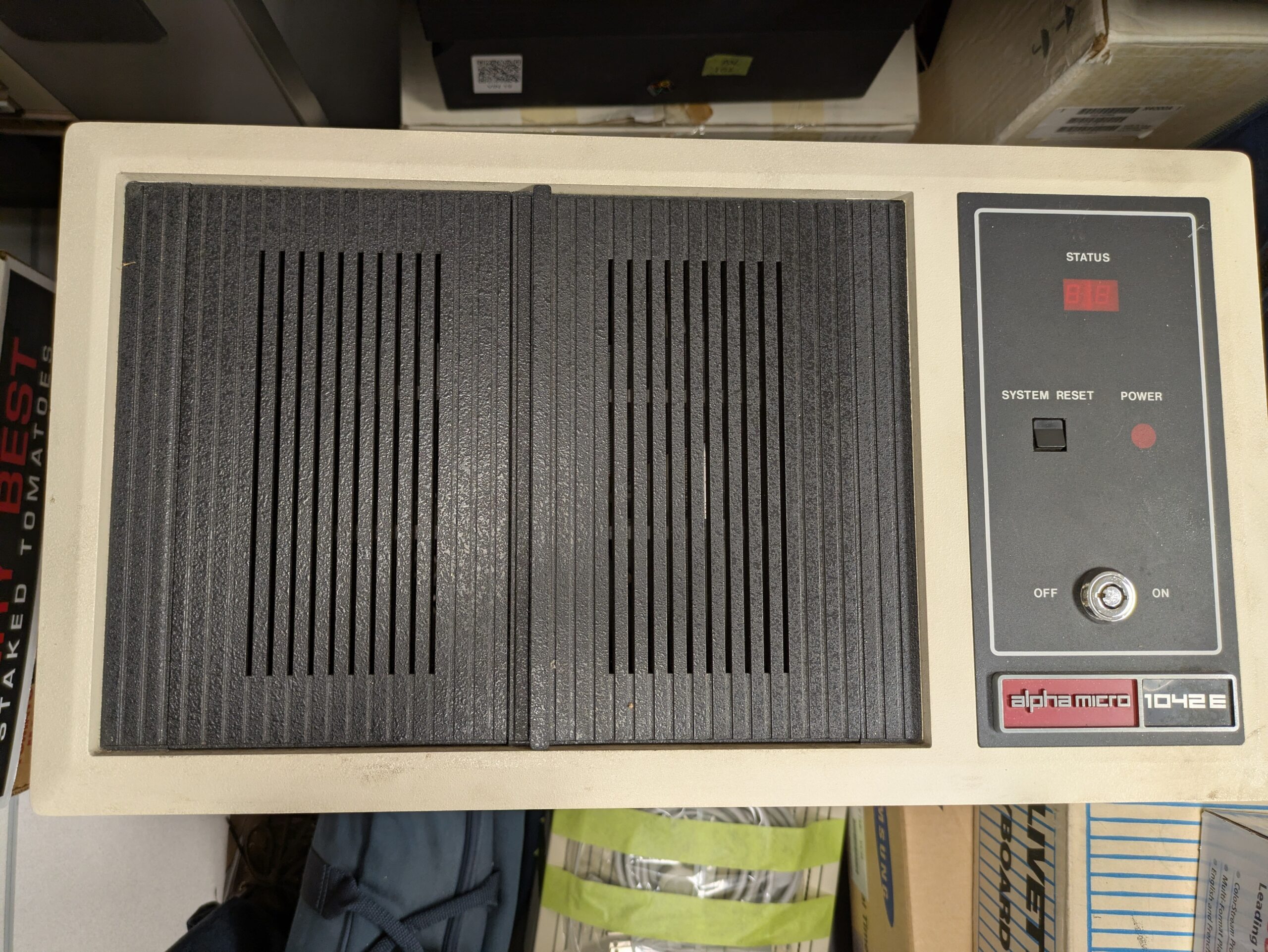
- Manufacturer: Alpha Microsystems, Inc. an American computer company founded in 1977 in Santa Ana, California.
- Type: Business computer
- Model: 1042E
- Release Date: 1984
- Cost at release: ~$70,000 (CAD adjusted for inflation)
- Cost with peripherals: ~$100,000 (CAD adjusted for inflation) It can connect up to 26 terminals to it
- MIPS: 0.3 – 0.5 (300-500 KIPS)
Hardware Specifications
- CPU: Motorola MC68000 8 MHz (standard 16/32-bit multi-user microprocessor of the era).
- Memory: 512 KB standard, expandable up to 3 MB maximum.
BitSavers - Storage: 60 MB Winchester hard disk drive (standard) typical ST-506 interface disk. Optional 20 MB streaming tape backup or VCR cassette interface for backups.
- I/O Interfaces: 26 x RS-232C serial ports for terminal connections (standard and expandable via I/O cards).
- Terminal Support: Designed to support up to 26 connected serial terminals concurrently under AMOS.
- Expansion: Additional RAM boards and serial I/O expansion boards could be added to increase memory and terminal support.
- Form Factor: Large desktop style chassis
- Dimensions: ~10.5″ H × 19″ W × 30″ D
- Weight: ~20-30 kg
Operating System & Programming Languages
- Operating System: AMOS / AMOS-L (Alpha Micro Operating System). A proprietary, multi-user, multitasking OS designed specifically for Alpha Micro systems. Not UNIX, but conceptually similar to minicomputer OSes, optimized for business workloads such as accounting, databases, and transaction processing.
- Supported Languages:
- AlphaBASIC / AMOS BASIC – the most widely used language on the platform; fast, structured, and tightly integrated with AMOS and ISAM file systems
- COBOL: widely used for accounting, payroll, and enterprise applications
- FORTRAN: used in technical, scientific, and some academic environments
- C: available on later AMOS-L releases for Motorola 68000 systems
- Assembly Language: (68000 assembler / MACRO-68K) for system-level and performance-critical programming
Notables
- The system came from a mechanic garage and ran its inventory system. It was ideal because it had the potential for so many terminals that could be installed around the shop.
- “Minicomputer in microcomputer clothing”. The AM-1042E was often described this way because it delivered true multi-user time-sharing on a microprocessor system, something still uncommon in the early 1980s.
- Alpha Micro deliberately avoided UNIX, instead refining AMOS, a proprietary OS optimized for business throughput; this choice made the system faster and simpler for accounting and database workloads.
- Early business time-sharing. It helped democratize department-level shared computing, allowing small offices, hospitals, and universities to run 10–25 terminals on one machine.
- Its BASIC dialect was famously powerful and structured, earning praise for being closer to a business application language than hobbyist BASICs.
- Particularly popular in medical offices, accounting firms, and manufacturing, where reliability mattered more than brand recognition.
- While not as famous as DEC’s PDP or VAX systems, Alpha Micro systems like the AM-1042E replaced many aging minicomputers at a fraction of the cost.
- Many systems stayed in daily use well into the 1990s, an unusually long service life for microcomputer-class hardware.
- Place in history – The AM-1042E represents a key transitional moment when microprocessors began to displace traditional minicomputers in professional environments.
Donated by: Dr. Arlen Michaels