Sega Genesis
[Vin154]
The Sega Genesis, known as the Mega Drive outside North America, stands out in vintage computing history for its Motorola 68000 16/32-bit CPU at 7.6 MHz paired with a Zilog Z80 sound controller, enabling arcade-quality ports and “blast processing” that delivered fast, responsive gameplay with hardware sprites, scrolling, and up to 61 on-screen colors from a 512-color palette. In a university museum context, it exemplifies 16-bit fourth-generation console architecture, backward compatibility with the Sega Master System, and innovations like the rare Sega Virtua Processor chip in Virtua Racing for early 3D polygon rendering, making it ideal for demos on emulation, hardware restoration, and lectures on the console wars rivalry with the SNES.
- Manufacturer: Sega
- Type: Video game console
- Release Date: 1989
- Cost at release: ~$500 (adjusted for inflation)
- MIPS: 6-8
Hardware Specifications
- CPU: Motorola 68000 16/32-bit at 7.6-7.67 MHz (NTSC), paired with Zilog Z80 8-bit co-processor at 3.58 MHz for sound and backward compatibility.
- Memory: 64 KB main work RAM (68000), 64 KB video RAM (VRAM), 8 KB audio RAM (Z80).
- Graphics (VDP): Yamaha YM7101, up to 61 on-screen colors from 512-color palette, hardware sprites, scrolling; pixel clock 6.71 MHz (NTSC).
- Sound: Yamaha YM2612 FM synthesizer (4 operators, 6 channels) with Z80-controlled PSG and DAC for PCM.
- I/O Chips: Custom Sega 315-53xx series (e.g., 315-5308, 315-5313) for controllers, TMSS, and system control.
- Other: ROM cartridge slot (up to 4 MB addressable), composite/RGB AV output via CXA1145 encoder.
- Weight: ~1.2 kg
Operating System & Programming Languages 
- Operating System: The Sega Genesis had no traditional operating system; each game cartridge contained its own custom boot code and initialization routines, directly handling hardware setup for the Motorola 68000 CPU, VDP graphics, and YM2612 sound chips
- Supported Languages: Native programming occurred primarily in Motorola 68000 assembly language (68k asm), with Zilog Z80 assembly for sound and compatibility modes
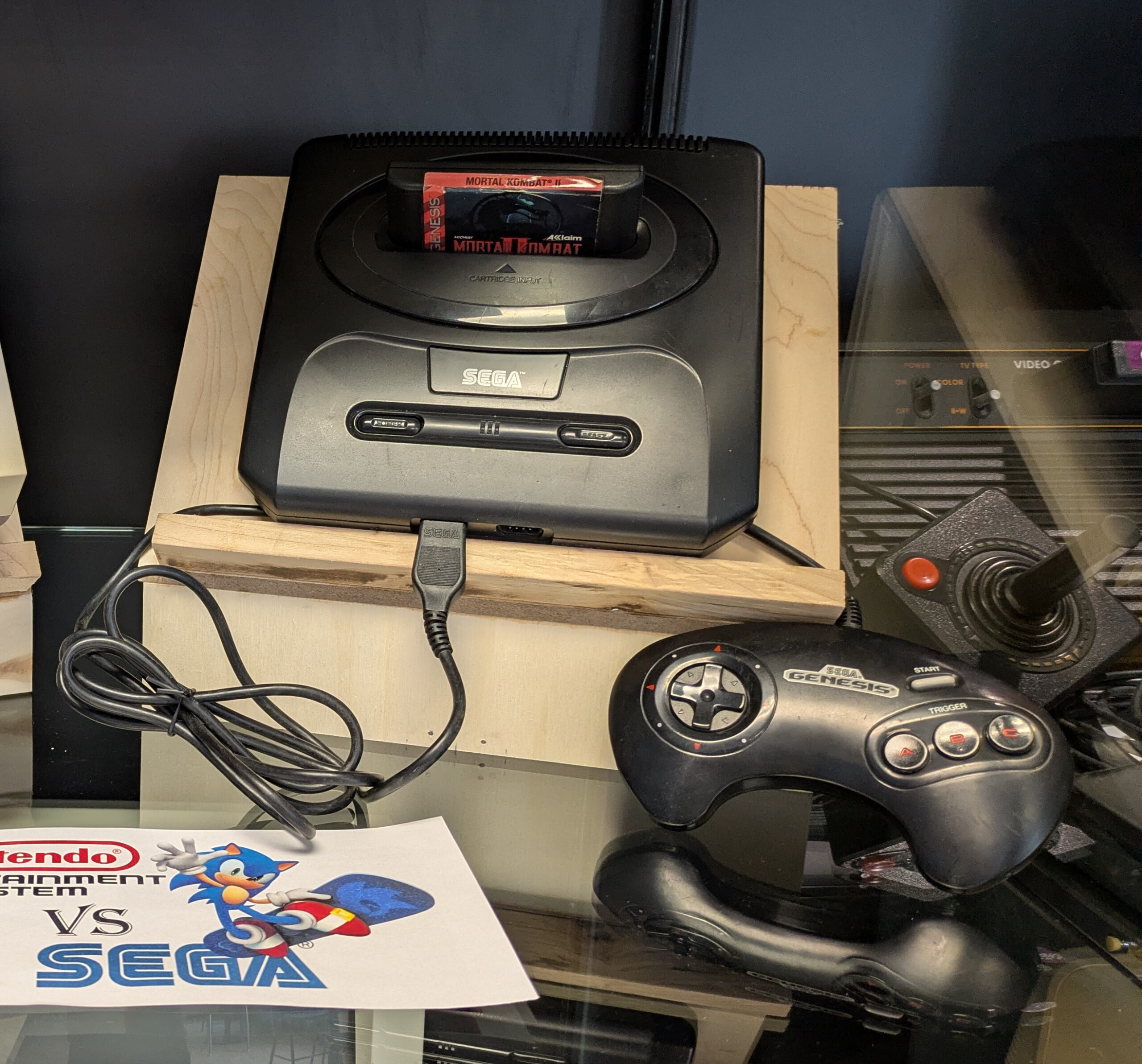
Notables
- First 16-bit console to market in North America (1989), beating SNES by two years and sparking the “console wars” that eroded Nintendo’s dominance.
- Sold over 30 million units worldwide, Sega’s best-seller ever, with 900+ games; outpaced TurboGrafx-16.
- Adapted from Sega’s System 16 arcade board for home use, introducing “blast processing” marketing for fast 68000 performance.
- First mass-market home console with Motorola 68000 CPU, enabling arcade-perfect ports like Golden Axe.
- Sonic the Hedgehog (1991) as Sega’s Mario rival, bundled to boost sales; Virtua Racing (1992) featured first home 3D polygons via add-on.
- TMSS anti-piracy chip (1990) forced “Produced by or under license” screen, hackable for dev mode.
- “Mega Drive” (international), “Genesis” (NA, evoking “new beginning”); “Blast Processing Beast.”
- “Genesis does what Nintendon’t!”
Donated By: Andrew Miles