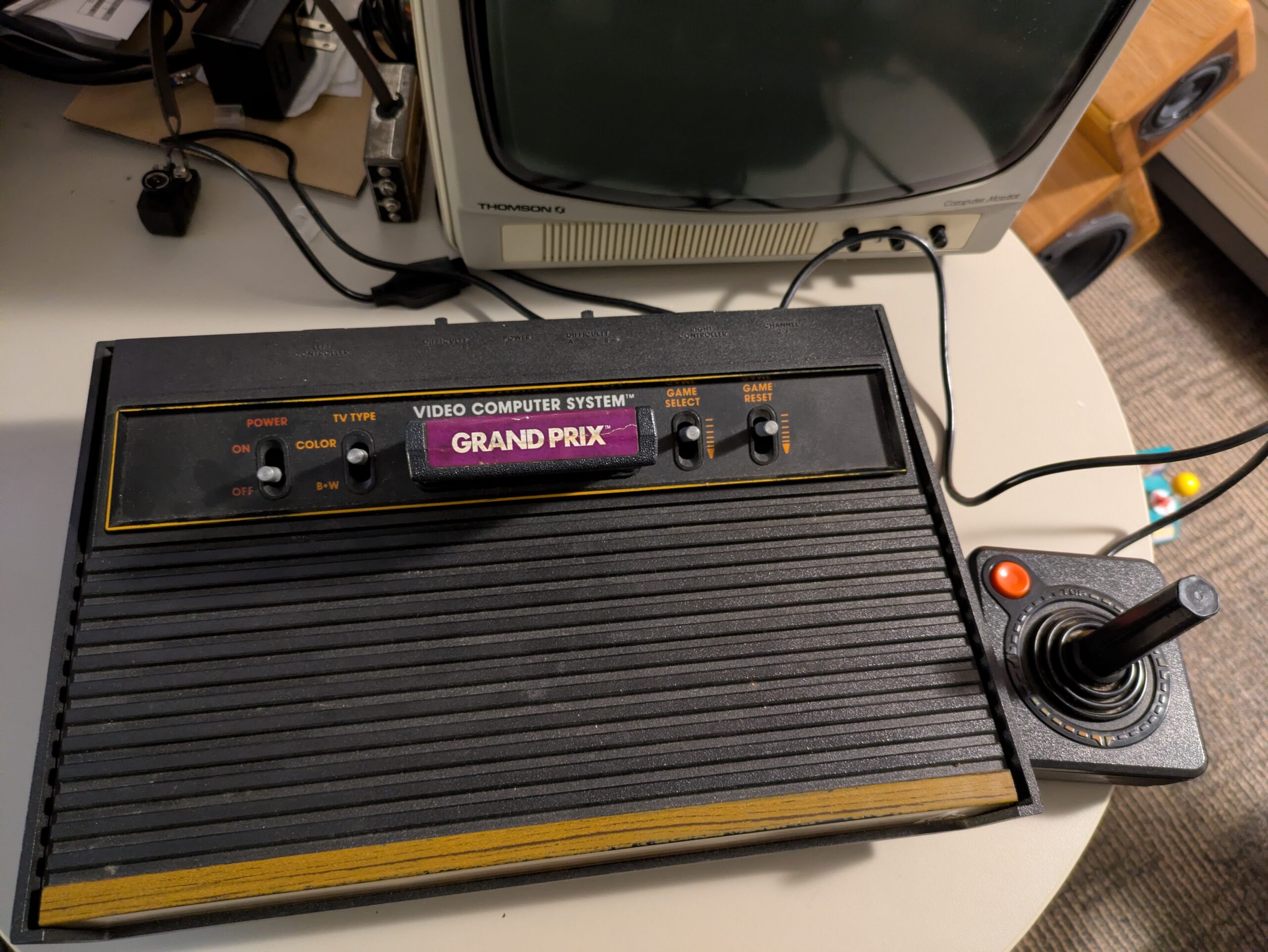
Atari 2600
[Vin156]
The Atari 2600, released in 1977, was a pioneering home video game console that brought digital gaming into millions of households, making it one of the first widely accessible consumer entertainment computers. Its claim to fame lies in popularizing cartridge-based games, allowing players to easily switch titles and creating a platform that sparked the modern video game industry. Hugely popular in the late 1970s and early 1980s, the 2600 sold over 30 million units worldwide, cementing its place as a cultural icon and a key artifact in the history of interactive computing.
- Manufacturer: Atari Inc.
- Type: Video game console
- Release Date: 1977
- Cost at release: ~$1,000 (adjusted for inflation)
- MIPS: 0.1 – 0.5
- Hardware Specifications
-
- CPU: MOS Technology 6507, 8-bit, 1.19 MHz
- Memory: 128 bytes (yes, bytes, not kilobytes!)
- ROM: Game cartridges from 2 KB up to 4 KB standard; later bankswitching allowed larger sizes
- Graphics: TIA (Television Interface Adapter) chip, 160×192 resolution, 128 colors, 2 player sprites + 2 missiles + 1 ball
- Sound: TIA-generated audio, 2-channel simple waveform sound
- Input: 2 joystick ports, optional paddle controllers
- Storage: ROM cartridges only (no internal storage or disk drive)
- Power Supply: External 9V DC adapter
- Weight: ~1.4 kg (3.1 lbs)
- Operating System & Programming Languages
-
- Operating System: The Atari 2600 did not have a traditional operating system like modern computers. Instead, it was essentially a bare-metal system: each game cartridge contained its own program and code that ran directly on the hardware.
- Supported Languages: Games and software were written in 6502/6507 assembly language, the low-level language of the CPU. There was no high-level OS support, so each game had to manage graphics timing, sound, and input manually. Some homebrew or experimental tools later allowed limited BASIC-to-Atari translation or development environments, but these were unofficial and not part of the original console.
- Notables
-
- One of the first successful cartridge-based home video game consoles, letting users swap games easily.
- Popularized home video gaming, sparking the modern gaming industry.
- Introduced the concept of “console as a platform”, not just a single built-in game.
- Originally called the Atari Video Computer System (VCS); renamed Atari 2600 in 1982.
- Sold over 30 million units worldwide, making it the most popular console of its era.
- Famous for “E.T. the Extra-Terrestrial”, one of the first video game commercial failures, often cited in discussions of the 1983 video game crash.
- Known for “racing the beam” programming, where developers had to sync code with the TV’s electron beam, a unique hardware challenge.
- Only 128 bytes of RAM, yet produced games with impressive graphics and sound.
- Some programmers could fit entire games into 4 KB cartridges, an exercise in extreme optimization.
- A cultural icon that marked the beginning of home digital entertainment.
- The Atari 2600 was programmed at the hardware level, making it a fascinating example of early “embedded computing” where programmers had to optimize every byte and cycle.
Share: Twitter, Facebook
Short URL:
https://carleton.ca/scs/?p=23278