Honeywell CP-6
[Vin158]
The Honeywell CP-6 mainframe, introduced in 1976, featured a versatile operating system supporting five concurrent access modes: batch, remote batch, time-sharing, transaction, and real-time processing along with integrated file management and multi-programming across multiple CPU’s, making it ideal for university environments handling diverse workloads like academic research and administration.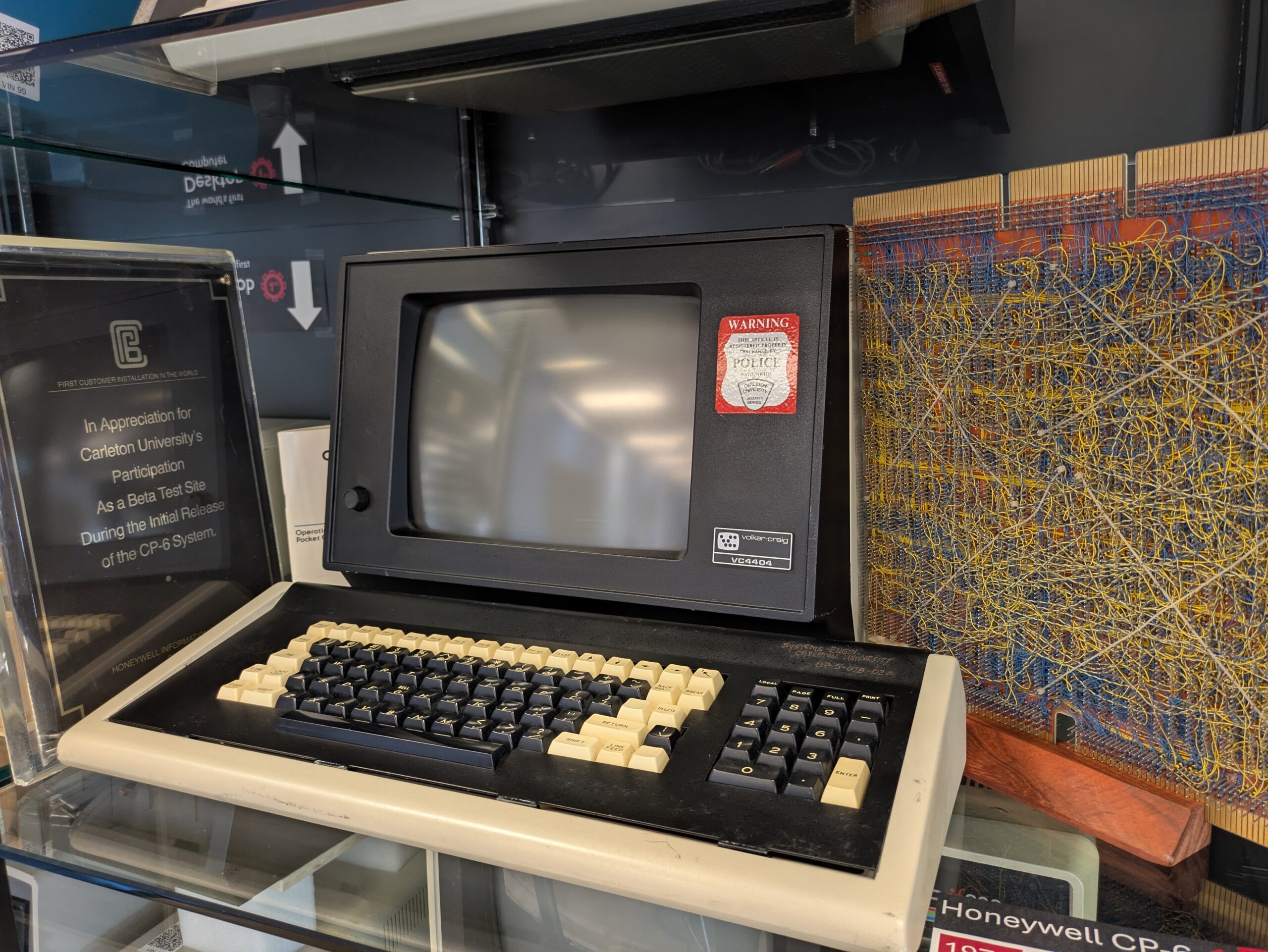
CP-6 was the university mainframe computer and began operating at Carleton in 1979. Carleton University ran two Honeywell CP-6 mainframe computers, one called PROD for administration (Student Records, Finance, HR, Alumni) and ACAD for the academic computing. Users were able to connect to them using serial connections using the Gandalf PACX front end processors (FEP’s) (see photo/framed vintage display).
- Manufacturer: Honeywell
- Release Date: 1976
- Type: Mainframe Computer
- Location: Diefenbunker Museum
- MIPS: < 1 MIPS
Notes
- CP-6 refers primarily to Honeywell’s operating system from 1976, a multi-mode (batch, timesharing, real-time) successor to Xerox CP-V, rewritten in PL-6 language for systems like Level 66/DPS and DPS 8.
- CP-6 ran on 36-bit mainframes with up to multiple CPUs, 1-16MB memory, and front-end Level 6 minicomputers for terminals/networking.
- The “CP-6 CPU board” is a processor module from this era’s Series 60 Level 66, expandable to 8MB+ memory with wire-wrap construction for custom or prototype builds.
- Level 66/DPS CPUs featured 72-bit accumulators, 8 index registers, and high-speed channels (18-216), delivering 1-6 MIPS performance rivaling IBM 4341s. Wire-wrapped boards allowed reliable, modifiable interconnections for complex logic, supporting virtual addressing and multiprogramming.
Donated by: Carleton University ITS (formerly CCS)