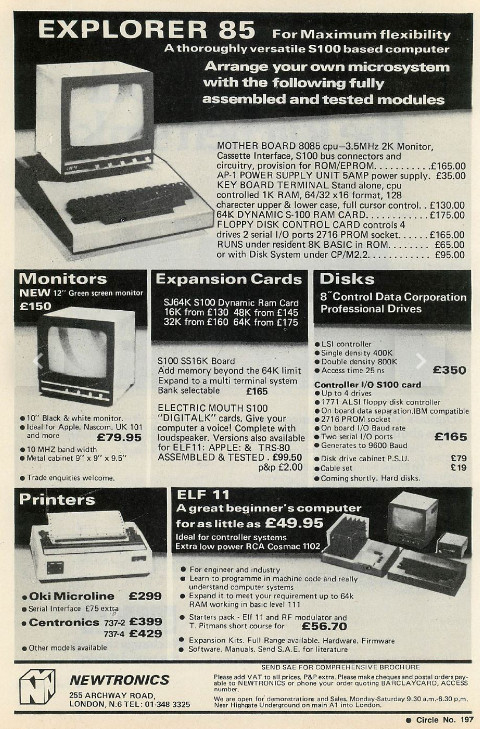
Netronics Explorer-85
[Vin16]
The Netronics Explorer-85 was a personal computer introduced in 1979, notable for its use of the Intel 8085 CPU, flexible S-100 bus expansion, and innovative serial port that automatically matched the baud rate of an attached terminal. Its claim to fame lies in its modular, hobbyist-friendly design-users could start with a basic motherboard and expand up to 64 KB RAM, floppy disk support, and a variety of S-100 peripherals, making it accessible and customizable for early personal computing enthusiasts. It was not a mass-market success and remained popular mainly among hobbyists and early adopters in North America.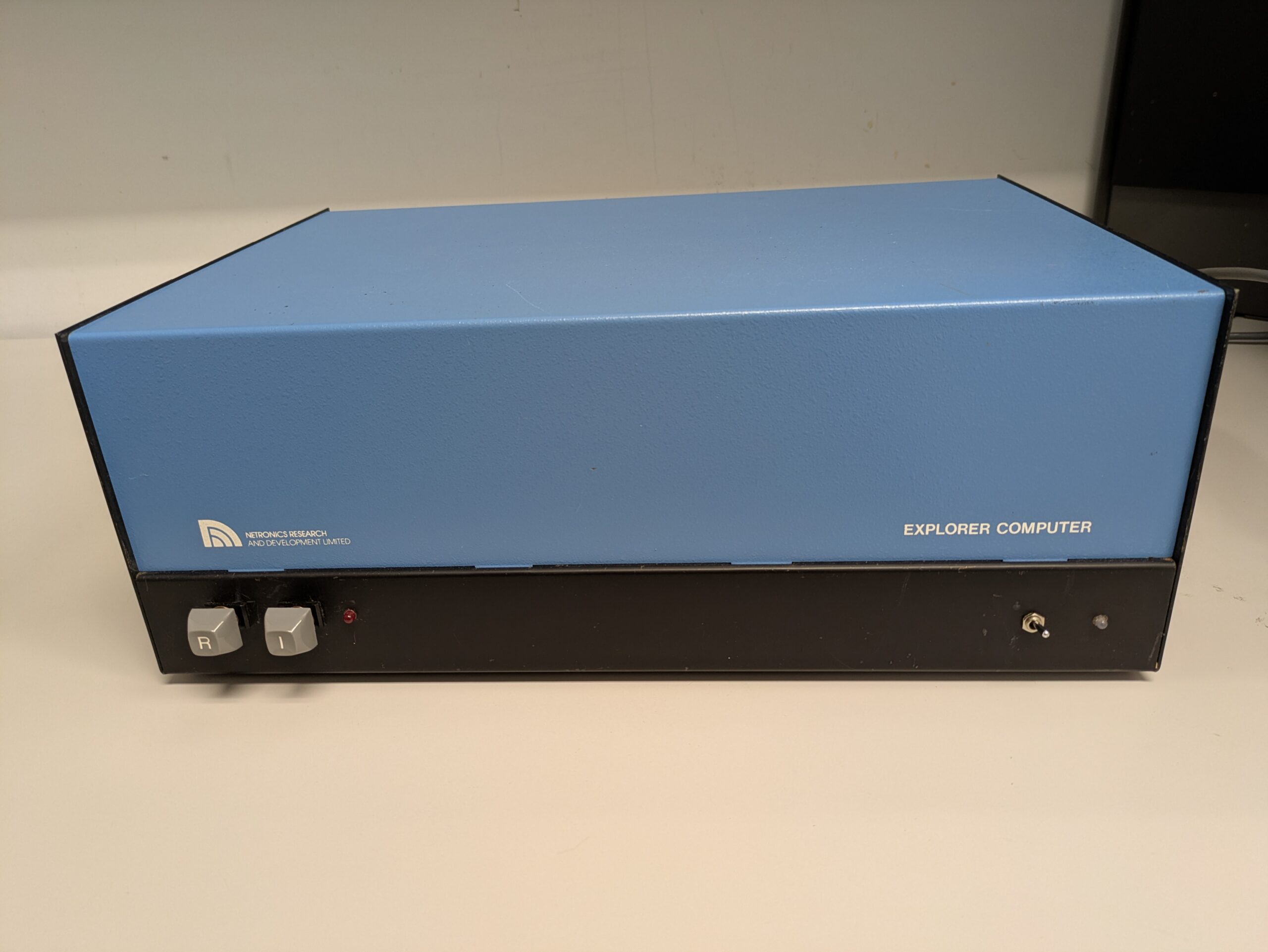
- Manufacturer: Netronics R&D Ltd
- Type: Personal computer
- Release Date: 1979
- Cost at release: USD $150 (CAD ~$700 adjusted for inflation)
- Cost with peripherals: fully expanded system with all peripherals (Level B–E upgrades, max 64 KB RAM, and floppy support) could reach ~$525 USD in 1982 (CAD $2,500 adjusted for inflation)
- MIPS: 0.2-0.5 (200 – 500 KIPS)
Hardware Specifications
- CPU: Intel 8085 microprocessor running at 3.072 MHz.
- RAM: 256 bytes (base), expandable up to 64 KB (with S-100 memory boards).
- ROM: 2 KB monitor ROM (expandable with Microsoft BASIC and CP/M support).
- Bus: S-100 bus with 2 slots on motherboard, expandable to 6 slots with expander card.
- Storage: Cassette tape interface (standard); optional floppy disk controller via S-100 expansion
Operating System & Programming Languages
- Operating System:
- Monitor ROM (built-in machine code monitor)
- Microsoft BASIC (ROM-based interpreter)
- CP/M (with sufficient RAM and storage expansion)
- Supported Languages:
- Microsoft BASIC (for general-purpose programming)
- Assembly language (via the monitor and third-party assemblers)
- CP/M allowed use of additional languages such as FORTRAN, COBOL, and others, provided compatible software was installed.
Notables
- The Netronics Explorer-85 was notable for being a kit computer, allowing hobbyists to assemble and expand it themselves.
- Its serial port featured a unique auto-baud detection: after reset, the user pressed the space bar on a terminal, and the firmware would automatically match the baud rate-a rare feature at the time.
- Unlike most S-100 bus computers, the Explorer-85’s large motherboard integrated the CPU and circuitry, with only two S-100 bus sockets (expandable to six), making it more compact and affordable.
- It included a front-panel interrupt button, letting users interrupt a crashed program and return to the debugger without losing work-a helpful tool for developers and tinkerers.
- The system was highly modular, sold in levels from a bare motherboard to a fully expanded computer with up to 64 KB RAM and floppy disk support.
- The Explorer-85’s place in computing history is as a flexible, hobbyist-oriented personal computer that helped popularise home computing and hands-on computer assembly during the late 1970’s and early 1980’s.
- The Explorer-85 was available internationally, including in the UK under the similar-sounding but unrelated “Newtronics” brand
Donated by: Arlen Michaels