Parker Brother’s Master Merlin
[Vin160]
Master Merlin is notable as an early example of a mass-market microprocessor-based consumer device, bringing embedded computing into millions of homes years before most people ever touched a personal computer. Its claim to fame was making a single-chip microcontroller do all the work: logic, memory, I/O, sound, and display. It demonstrated how computing could be cheap, portable, and purpose-built, a design philosophy that directly foreshadowed modern embedded systems. With several million units sold across the Merlin family, it was one of the most popular microcontroller-driven devices of its era, making it historically significant not for programmability, but for normalizing computers as everyday objects rather than lab equipment.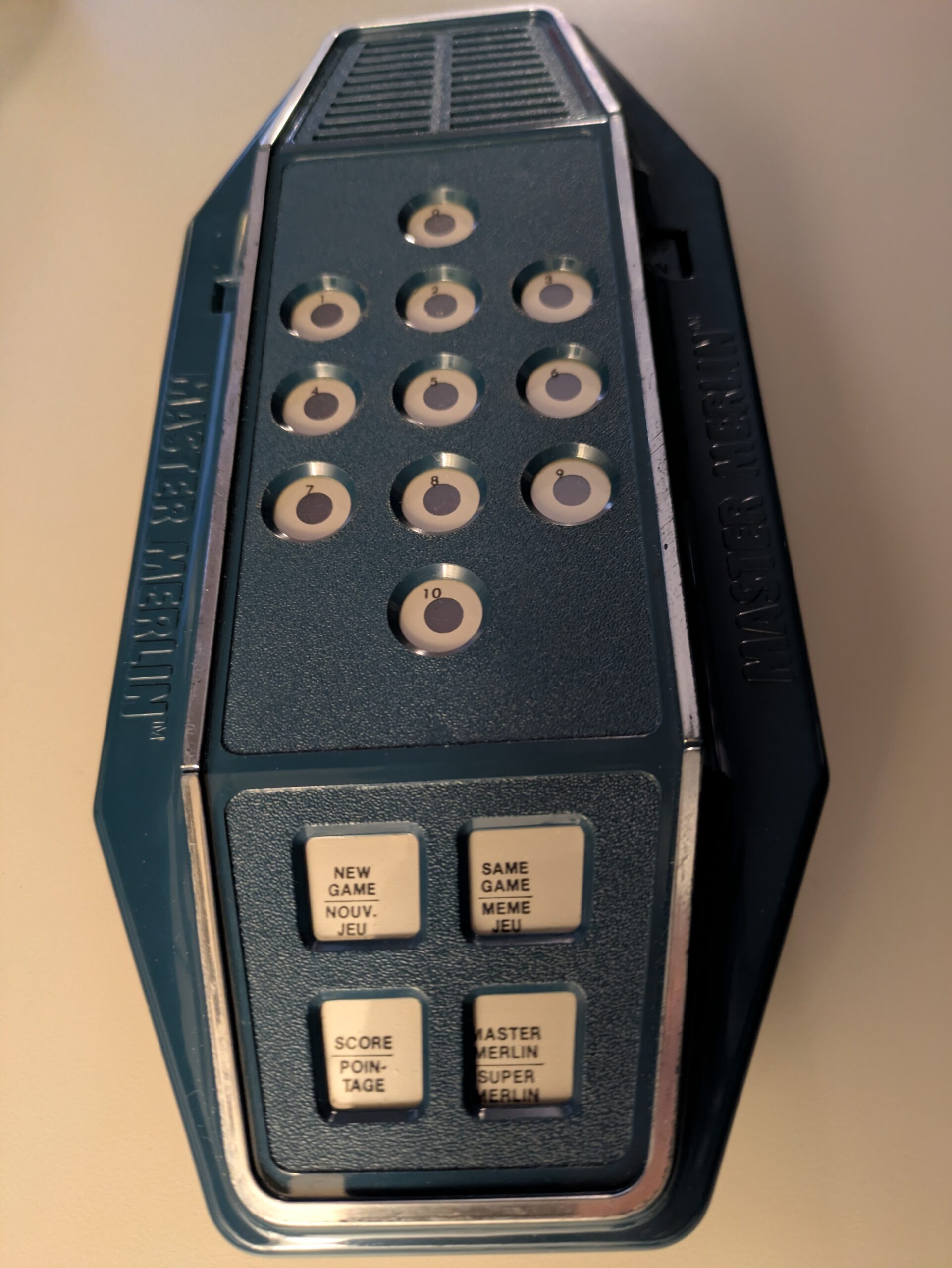
- Manufacturer: Parker Brother’s
- Type: Electronic Toy
- Release Date: 1982
- Cost at release: $160 (adjusted for inflation)
- MIPS: 0.002 (~2 KIPS)
Hardware Specifications
- CPU: Single-chip 4-bit microcontroller (Texas Instruments TMS1000 / TMS1100 family, mask-programmed ROM)
- Display: 11 red LEDs arranged in a geometric “wizard board” pattern
- Input: 11 membrane push-buttons (numeric + function keys)
- Power: 6 × AA batteries (≈9 V total)
- Memory/Storage:
- On-chip ROM (fixed firmware; exact size undocumented, typically 1–2 KB for this class)
- On-chip RAM (tens of bytes, used for game state)
- Weight: ~0.45–0.6 kg
Operating System & Programming Languages
-
Operating System: None. It ran a fixed mask-programmed ROM on the TMS1000 microcontroller with no support for loading or switching software.
-
Supported Languages: None available to users. The firmware was written by engineers in microcontroller assembly language (and possibly supported by internal tooling or macros at Texas Instruments), but this code was mask-programmed at the factory and could not be changed, accessed, or extended by the owner.
Notables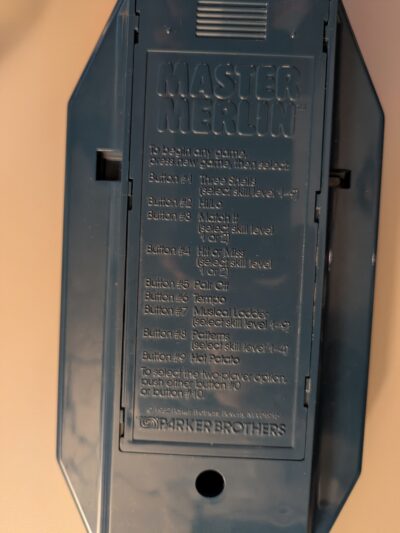
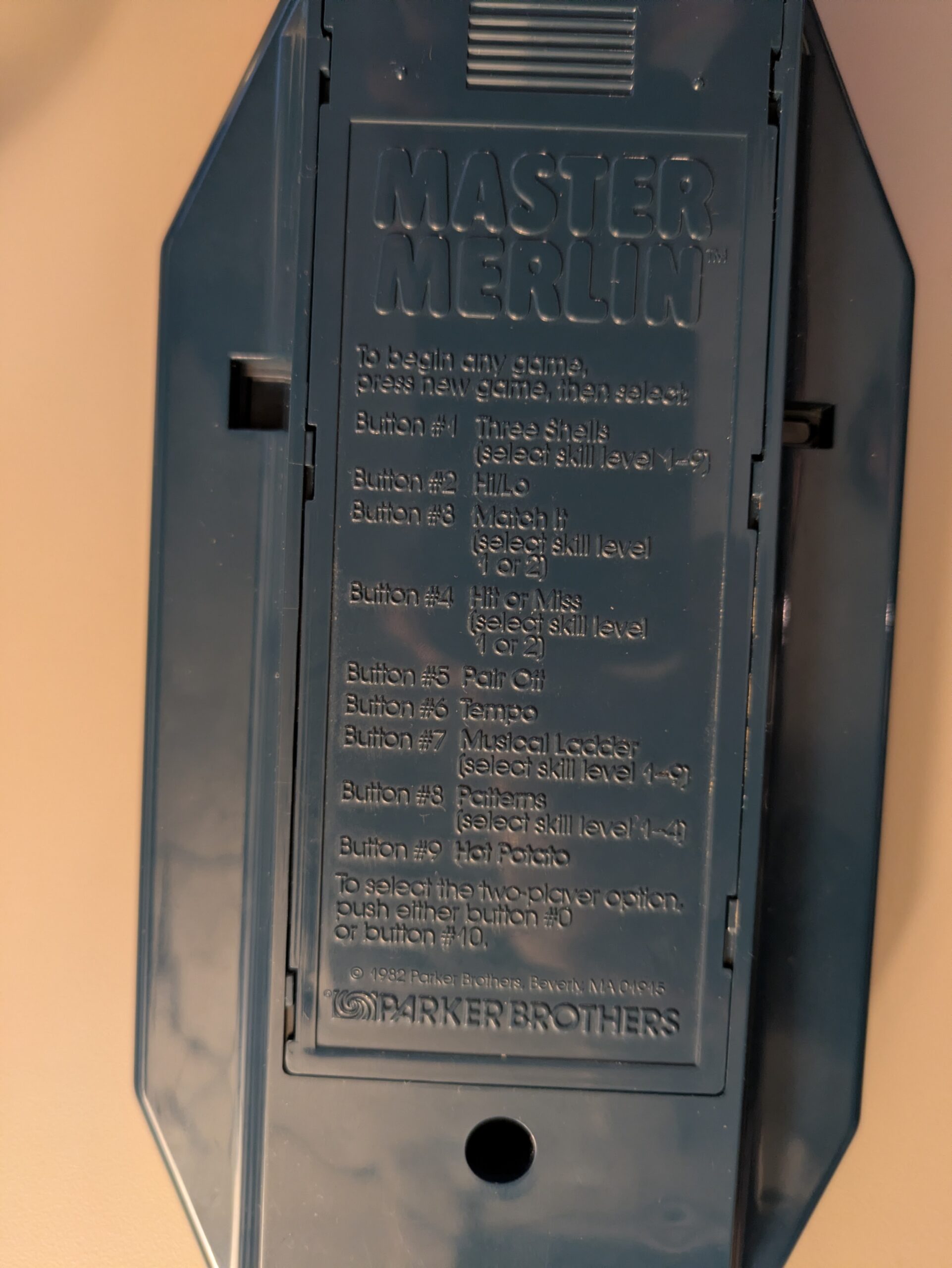
- One of the earliest mass-market consumer devices built entirely around a single-chip microcontroller, selling in the millions at a time when most people had never seen a “computer.”
- Helped normalize embedded computing by disguising a computer as a toy, years before PCs became common in homes or schools.
- Used LEDs and membrane keys only, no screen, showing how early computing relied on clever UI constraints rather than graphics.
- Based on the Texas Instruments TMS1000 family, the first commercially successful microcontroller, a cornerstone of modern embedded systems.
- Often remembered as a “thinking toy” or “electronic brain”, marketed more as a wizard than a machine.
- Frequently cited as a gateway device that sparked early interest in logic, patterns, and computational thinking, especially among children.
- The Merlin family sold several million units worldwide, making it far more widespread than most early personal computers.
- Represents the parallel history of computing, not programmable, but vastly more common, demonstrating that embedded computers shaped everyday life before PC’s did.
- The original (red) Merlin, “The Electronic Wizard (1978)”, became one of the best-selling electronic games of the 1970’s, widely credited with introducing the public to the idea of a “thinking machine” years before home computers were common, It won major toy awards and firmly established microcontrollers as viable, low-cost brains for consumer products.
Donated by: Andrew Miles