Netronics ELF II
[Vin17]
 The Netronics ELF II, released in 1978, was a pioneering, affordable microcomputer kit designed for hobbyists and tech experimenters. It featured the RCA 1802, one of the first commercially successful CMOS microprocessors, running at 1.76 MHz. The system came with 256 bytes of RAM expandable up to 64 KB via 4KB or 16KB static RAM expansion cards and offered a five-slot expansion bus for modular hardware upgrades.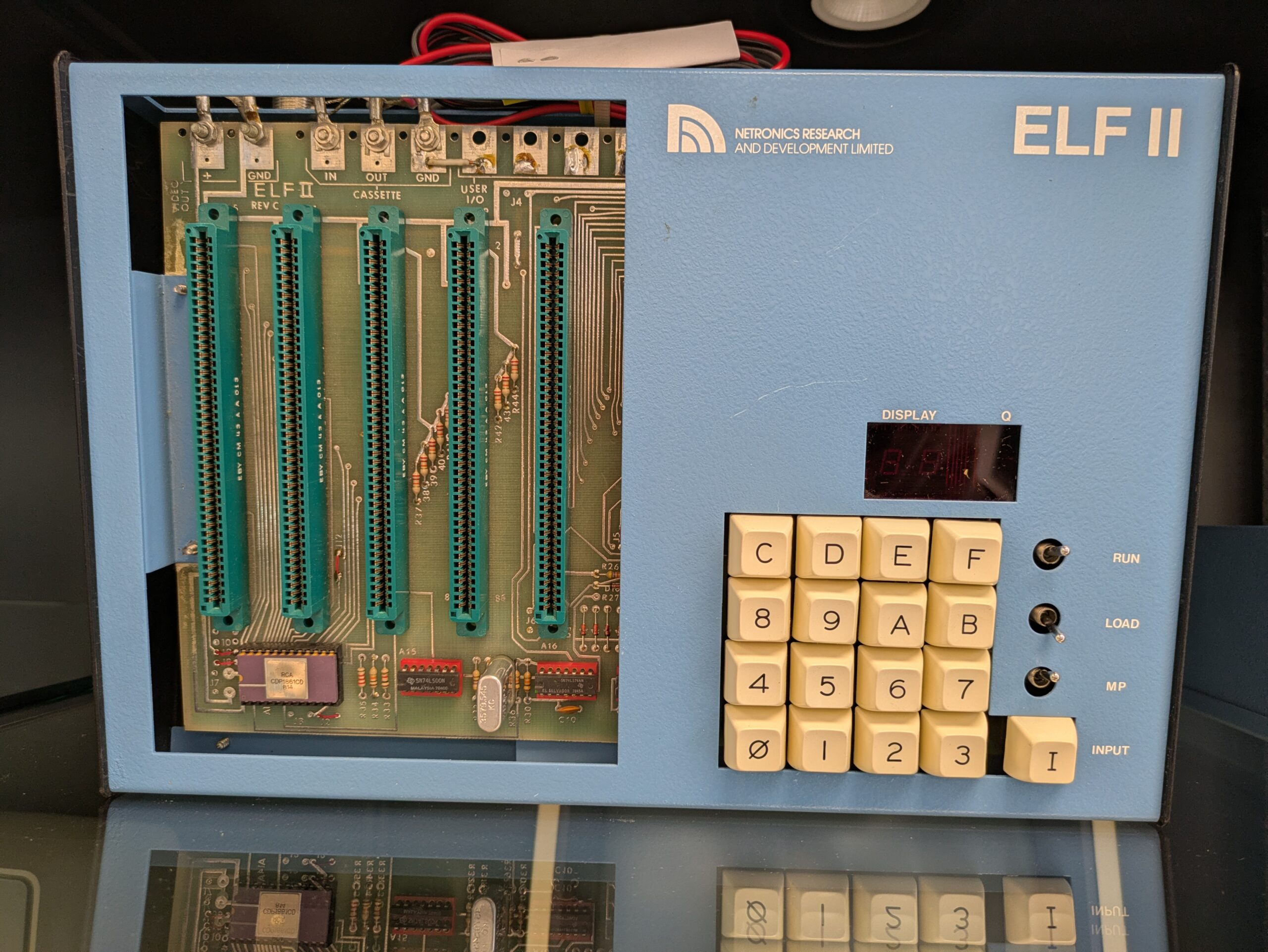
Key hardware features included a built-in hexadecimal keypad for input, a two-digit hexadecimal LED display, and DMA-based bitmap graphics at 64×32 pixels output to an NTSC TV using the CDP1861 “Pixie” graphics chip. Storage was supported via an optional cassette interface through the “Giant Board” expansion.
- Manufacturer: Netronics Research and Development Limited
- Type: Single-board computer
- Release Date: 1978
- Cost at release: USD $99.95 as a kit (CAD ~$525 adjusted for inflation)
- Cost with peripherals: Adding common peripherals-such as the “giant board” for cassette I/O ($59.95), a 4KB RAM board ($114.95), and a color video board-could bring the total system cost with peripherals to several hundred dollars, with a typical expanded setup exceeding $300 USD (CAD ~$1,550 adjusted for inflation)
- MIPS: 0.3 (300 KIPS)
Hardware Specifications
- CPU: RCA 1802 microprocessor running at 1.76 MHz.
- RAM: 256 bytes standard, expandable up to 64 KB.
- Expansion: 5-slot system bus for expansion cards.
- Display: Two-character hexadecimal LED display (TIL311), driven by CDP1861 “Pixie” video chip; optional video graphics support.
- Keyboard/Input: 20-key hexadecimal keypad using 74C923 encoder.
- Storage: Optional cassette interface via the “Giant Board” for data storage and loading.
Operating System & Programming Languages
- Operating System:
- Its software environment used a Monitor ROM for basic control and program entry, with available interpreters such as Tiny BASIC (integer-based) and Full BASIC (floating point using Reverse Polish Notation math with an RPN coprocessor chip).
- Programs were entered in machine code or loaded via cassette interface.
- Supported Languages:
- Machine language (entered via hexadecimal keypad).
- Tiny BASIC (integer BASIC interpreter).
- Full BASIC (floating point BASIC with Reverse Polish Notation math coprocessor).
- Assembly language programming for the RCA 1802.
Notables
- The Netronics ELF II used the RCA 1802 microprocessor, which is considered the first commercially successful CMOS (Complementary Metal-Oxide-Semiconductor) microprocessor.
- The RCA 1802 CPU was notable for its use in aerospace and telemetry markets (e.g., NASA’s Galileo spacecraft)
- Made early computing accessible to hobbyists for under $100, offering expandability and graphics capabilities that set it apart from other bare-bones trainer systems of the era
- The ELF II was an improved commercial version of the COSMAC ELF, replacing toggle switches with a hexadecimal keypad and adding a pre-etched PCB and expansion bus.
- It was one of the earliest affordable microcomputers to offer bitmap graphics via the CDP1861 “Pixie” chip.
- The “Giant Board” expansion provided cassette I/O and a small monitor ROM, enhancing usability.
- The system’s floating point BASIC used RPN syntax, reflecting the popularity of HP calculators at the time.
- It fostered a community of hobbyists and was supported by notable figures like Tom Pittman, who contributed Tiny BASIC and educational materials.
- Nicknamed simply “ELF II,” it is remembered as a practical and expandable early microcomputer that bridged the gap between barebones kits and more polished personal computers.
Donated by: Dr. Arlen Michaels