Osborne 1
[Vin18]

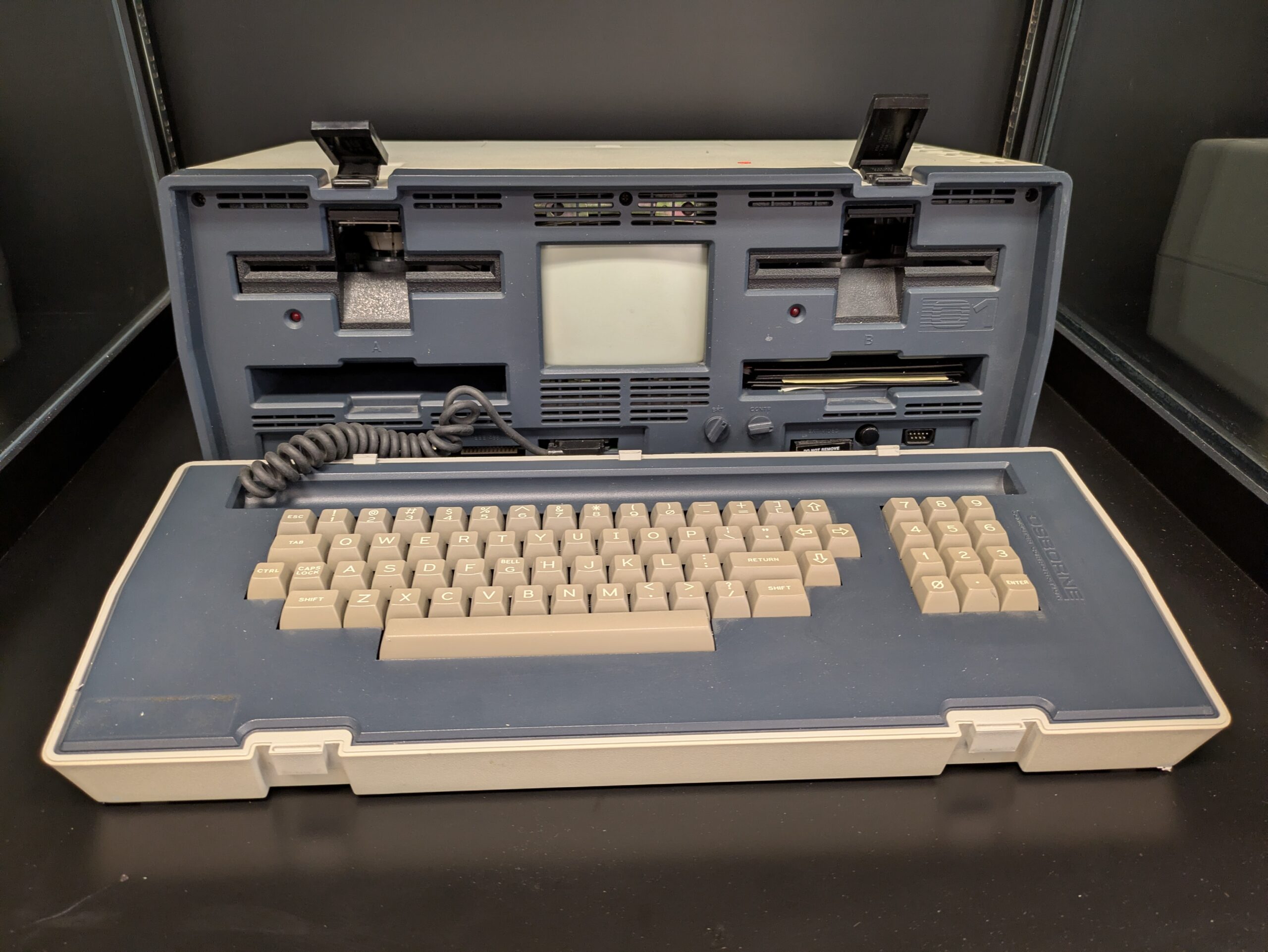
The Osborne 1, introduced in April 1981, was the first commercially successful portable computer, often called the first true “luggable” thanks to its 11 kg (25 lbs) suitcase-style design. Built for business users on the move, it packed a 5-inch monochrome CRT display, dual 5.25-inch floppy drives, and a detachable full-sized keyboard that latched onto the case to form a compact, transportable unit.
What truly set the Osborne 1 apart was its bundled software package, valued at nearly the cost of the machine itself, which helped establish the now-common industry practice of shipping valuable productivity software with hardware. Running CP/M 2.2 on a Zilog Z80A processor with 64 KB of RAM, it delivered serious business capability in a form that could fit under an airplane seat.
The Osborne claim to fame was making computing genuinely portable for professionals while setting a new price/performance benchmark. During its production run from 1981 to 1983, it sold over 125,000 units, at one point reaching 10,000 units per month, remarkable numbers for an early-1980s microcomputer.
- Manufacturer: Osborne Computer Corporation
- Type: Luggable (portable) computer
- Release Date: April 1981
- Cost at release: USD $1,795 (CAD ~$7,000 adjusted for inflation)
- MIPS: 0.57 (570 KIPS)
Technical Specifications
- CPU: Zilog Z80 @ 4 MHz
- RAM: 64 KB
- ROM: 4 KB
- Display: 5-inch monochrome CRT, 52 x 24 characters
- Storage: Dual 5.25-inch single-sided, single-density floppy drives (about 91 KB per disk)
- Ports: Parallel (IEEE-488), serial (RS-232C/modem)
- Keyboard: Detachable, full-sized with numeric keypad
- Weight: 24.5 lb (11.1 kg)
- Power: AC only (no built-in battery; aftermarket battery pack available)