Sun Ultra 25
[Vin181]
 The Sun Ultra 25 workstation, released around 2007, stands out in vintage computing history for its role as an entry-level SPARC/Solaris system that delivered reliable Unix performance in a compact tower form, succeeding models like the Sun Blade 1500 with upgrades to UltraSPARC IIIi processors (up to 1.34 GHz), support for 8 GB ECC memory, dual Gigabit Ethernet, and PCI Express graphics like the XVR-2500 for 3D visualization. Its claim to fame lies in bridging high-end workstation capabilities with affordability for sectors like education, CAD, scientific computing, and government, emphasizing dense SATA/SAS storage (up to 1 TB internally) and robust I/O for handling complex datasets. In a university museum context, it exemplifies Sun Microsystems’ late-era push for accessible RISC/Unix power before Oracle’s acquisition, making it valuable for demos of Solaris ecosystems and SPARC architecture’s legacy in networked computing.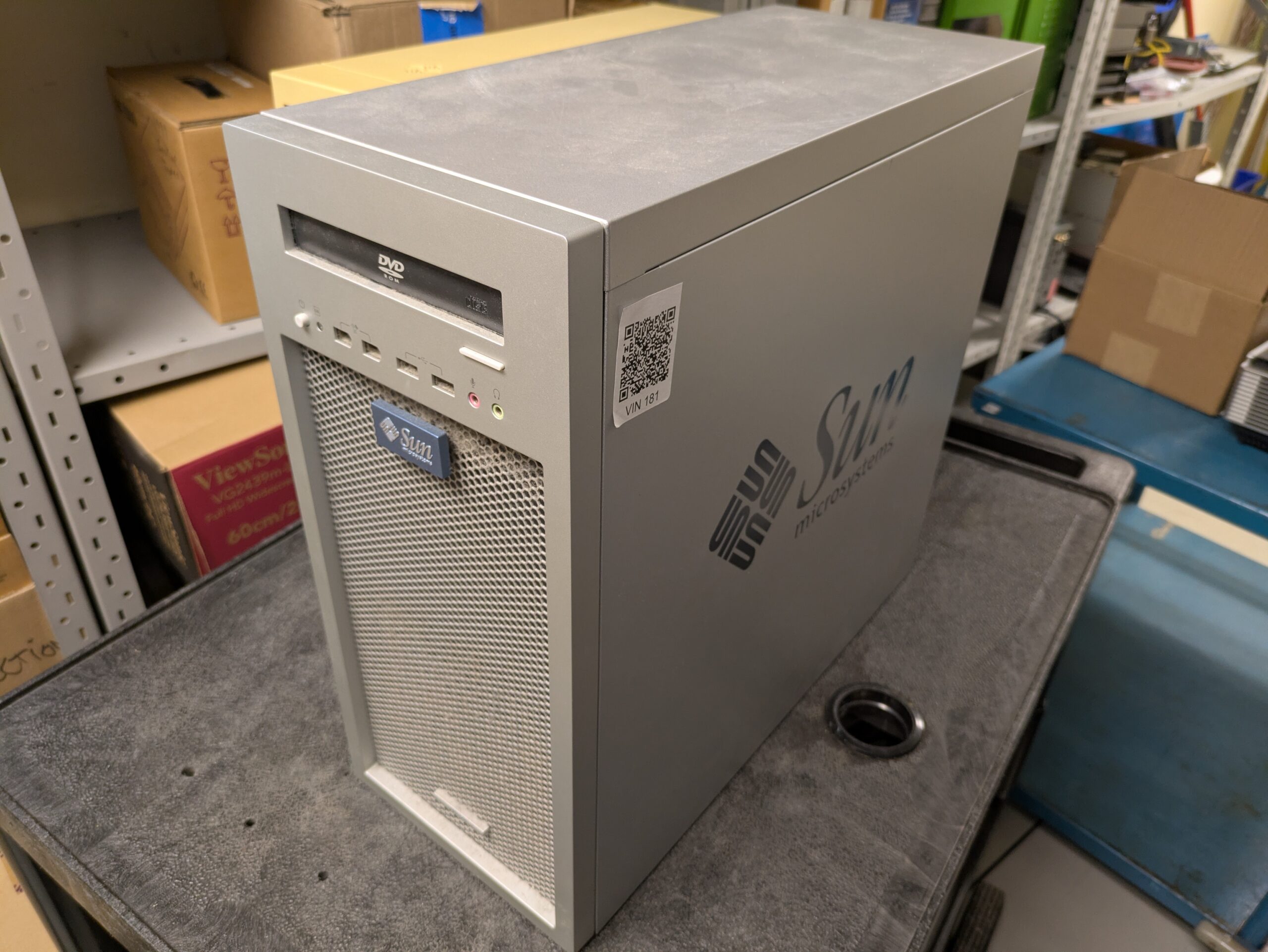
- Manufacturer: Sun Microsystems
- Model: Ultra 25
- Type: Desktop
- Released: 2007
- Original Pricing: ~$4,000 (adjusted for inflation in CAD)
- MIPS: 20-30
Hardware Specifications
- Processor: Single Sun UltraSPARC IIIi at 1.34 GHz with 1 MB L2 cache.
- Memory: Up to 8 GB ECC DDR-1 (4 DIMM slots).
- Expansion Slots: Two PCI-Express x16 (electrically x8), one PCI-Express x8 (electrically x4), two PCI-X 100 MHz/64-bit.
- Storage: Up to four internal SATA (250 GB each) or SAS (146 GB, 15K rpm) drives; standard 160 GB SATA.
- Networking: Dual 10/100/1000 Base-T Gigabit Ethernet ports.
- Graphics: Supported Sun XVR-300, XVR-2500 accelerators; up to two in PCI-Express slots.
- Ports: Six USB 2.0, two FireWire, two serial, AC97 audio.
- Optical Drive: DVD-ROM/CD-RW.
- Power Supply: 300-1000W.
- Weight: Approximately 15-20 kg
Operating System & Programming Languages
- O/S: Solaris 10
- Programming Languages:
- C/C++: Via Sun Studio 11 compiler suite, preinstalled for high-performance computing and Solaris development.
- Java: Through Sun Java Studio Creator, Enterprise, and NetBeans IDE, optimized for web and enterprise apps.
- Fortran: Included in Sun Studio 11 for scientific and engineering workloads common on SPARC systems.
- Unix shells like Bourne, Korn, and Bash for scripting; additional languages via packages, such as Python or Perl on Solaris.
Notables
- SUN computers were used extensively at the HPCVL (High Performance Computing Virtual Laboratory) and the Paradigm Laboratory at the School of Computer Science at Carleton University supervised by Dr. Jörg-Rüdiger Sack
- Entry-level SPARC workstation succeeding Sun Blade 150/1500, introducing PCI-Express graphics and SATA/SAS storage for denser, faster I/O in Unix environments.
- One of the last Sun-designed SPARC systems before Oracle acquisition, retaining binary compatibility for legacy Solaris apps in education, CAD, and defense.
- Emphasized N1 Grid Engine for clustering idle workstations, pioneering resource pooling in mid-2000s enterprise computing
Donated by: Dr. Jörg-Rüdiger Sack