Digital Equipment Corporation (DEC) VT100
[Vin184]
The Digital Equipment Corporation (DEC) VT100, introduced in August 1978, is a historically significant video terminal known for pioneering support of ANSI escape codes for cursor control and screen formatting. It was built around the Intel 8080 microprocessor, supported display modes of 80×24 or 132×14 characters, and offered advanced features like smooth scrolling and an extended character set for drawing forms on screen. The VT100 helped establish the ANSI standard as the industry norm for hardware video terminals, influencing many subsequent terminal designs and emulators. Variants such as the VT100-AA, which used 115 V main voltage, were common, and the terminal’s modular design improved maintainability. Over six million terminals in the VT series were sold.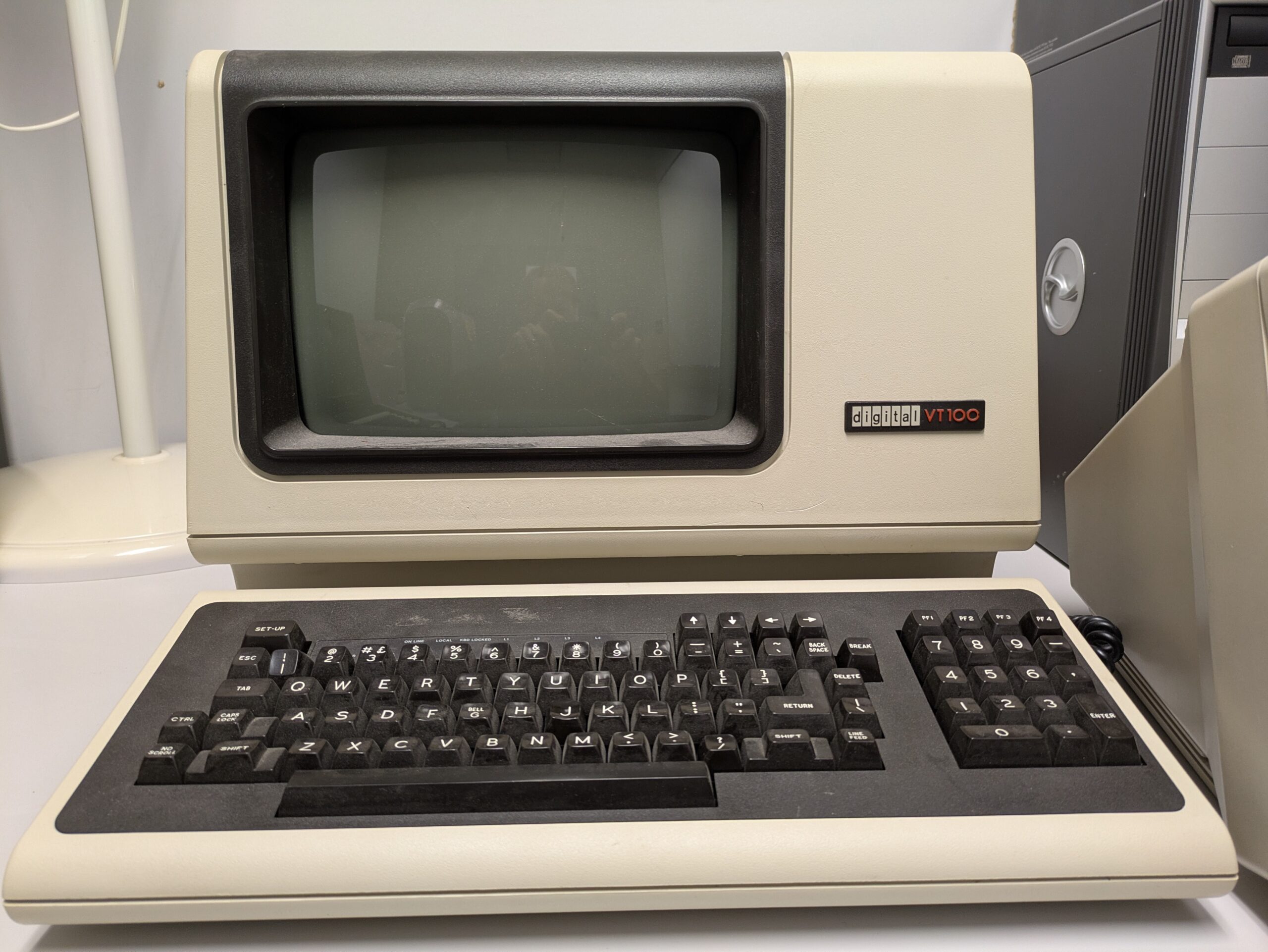
- Manufacturer: Digital Equipment Corporation (DEC)
- Type: Terminal
- Model: VT100
- Release Date: 1978
- Cost at release: USD $1,195 (CAD ~$6,250 adjusted for inflation)
- MIPS: 0.29 (290 KIPS)
Hardware Specifications
- CPU: Intel 8080 microprocessor running at approximately 2 MHz
- Display: Monochrome CRT capable of 80×24 or 132×14 characters
- Character Set: ASCII with extended graphical characters for drawing boxes and forms
- Memory: 4 KB to 64 KB of RAM, depending on configuration
- Communication: Asynchronous serial interface, typically RS-232
- Keyboard: Detachable, full-stroke mechanical keyboard specific to VT100
- Weight: Approximately 20 kg (44 lbs)
- Additional Features: Support for ANSI escape sequences, smooth scrolling, and programmable function keys
Operating System & Programming Languages
- OS: The VT100 terminal itself did not have an operating system like a general-purpose computer. It was a smart video terminal designed primarily for interfacing with larger host computers such as mainframes and minicomputers. The VT100 provided a user interface for remote systems rather than an independent computing environment.
- Programming Languages: As a terminal, the VT100 did not run computer languages or execute programs locally. Instead, it communicated with host systems which ran various operating systems and programming languages.
Notables
- First ANSI-Compatible Terminal: The VT100 was the first commercially successful terminal to support ANSI X3.64 escape codes, establishing the de-facto standard for hardware terminals and modern terminal emulators.
- Market Dominance: Over six million terminals in the VT series were sold, making DEC the leading terminal vendor during the 1980’s.
- “Smooth Scrolling” Innovation: The VT100 introduced smooth scrolling, where text moved gradually rather than jumping, which was visually impressive but slowed performance.
- Used in Space and Military: VT100 terminals were deployed in NASA space missions for real-time telemetry and various military applications due to their reliability.
- Gaming History: Early online gaming, including MUDs (Multi-User Dungeons), the precursors to MMOs, ran on VT100 terminals.
- Expandable Platform: The VT100’s modular case allowed DEC to create all-in-one systems like the VT103 (with LSI-11 minicomputer) and VT180 (with Z80 running CP/M).
- Speed Limitations: Despite supporting up to 19,200 baud, the VT100 couldn’t update the screen fast enough at 9,600 baud full throttle, requiring flow control like Xon/Xoff.
- Legacy in Modern Computing: ANSI escape sequences introduced by the VT100 are still used in Linux/Unix shells, SSH, and terminal emulators today.
Donated by: Dr Arlen Michaels