Texas Instruments Speak & Spell
[Vin186]
 Released in June 1978 by Texas Instruments, the Speak & Spell was a pioneering handheld electronic educational toy utilising the TMC0280 speech synthesizer chip with a vacuum fluorescent display for output. It ran embedded educational software from interchangeable ROM cartridges rather than conventional programming languages. It was a historic innovation leading the first use of solid-state speech synthesis in a toy and influencing later educational products and speech synthesis technology. Recognised as an IEEE Milestone, it also inspired music and circuit-bending culture and contributed to speech synthesis accessories in home computing.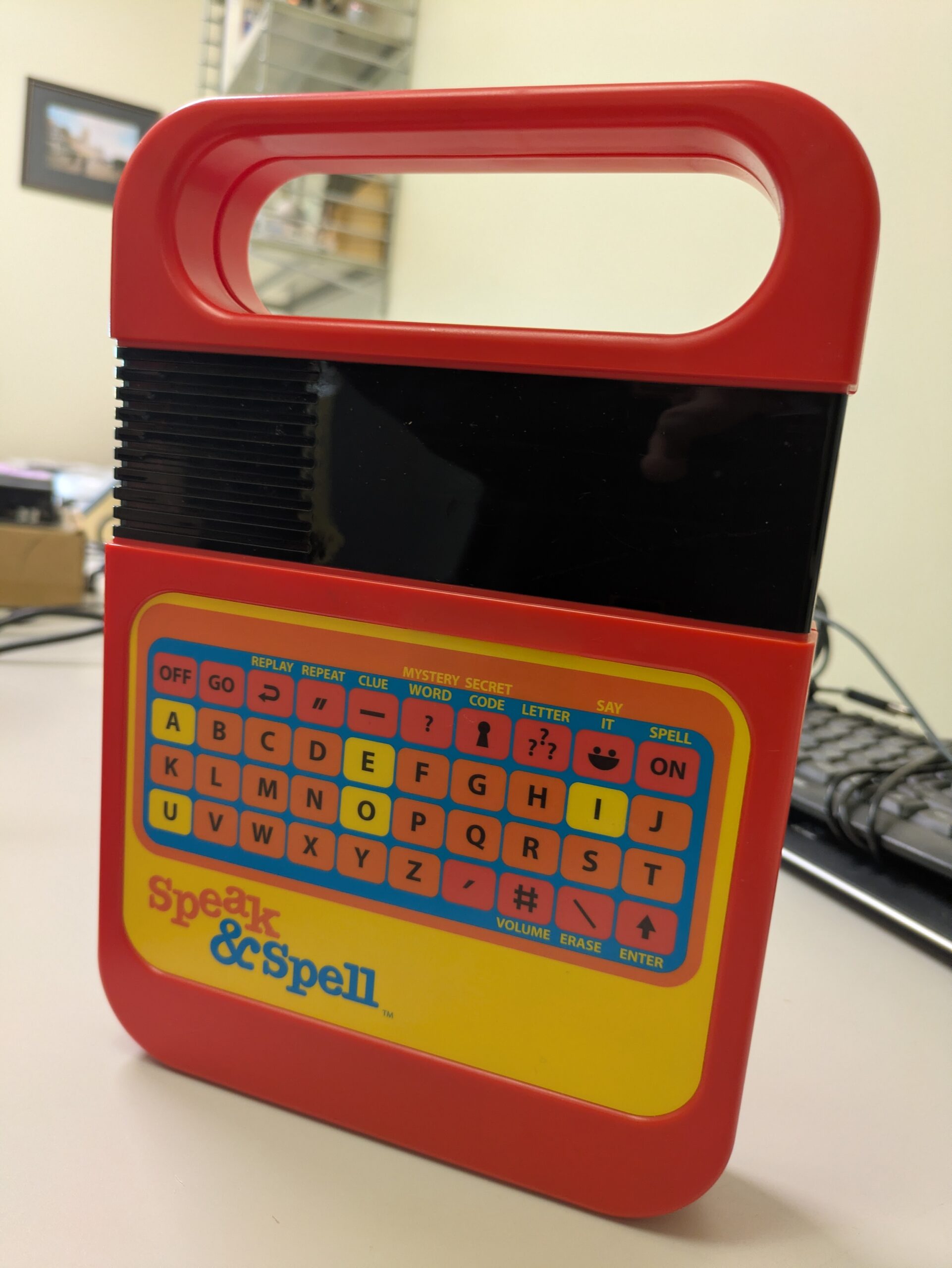
- Manufacturer: Texas Instruments
- Type: Electronic Toy
- Release Date: 1978
- Cost at release: $50 USD (~$250 CAD adjusted for inflation)
- MIPS: 0.05 (50 KIPS)
Hardware Specifications
- CPU (Speech Synthesizer): TI TMS5100 speech synthesis chip (approx. 320 kHz clock speed)
- Display: 8-character vacuum fluorescent display (VFD)
- Input: Membrane keyboard with alphanumeric keys and function keys
- Memory: ROM cartridge-based software expansion (no user-programmable RAM)
- Speech Technology: Linear Predictive Coding (LPC) speech synthesis
- Power: Operated on 4 C-cell batteries or optional AC adapter
Operating System & Programming Languages
-
Operating System: The Speak & Spell did not have a traditional operating system like general-purpose computers. Instead, it ran embedded firmware programmed directly into ROM chips, which controlled its educational spelling games and speech synthesis functions. This firmware was proprietary and purpose-built for the device.
-
Supported Languages: As a specialised handheld educational toy, Speak & Spell did not support programming languages nor user programmability. Its software was developed in low-level assembly or machine code specific to the Texas Instruments TMS5100 speech synthesizer and associated micro-controllers, but no high-level programming languages could be run or developed on it by users.
Notables
- Speak & Spell was one of the first consumer products to use solid-state speech synthesis through TI’s linear predictive coding (LPC) technology, a major innovation in digital speech at the time.
- It was among the earliest handheld electronic learning toys with interchangeable ROM cartridges for content expansion, pioneering cartridge-based embedded systems.
- The CPU used in the Speak & Spell, the TI TMS5100 speech synthesizer chip, is related to the Texas Instruments TMS1000 micro-controller family in that the TMS5100 was derived from the TMS1000 series architecture. The TMS1000 is a pioneering family of 4-bit micro-controllers introduced by TI in 1974, known as the first high-volume micro-controller integrating CPU, ROM, RAM, and I/O on a single chip. The TMS5100 extended the TMS1000 architecture by incorporating voice synthesis, while the TMS1000’s underlying technology provided the control and logic functionality.
- Nicknamed simply as “Speak & Spell,” it became an iconic symbol of 1980s educational tech and appeared famously in the movie E.T. the Extra-Terrestrial, cementing its cultural legacy.
- It received recognition as an IEEE Milestone for advancing speech synthesis technology in electronics.
- The device inspired later educational toys like Speak & Read and Speak & Math, expanding the category of speech-enabled learning tools.
- Unusually, it sparked creativity in circuit bending and DIY electronics communities due to its accessible speech synthesis chip.
Donated by: Andrew Miles