The Nintendo Family Computer (Famicom) was groundbreaking for bringing arcade-quality gaming into the home with its 8-bit hardware, innovative controllers, and expandable cartridge-based game library. Often called the grandfather of the NES, its claim to fame lies in launching iconic franchises like Super Mario Bros., The Legend of Zelda, and Metroid, shaping the platforming, RPG, and adventure genres while revitalizing the video game industry after the early 1980’s crash. Hugely popular in Japan, selling over 19 million units, the Famicom set the standard for home consoles worldwide and cemented Nintendo as a dominant force in gaming, profoundly influencing hardware design, game development, and popular culture.
Manufacturer: Nintendo (Nintendo Co., Ltd., Japan)
Operating System: It did not have a traditional operating system like a PC; it ran games directly from ROM cartridges, which contained the program and low-level routines needed to interface with the hardware. Each game essentially included its own minimal “OS” code to manage graphics, sound, and input.
Supported Languages:
6502 Assembly language – the standard for high-performance games.
C – used rarely, usually via cross-compilers on development systems; most commercial games were assembly for speed.
Family BASIC (1984, optional peripheral) allowed users to write programs directly on the Famicom using a BASIC dialect, enabling hobbyist coding and simple games.
Grandfather of the NES; design directly inspired the Nintendo Entertainment System for North America
Launched on July 15, 1983 in Japan, selling over 19 million units by the end of its lifecycle
Originally had hardwired red-and-white controllers, unusual compared to detachable black controllers of the era
Credited with revitalizing the video game industry in Japan after the early 1980’s crash
Introduced peripherals like Family BASIC keyboard and Famicom Disk System for rewritable floppy games
Home to first releases of Super Mario Bros., The Legend of Zelda, Metroid, and Dragon Quest
Sometimes nicknamed “arcade in your living room” for bringing arcade-quality games home
One of the first consoles to support expansion chips on cartridges, enabling larger, more complex games
Advertised with bright, playful campaigns emphasizing family fun and revolutionary graphics and sound; famous 1983 TV ads showed kids controlling on-screen characters with arcade-like excitement
Landmark in home entertainment computing, bridging consumer electronics and interactive software design
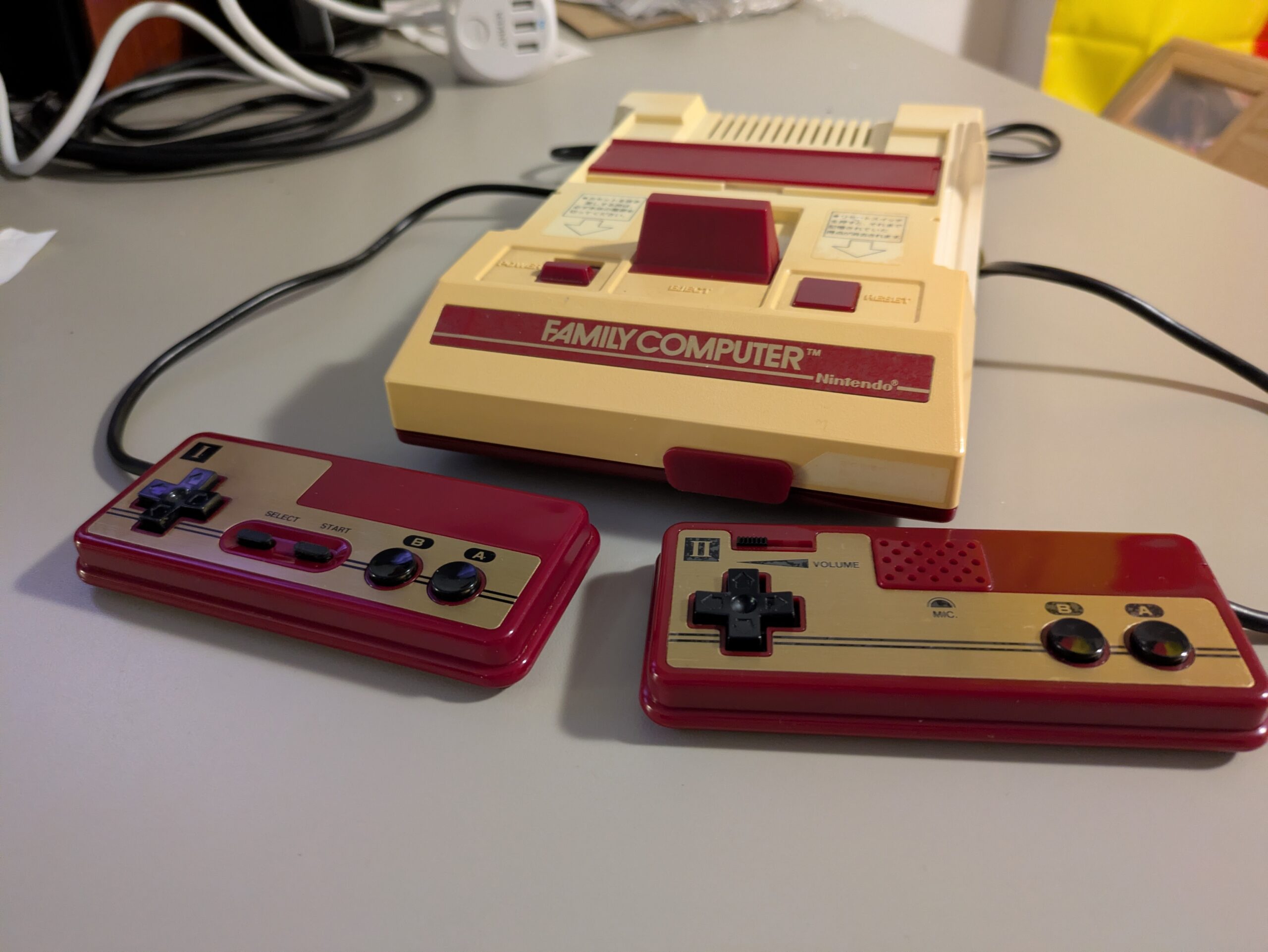 Often called the grandfather of the NES, its claim to fame lies in launching iconic franchises like Super Mario Bros., The Legend of Zelda, and Metroid, shaping the platforming, RPG, and adventure genres while revitalizing the video game industry after the early 1980’s crash. Hugely popular in Japan, selling over 19 million units, the Famicom set the standard for home consoles worldwide and cemented Nintendo as a dominant force in gaming, profoundly influencing hardware design, game development, and popular culture.