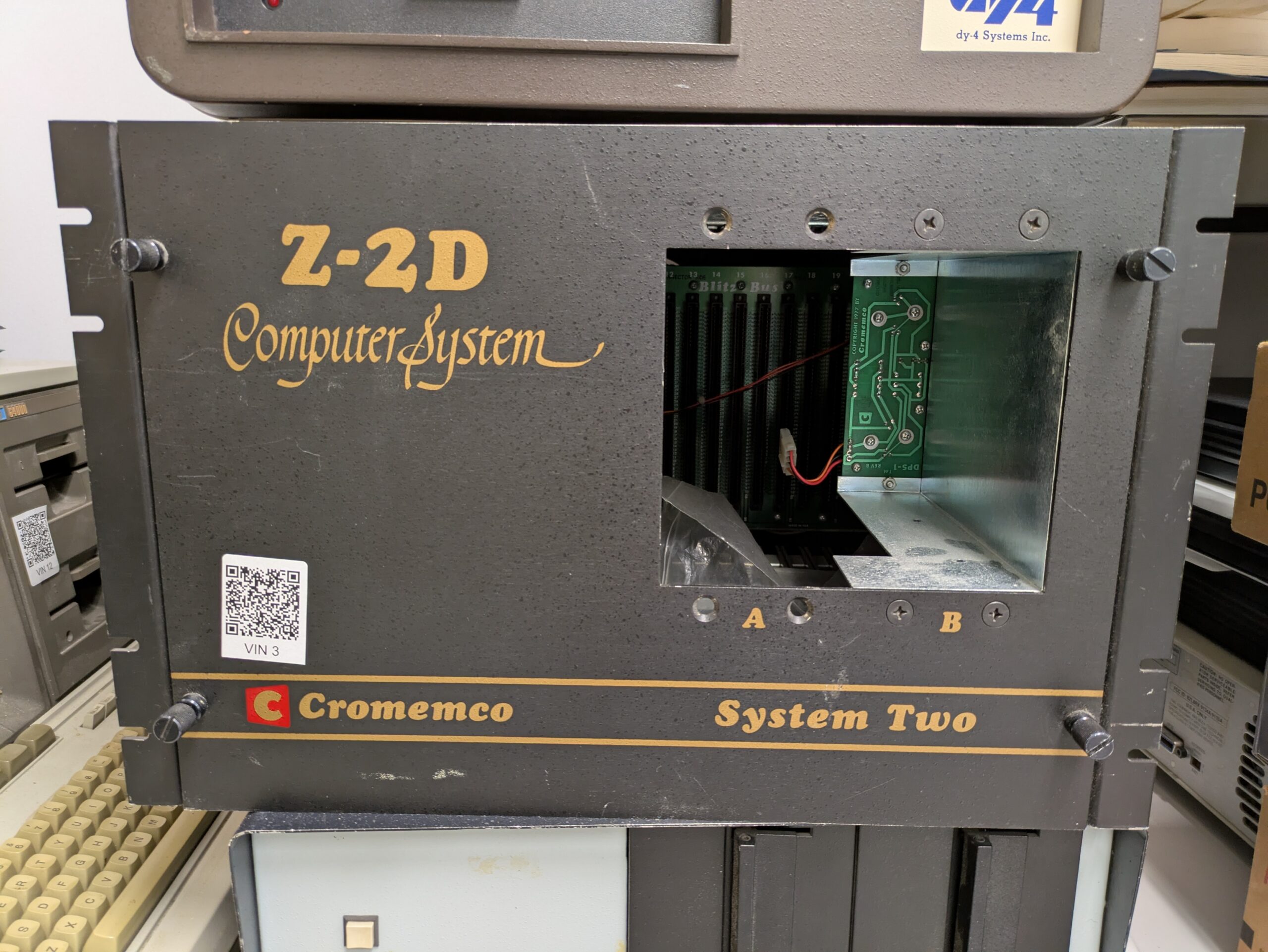
Cromemco Z-2D
[Vin3]
The Cromemco Z-2D, introduced in 1977, was a pioneering microcomputer notable for its robust modular design, use of the Zilog Z80 processor, and especially its built-in dual 5¼-inch floppy disk drives—an advanced feature at the time that provided substantial data storage and flexibility. Its claim to fame was its exceptional reliability, expandability (supporting up to 21 S-100 bus cards), and adoption in demanding professional, scientific, and military environments, such as the Chicago Mercantile Exchange and the U.S. Navy’s Aegis Combat System, which established Cromemco as a leader in early microcomputing. While not a mass-market consumer machine, the Z-2D was highly respected among professionals and enthusiasts. 
- Manufacturer: Cromemco Inc.
- Type: Rackmount computer
- Release Date: 1977
- Cost at release: $3,990 (~$20,000 adjusted for inflation)
- Cost with peripherals: including dual floppy drives and controllers USD $8,000 (CAD ~$40,000 adjusted for inflation
- MIPS: 0.07 MIPS (70 KIPS)
- Hardware Specifications
-
- CPU: Zilog Z80 microprocessor, 4 MHz
- Memory: Standard 64 KB RAM (expandable via S-100 bus)
- Storage: Two internal 5¼-inch double-density floppy disk drives
- Motherboard: S-100 bus with up to 21 expansion slots
- Case: Sturdy, industrial-style all-metal rack-mountable chassis
- Ports: TU-ART dual serial and parallel interface board
- Operating System & Programming Languages
-
- Operating System:
- CP/M (Control Program for Microcomputers)
- Cromemco DOS (CDOS), an enhanced derivative of CP/M
- Cromix, a Unix-like multi-user operating system (supported on later or expanded Z-2D systems)
- Supported Languages:
- BASIC (including disk BASIC and multi-user BASIC)
- FORTRAN IV (and FORTRAN 77 on later systems)
- COBOL
- Pascal
- C (notably for Cromix and advanced development)
- Macro Assembler
- RATFOR, LISP, RPG-II (available on some Cromemco systems and through CP/M compatibility)
- Notables
-
- The Cromemco Z-2D was sometimes nicknamed the “System Two,” distinguishing it from earlier models.
- It featured a robust, industrial metal chassis and was known for its reliability and quiet, stable S-100 bus operation—qualities rare among early microcomputers.
- The Z-2D’s switch-selectable CPU speed (250 or 500 ns cycle time) was unusual for its era, allowing compatibility with a wide range of S-100 expansion cards.
- Its dual 5¼-inch floppy drives (the “D” in Z-2D) provided significant storage and enabled the use of more complex applications, a major advantage over tape-based systems.
- The Z-2D was available both as a kit and fully assembled, appealing to both hobbyists and professionals.
- It was widely used in scientific, financial, and military applications, including the Chicago Mercantile Exchange (where it processed every trade for a decade) and the U.S. Navy’s Aegis Combat System.
- Cromemco’s Z-2D helped pioneer the use of microcomputers in mission-critical environments, paving the way for later multi-user and Unix-like systems.
- Its modularity—supporting up to 21 S-100 expansion cards—set a benchmark for expandability in early computing.
- The Z-2D’s legacy is its role in establishing microcomputers as reliable, professional tools for business, science, and government, rather than just as hobbyist devices.
Share: Twitter, Facebook
Short URL:
https://carleton.ca/scs/?p=19721