Exidy Sorcerer
[vin33]
The Exidy Sorcerer, released in 1978, was notable for its advanced-for-the-time Zilog Z80 processor, high-resolution monochrome graphics, and innovative use of ROM cartridge “Pacs”-which allowed instant software loading and easy support for foreign languages through programmable character sets. Its claim to fame was its versatility, CP/M compatibility, and international appeal, particularly in Australia and the Netherlands, where it developed strong user communities and found greater popularity than in North America. While its commercial success was modest (about 20,000 units sold), the Sorcerer played an important role in early home computing by bridging the gap between hobbyist and business use.
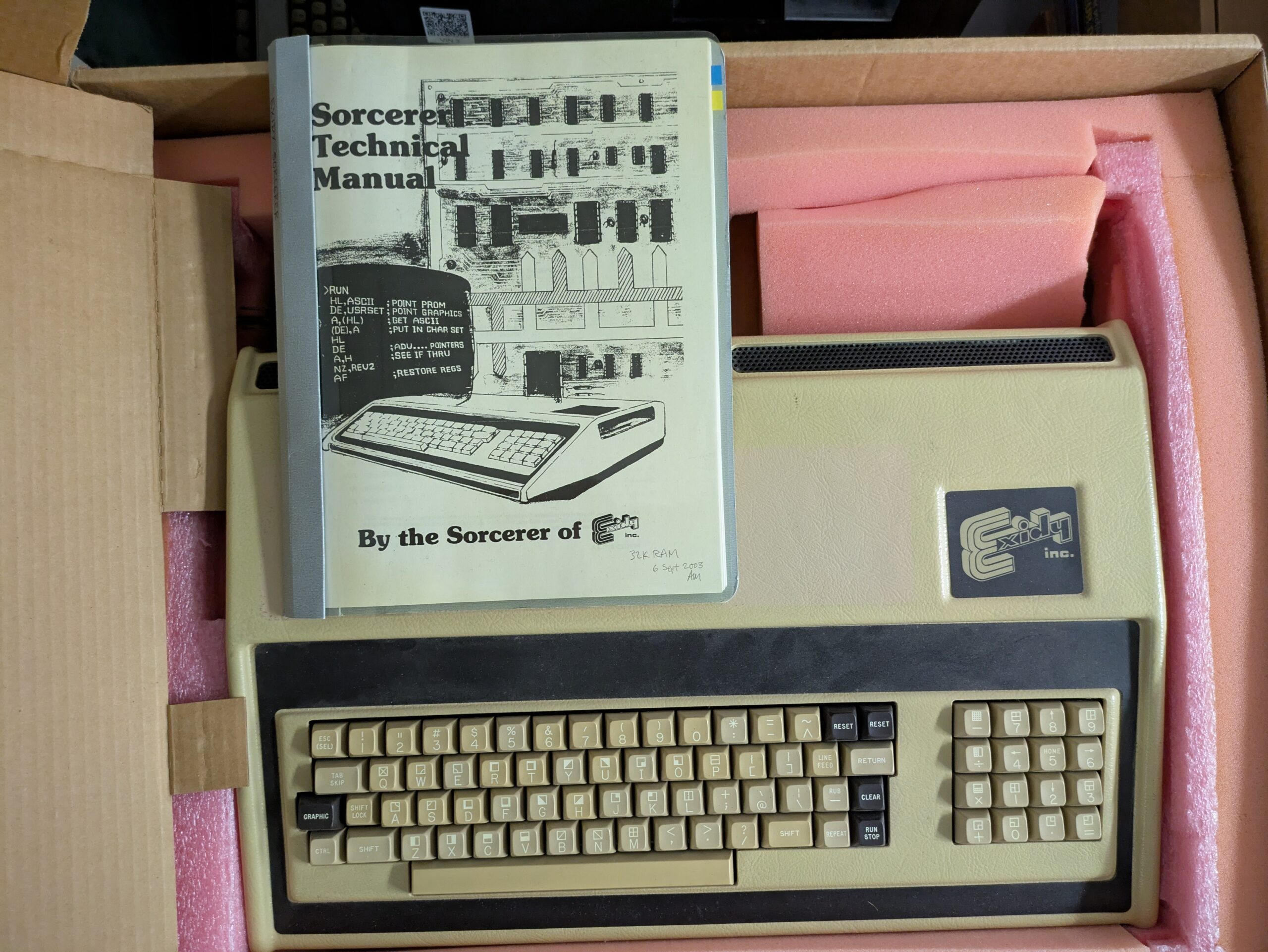
- Manufacturer: Exidy Inc.
- Type: Home computer
- Model: DP1000-1
- Release Date: 1978
- Cost at release: USD $895 as a kit (CAD ~$4,650 adjusted for inflation)
- Cost with peripherals: A fully configured system with the “Video/Disk” monitor and dual-disk drive cost $3,890 USD ($895 + $2,995 monitor/drive) (CAD ~$20,000 adjusted for inflation)
- MIPS: 0.5 (500 KIPS)
Hardware Specifications
- CPU: Zilog Z80, 8-bit, running at 2.106 MHz.
- RAM: Base models shipped with 8K, 16K, or 32K RAM options.
- ROM: 4 KB monitor ROM, expandable with ROM PAC cartridges (up to 8 KB additional).
- Display: Text: 64 × 30 characters, upper and lower case supported.
- Graphics: Pseudo 512 × 240 pixel monochrome graphics via programmable character set.
- Keyboard: Full-stroke, typewriter-style with 63 keys, including a dedicated “Graphics” key.
- Storage: Standard: External cassette recorder (1200 baud) for data storage.
- Optional: Floppy disk drives via S-100 expansion chassis.
- Expansion: 50-pin ribbon connector for S-100 bus expansion chassis (6 slots).
- Connectivity: Composite video output, Centronics parallel port, RS-232 serial port, cassette I/O, S-100 bus connector.
- Sound: None built-in; external sound options available
Operating System & Programming Languages
- Operating System: The Exidy Sorcerer initially ran a simple monitor program stored in ROM, which allowed users to control the machine at a low level and load programs from cassette or ROM cartridge. With the addition of floppy disk drives and the S-100 expansion chassis, the Sorcerer could run the CP/M operating system, making it compatible with a wide range of business and development software of the era.
- Supported Languages: Microsoft BASIC (provided via ROM cartridge), FORTRAN, and COBOL, with additional languages such as assembly and others available through CP/M and cassette or disk loading
Notables
- The Exidy Sorcerer was the first home computer with a ROM cartridge port for instant program access, using repurposed 8-track tape shells for its “ROM-PACs”.
- Its programmable character set allowed users to redefine characters for custom graphics and foreign language support, a feature that won it a “Most Innovative” award at CES.
- The Sorcerer’s high-resolution graphics (pseudo 512×240) were superior to most contemporaries, making it popular for early graphical applications.
- It was one of the first computers to license Microsoft BASIC directly from Microsoft, before the company moved to Seattle.
- The Sorcerer was sometimes nicknamed the “smart-ALEC” after being rebranded by Dynasty Computer Corp. in the U.S..
- While not a major success in North America, it gained a strong following in Europe (especially the Netherlands) and Australia, where it was distributed by Dick Smith Electronics and CompuData, and even served as the basis for the Dutch Tulip computer line.
- Its full-stroke keyboard and inclusion of lower-case characters set it apart from many early competitors.
- The Sorcerer is now a coveted collector’s item due to its rarity and innovative features.
- The system’s concept originated with Paul Terrell, founder of the Byte Shop, a pioneering early computer retailer
Donated by: Dr. Arlen Michaels