Heathkit H-100
[vin34]
The Heathkit-Zenith Z-110, introduced in 1982, was notable for its dual-processor architecture (Intel 8085 and 8088), allowing it to run both CP/M and a version of MS-DOS called Z-DOS, and for its advanced graphics capabilities, which surpassed many contemporaries and made it popular for early CAD applications. Its claim to fame was its versatility, expandability (with S-100 slots), and its position as a bridge between the kit-computer era and factory-assembled personal computers, reflecting a shift in the home and business computing markets. While it was quite popular in the US, especially in educational and business settings.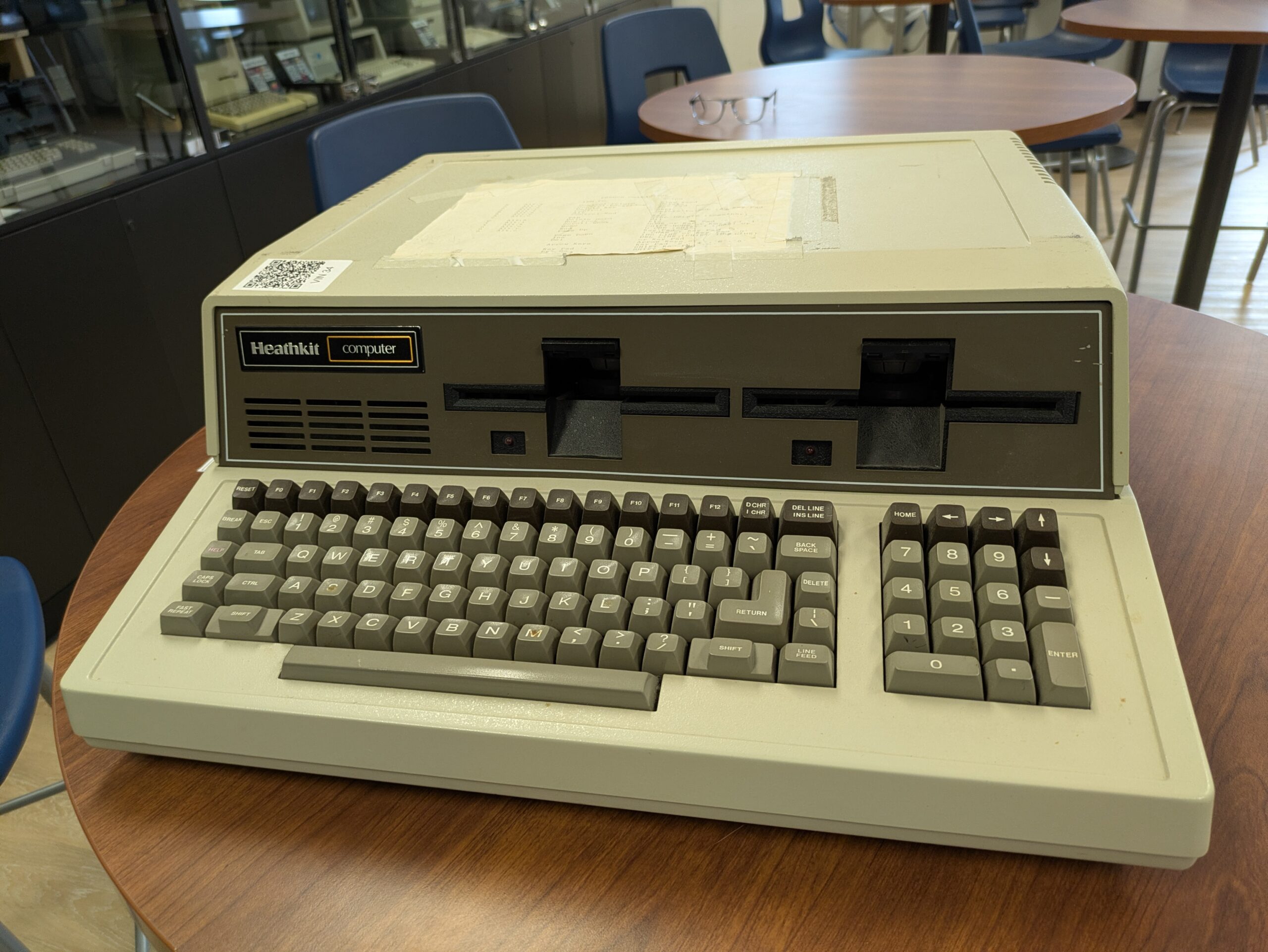
- Manufacturer: Heathkit (kit version), later sold assembled by Zenith Data Systems
- Release Date: 1982
- Type: Desktop Computer
- Model: H-100-I (Kit version of Z-100)
- Cost at release: USD $3,499 (CAD ~$12,800 adjusted for inflation)
- Cost with peripherals: USD $5,499 (CAD ~$20,000 adjusted for inflation)
- MIPS: 0.37 (370 KIPS)
Hardware Specifications
- CPU: Dual 8085 and 8088
- Memory: 128 KB, expandable to 192 KB on the mainboard and up to 768 KB using S-100 expansion cards.
- Storage: Two 320 KB 5.25-inch floppy disk drives
- Display: 640×225 pixel bitmap display, supporting 8 colors (low-profile model) or up to 8-level greyscale (all-in-one model); advanced graphics for its era.
- Video RAM: Up to 64 KB dedicated for graphics.
- Expansion: Five S-100/IEEE-696 expansion slots for peripherals and additional memory.
- Ports: Two RS-232 serial ports, one Centronics parallel printer port, and a light pen port.
- Power: 300-watt switching power supply.
Operating System & Programming Languages
-
Operating System:
- Z-DOS (a non-IBM compatible version of MS-DOS, sometimes simply called “Zenith’s version of MS-DOS”)
- CP/M-85 (for the 8085 processor) and CP/M-86 (for the 8088 processor).
- Concurrent CP/M-86 and UCSD Pascal
-
Supported Languages:
-
Microsoft BASIC (BASIC-80 for CP/M-80, Z-BASIC for Z-DOS)
-
Microsoft FORTRAN-86 (for Z-DOS)
-
Microsoft COBOL-86 (for Z-DOS)
-
Microsoft Pascal (for both CP/M and Z-DOS)
-
Microsoft BASCOM-86 (for Z-DOS)
-
Assembly language (with available assemblers and editors for CP/M and Z-DOS environments)
-
UCSD Pascal and other languages available for CP/M systems
-
Notables
- The Z-110 was nicknamed the “low-profile” model of the Z-100 series, designed without an internal monitor for flexibility and compactness.
- It featured a rare dual-processor setup (Intel 8085 and 8088), allowing it to run both CP/M and a non-IBM compatible version of MS-DOS (Z-DOS), which was unusual for its time.
- Its graphics capabilities were advanced, supporting 640×225 resolution with 8 colors-superior to IBM’s CGA and even rivaling the Hercules Graphics Card-making it popular for early CAD and graphics applications.
- The Z-110 used the S-100 bus, a hallmark of earlier hobbyist systems, but was sold both as a kit (Heathkit) and pre-assembled (Zenith), bridging the gap between DIY and commercial PCs.
- While not fully IBM PC compatible, it could run some generic MS-DOS software, and third-party solutions existed to improve compatibility.
- Its place in computing history is as a transitional machine: robust, versatile, and influential in both educational and professional settings during the early 1980s
Donated by: Dr. Arlen Michaels