Compaq Plus

The Compaq Plus, introduced in October 1983, was a notable evolution of the original Compaq Portable, distinguished by its built-in 10 MB hard disk drive-an innovation that greatly enhanced its utility for business users. Its claim to fame was being among the very first IBM PC-compatible portable computers, with near-complete software compatibility thanks to a legally reverse-engineered BIOS. The Compaq Plus played a crucial role in legitimising the IBM PC clone market, breaking IBM’s near-monopoly and accelerating the spread of PC-compatible systems. It was highly popular for its time, with the original Portable (on which the Plus was based) selling over 53,000 units in its first year and setting a record for first-year sales by a U.S. company.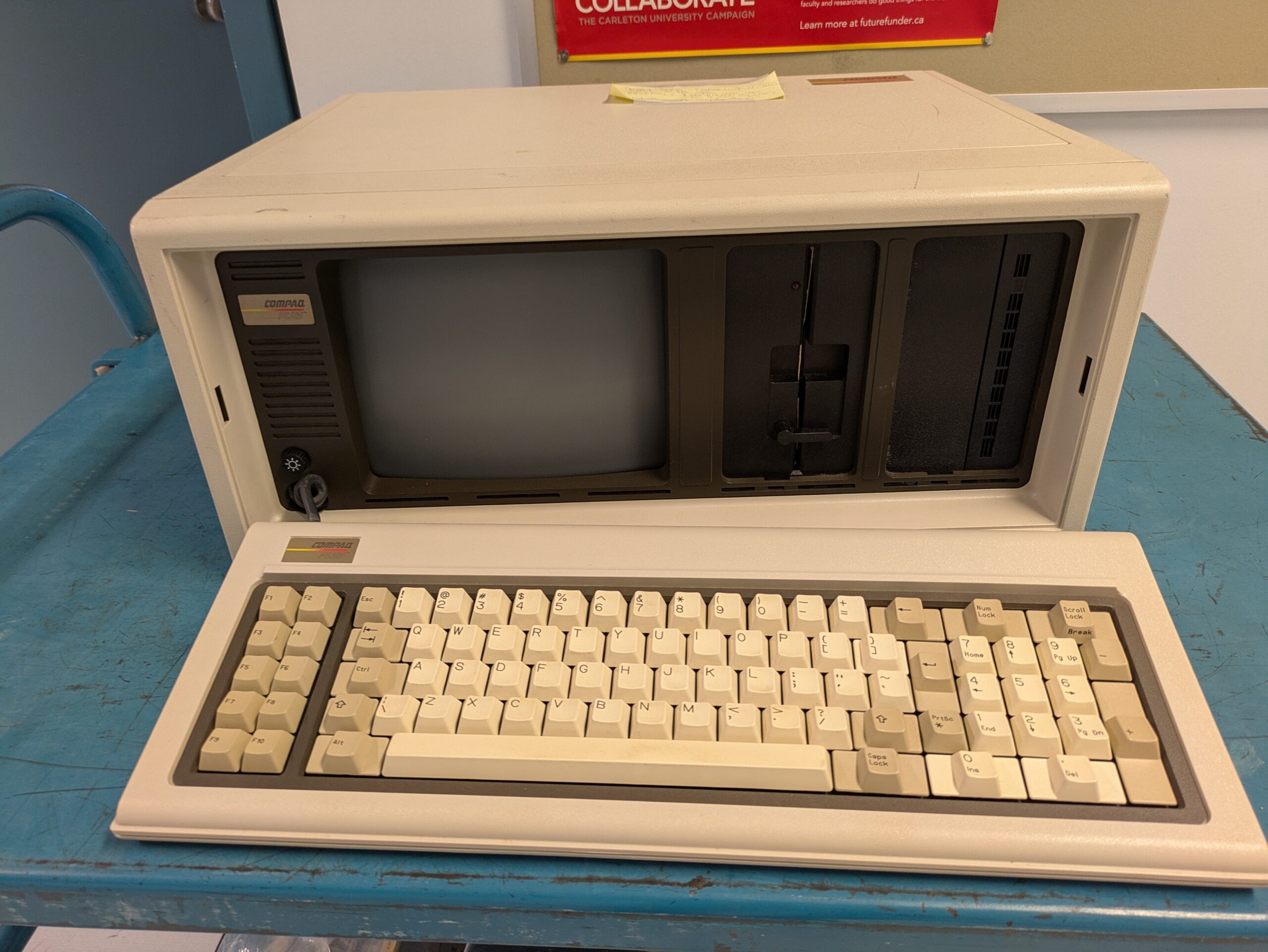
- Manufacturer: Compaq Computer Corporation
- Type: Luggable (portable) computer
- Release Date: October 1983
- Cost at release: USD $3,590 (CAD ~$12,000 adjusted for inflation)
- MIPS: 0.33 (330 KIPS)
Hardware Specifications
- CPU: Intel 8088 CPU @ 4.77 MHz
- Memory: 128 KB standard, expandable to 640 KB
- Storage: 10 MB MFM hard disk, one 5.25″ double-sided double-density floppy drive (360 KB)
- Display: Built-in 9″ green (monochrome) CRT monitor
- Graphics: CGA-compatible video card (hybrid MDA/CGA)
- Weight: 28 lbs (13 kg)
- Keyboard: Detachable, “foam and foil” Keytronics keyboard
- Ports: Parallel, CGA, and others for expansion
- Case: Designed to be carried as luggage, with a handle and detachable keyboard
Operating System & Programming Languages
- Operating System: MS-DOS (Compaq DOS 1.12 or 2.00), which was fully compatible with IBM PC DOS; later versions supported hard disk operations. Could also run CP/M-86 and other IBM PC-compatible operating systems.
- Supported Languages:
- Supported all languages available for IBM PC compatibles, including BASIC, C, Pascal, FORTRAN, COBOL, and others, as long as they ran under MS-DOS.
- Popular compilers and interpreters of the era (such as Microsoft BASIC, Turbo Pascal, and C compilers) ran on the Compaq Plus.
Notables
- The Compaq Portable, released in March 1983, was the first fully IBM PC-compatible luggable (portable) computer. Its engineers achieved this by reverse-engineering the IBM PC BIOS, allowing the Compaq Portable to run essentially all IBM PC software-a feat that earlier portables had not fully accomplished
- Nicknamed the “luggable” or “sewing machine” due to its suitcase-like design and portability.
- The Compaq Plus was the first portable fully IBM PC-compatible with a built-in hard disk, making it a practical business tool for mobile professionals. The Bytec Hyperion released their IBM compatible luggable computer a few months before the Compaq Portable.
- Its success helped break IBM’s dominance in the PC market by proving that legal, fully compatible clones were possible, leading to the explosion of the PC-compatible industry.
- Its BIOS was developed using a “clean room” technique, which became the industry standard for reverse engineering proprietary systems.
- While not uniquely Canadian, the Compaq Plus was widely adopted in Canada as part of the North American business computing boom.
Donated by: Carleton University’s School of Computer Science
Carleton University: This portable computer was in production the School of Computer Science