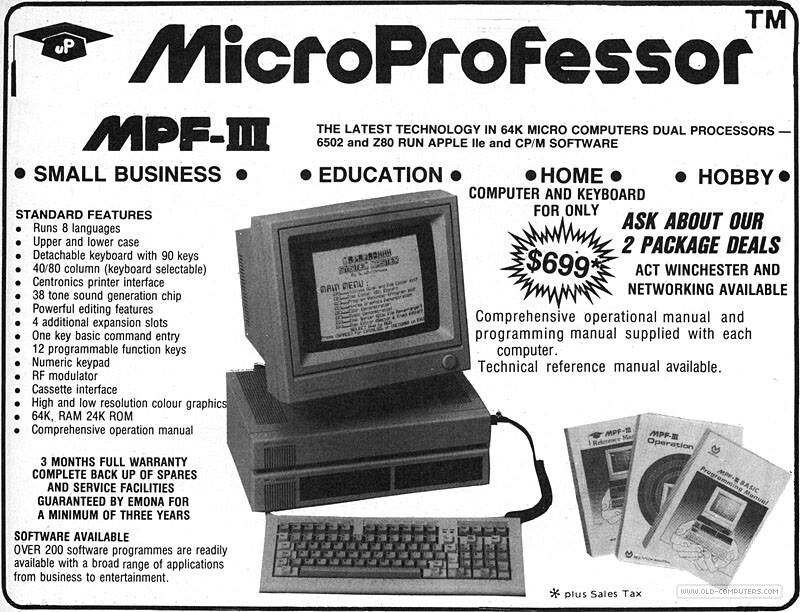
Multitech Micro-Professor MPF-III/310
[Vin 51]
The Multitech Micro-Professor MPF-III/310, introduced in 1983, was notable as one of the earliest Apple IIe clones and was produced by Multitech, the company that would later become Acer. Its standout features included partial Apple IIe compatibility, a MOS 6502 CPU, up to 64KB RAM, and expandability options such as an optional Z80 CP/M emulator card, allowing it to run both Apple DOS/ProDOS and CP/M software.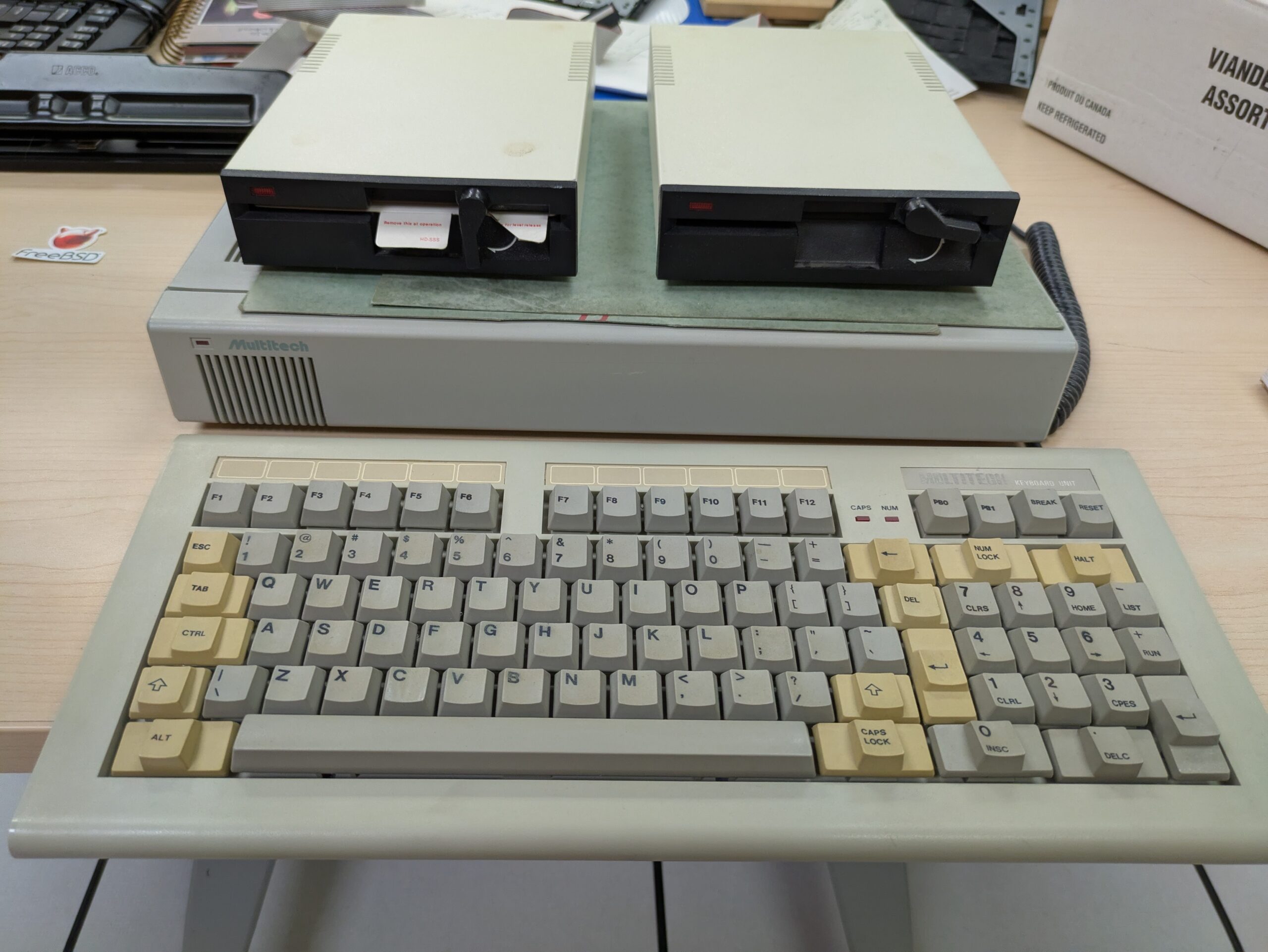
- Manufacturer: Multitech
- Type: Personal computer
- Release Date: 1984
- Cost at release: AUS $699 (CAD ~$2,400 adjusted for inflation)
- MIPS: 0.3 (300 KIPS)
Hardware Specifications
- CPU: MOS Technology 6502 CPU running at 1 MHz. Optional Z80 card for CP/M compatibility.
- Memory: 16 KB RAM standard, expandable up to 64 KB
- Display: 40-column text display, color graphics support
- Optional: Expansion slots for peripherals and cards
- Storage: Cassette and floppy disk storage support (5.25-inch drives)
- Keyboard: Keyboard with 53 keys (including function keys)
Operating System & Programming Languages
-
Operating System: Apple DOS 3.3 or ProDOS as its primary operating systems. With the optional Z80 CP/M emulator card, it could also run the CP/M operating system
- Supported Languages:
- Applesoft BASIC (built-in, including a Chinese-localized version on some models)
- MBASIC (MPF-III BASIC)
- Forth language
- Assembly language (via two-pass assembler and editor)
- Additional CP/M languages (such as Microsoft BASIC, COBOL, FORTRAN, and others) when using the Z80 card
Notables
- The MPF-III/310 was one of the first Apple IIe clones and was produced by Multitech, which later became Acer.
- It featured a unique Chinese-localized BASIC, using a Dragon symbol system for character input—an unusual capability for its era.
- The system was partially Apple IIe compatible but had custom ROMs and graphics routines, which meant not all Apple II software or games would run without modification.
- An optional Z80 CP/M emulator card allowed it to run CP/M software, expanding its versatility beyond typical Apple II clones.
- The MPF-III/310 is sometimes affectionately called the “Micro-Professor”—a nod to its educational roots and its predecessor, the MPF-1 Z80 training kit.
- Multitech intentionally wrote its own ROMs to avoid legal issues with Apple, a practice that foreshadowed Acer’s later approach in the IBM PC clone market.
- Although innovative, the MPF-III/310 remained a niche product and is now a rare collectible, notable for its role in early East Asian computing and for helping to launch Acer as a major global computer manufacturer
Donated by: Arlen Michaels