Timex Sinclair 1000
[VIN53]
The Timex Sinclair 1000, launched in July 1982, was the first home computer in the U.S. to be sold for under $100, making it a landmark in affordable personal computing. Its most notable features included a compact, minimalist design with 2 KB of RAM (expandable to 16 KB), a membrane keyboard, and the ability to connect to a standard television for display, all powered by a Z80 CPU.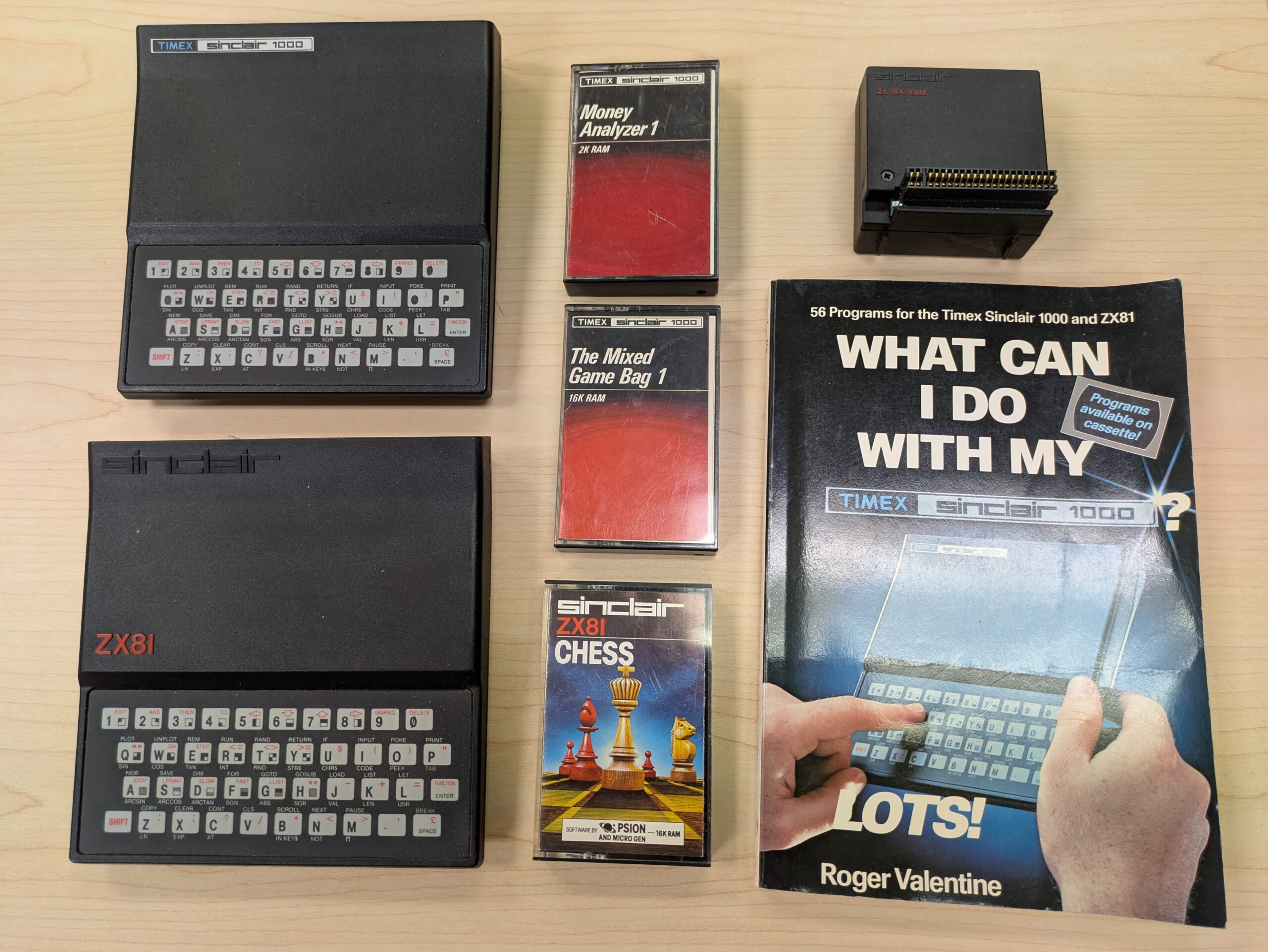
- Manufacturer: Timex Corporation, in partnership with Sinclair Research
- Type: Home computer
- Release Date: July 1982
- Cost at release: USD $99.95(CAD ~$360 adjusted for inflation)
- MIPS: 0.058 (58 KIPS) – theoretical max but ran much slower
Technical Specifications
- CPU: Zilog Z80A CPU running at 3.25 MHz
- RAM: 2 KB RAM (expandable to 16 KB with external module)
- ROM: 8 KB ROM with Sinclair BASIC interpreter
- Display: RF modulator for connection to standard TV, monochrome display (32 characters × 24 lines)
- Storage: Programs and data saved/loaded via standard cassette tape recorder
- Power: External 9V DC adapter
Operating System & Programming Languages
-
Operating System: Sinclair BASIC
- Supported Languages:
- Z80 assembly language/machine code
- Forth (including fig-FORTH and ZX-FORTH)
- Pascal (via third-party add-ons)
- BASIC compilers and assemblers
- BCPL (with add-ons)
- RPNZL (a FORTH-like language)
- Extended BASIC (with additional commands)
Notables
- Nicknamed the “T/S 1000,” it was the first home computer sold in the U.S. for under $100 and was advertised as “the first computer under $100”.
- The Timex Sinclair 1000 was known for its extremely limited performance. Its Z80A CPU ran at 3.25 MHz, but the BASIC interpreter was notably slow because the CPU had to handle both program execution and continuous screen updates, which reduced effective processing speed to about one quarter of its rated clock speed. With only 2 KB of RAM (most of which was used for the display buffer), running anything but the simplest programs required a RAM expansion, and even with more memory, performance in BASIC remained sluggish compared to other home computers of the era
- It was a slightly modified version of the Sinclair ZX81, adapted for North American TVs and with doubled onboard RAM.
- The T/S 1000 sparked a price war in the home computer market, forcing competitors like Commodore to drop prices and offer trade-in deals.
- Its membrane keyboard was widely criticized for being difficult to use, leading to a cottage industry of aftermarket keyboard upgrades and peripherals.
- The T/S 1000 used a unique “keyword” entry system for BASIC commands, streamlining programming for beginners.
- It had no sound and only black-and-white graphics, but inspired many to learn programming and experiment with hardware hacking.
- The computer’s compact, minimalist design and use of just four main microchips (including a “Master Chip”) were notable for the era.
- At its peak, Timex produced one unit every ten seconds, yet still struggled to meet demand, with over 500,000 sold in the first six months.
- The T/S 1000 had a vibrant ecosystem, with hundreds of companies offering third-party add-ons and software.
- Today, it is a prized collectible, remembered for democratizing computing and inspiring a generation of tech enthusiasts.
Donated by: Arlen Michaels