Apple Macintosh IIsi
[Vin55]
The Apple Macintosh IIsi, released in October 1990, was a compact, affordable member of the Macintosh II family, notable for bringing 32-bit computing, color graphics (up to 256 colors at 640×480), and built-in sound input to a wider audience. Its streamlined design featured a 20 MHz Motorola 68030 processor, support for multiple monitors, and a single expansion slot, making it more powerful and expandable than the Macintosh LC, yet less costly than higher-end models like the IIci. The IIsi’s claim to fame was democratizing Macintosh II-class performance by offering a midrange, modular machine that appealed to both home and professional users, and it was popular for its balance of price, expandability, and multimedia capabilities.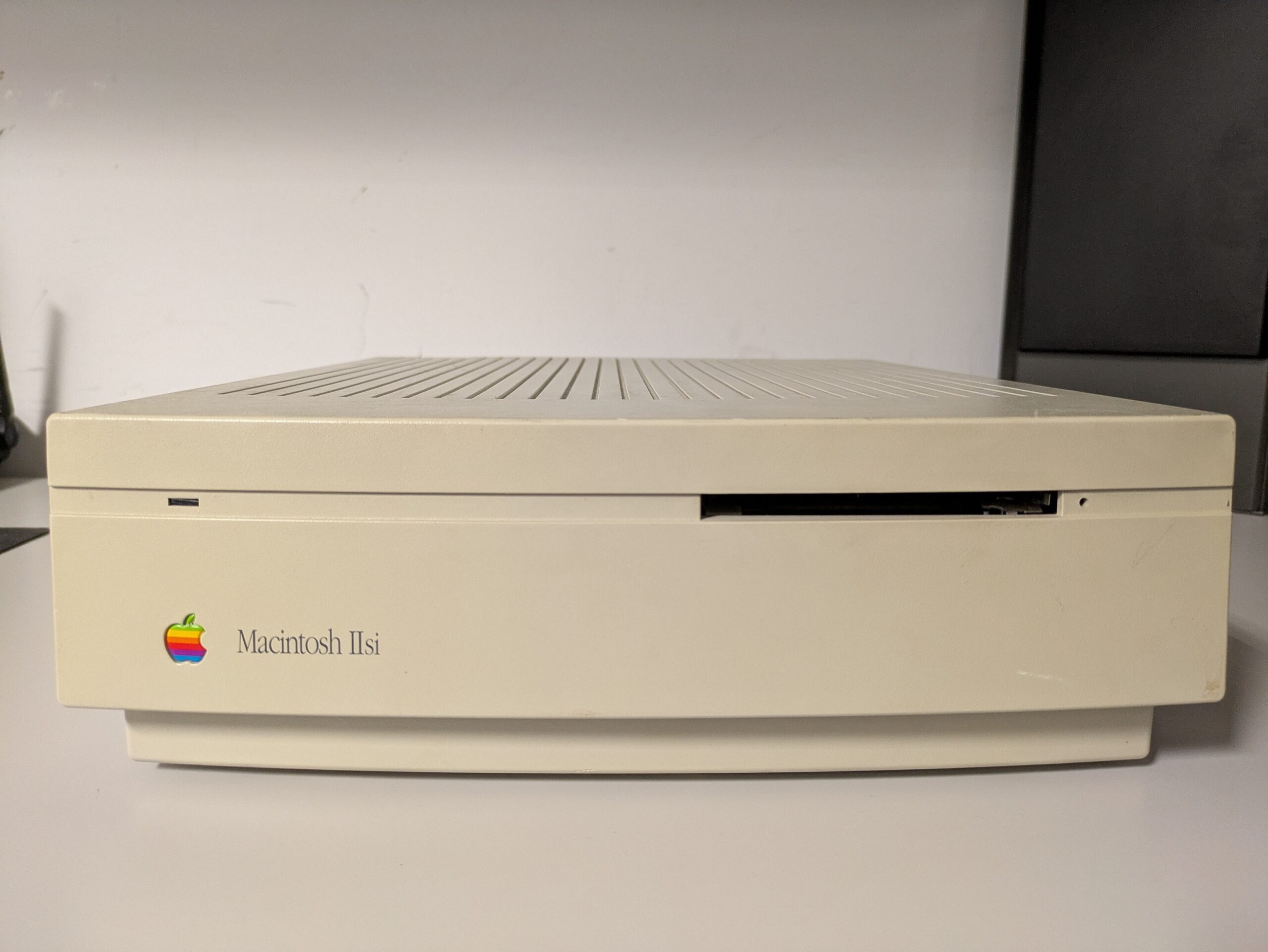
- Manufacturer: Apple Computer Inc.
- Type: Personal Computer
- Release Date: 1990
- Cost at release: USD $3,769 (CAD ~$9,000 adjusted for inflation)
- MIPS: 5
Hardware Specifications
- CPU: Motorola 68030, 20 MHz (optional Motorola 68882 FPU coprocessor)
- RAM: 1 MB soldered onboard, expandable to 17 MB (4 × 30-pin SIMM slots, 100 ns)
- ROM: 512 KB
- Hard Drive: 40 MB, 80 MB, or 160 MB internal SCSI hard drive; 1.44 MB SuperDrive floppy disk
- Video: Uses system RAM as VRAM; supports up to 8-bit color at 640 × 480 resolution
- Expansion: 1 NuBus or Processor Direct Slot (PDS)
- Ports: ADB (keyboard/mouse): 1, SCSI: 1 (DB-25), Floppy: 1 (DB-19), Serial: 2 (Mini DIN-8), Audio: 8-bit stereo out, 8-bit mono in (3.5mm jacks), Printer and modem ports
- Power Supply: 160 Watts
- Weight: 19 lbs (8.6 kg)
Operating System & Programming Languages
- OS: The Macintosh IIsi shipped with System 6.0.7 as its original operating system and officially supported up to Mac OS 7.6.1; with a 68040 processor upgrade, it could run Mac OS 8.1
- Programming Languages: Pascal (notably THINK Pascal and Borland Turbo Pascal), C and C++ (using Macintosh Programmer’s Workshop, CodeWarrior, and other IDEs), HyperTalk (via HyperCard), AppleScript (for automation and scripting), Perl (through available Mac ports) and BASIC (such as Real Basic, compatible with later versions of Mac OS 7)
Notables
- The IIsi was the only Macintosh to use its uniquely compact case design, never reused for any other model.
- It was one of the first Macs (along with the LC) to feature built-in audio input, a notable step for multimedia capabilities at the time.
- Apple intentionally underclocked the IIsi’s components from 25 MHz to 20 MHz to avoid competing with the more expensive IIci, though many users later “chipped” their IIsi to run at higher speeds.
- The IIsi used system RAM for video memory, which slowed graphics performance but helped reduce costs; creative users found ways to speed this up by manipulating RAM allocation.
- It shipped without a built-in NuBus slot (unlike other Macintosh II models), but a special adapter could convert its Processor Direct Slot to NuBus, expanding its capabilities.
- The IIsi was discontinued after two and a half years, replaced by the Centris 610, but remains a favorite among vintage Mac enthusiasts for its unique blend of features and quirks
Donated by: Arlen Michaels