Commodore Amiga 2000
[vin61]
The Amiga 2000, released by Commodore in 1987, was a highly expandable personal computer notable for its advanced graphics and audio capabilities, multitasking operating system, and extensive internal expansion slots, including both proprietary Zorro II and standard ISA slots. Its claim to fame was its revolutionary impact on budget multimedia and television production, especially when paired with the Video Toaster system, making it a favorite in video editing and broadcast environments. While it was less popular in North America compared to Europe, with sales in the high hundreds of thousands across the continent and only moderate adoption in Canada.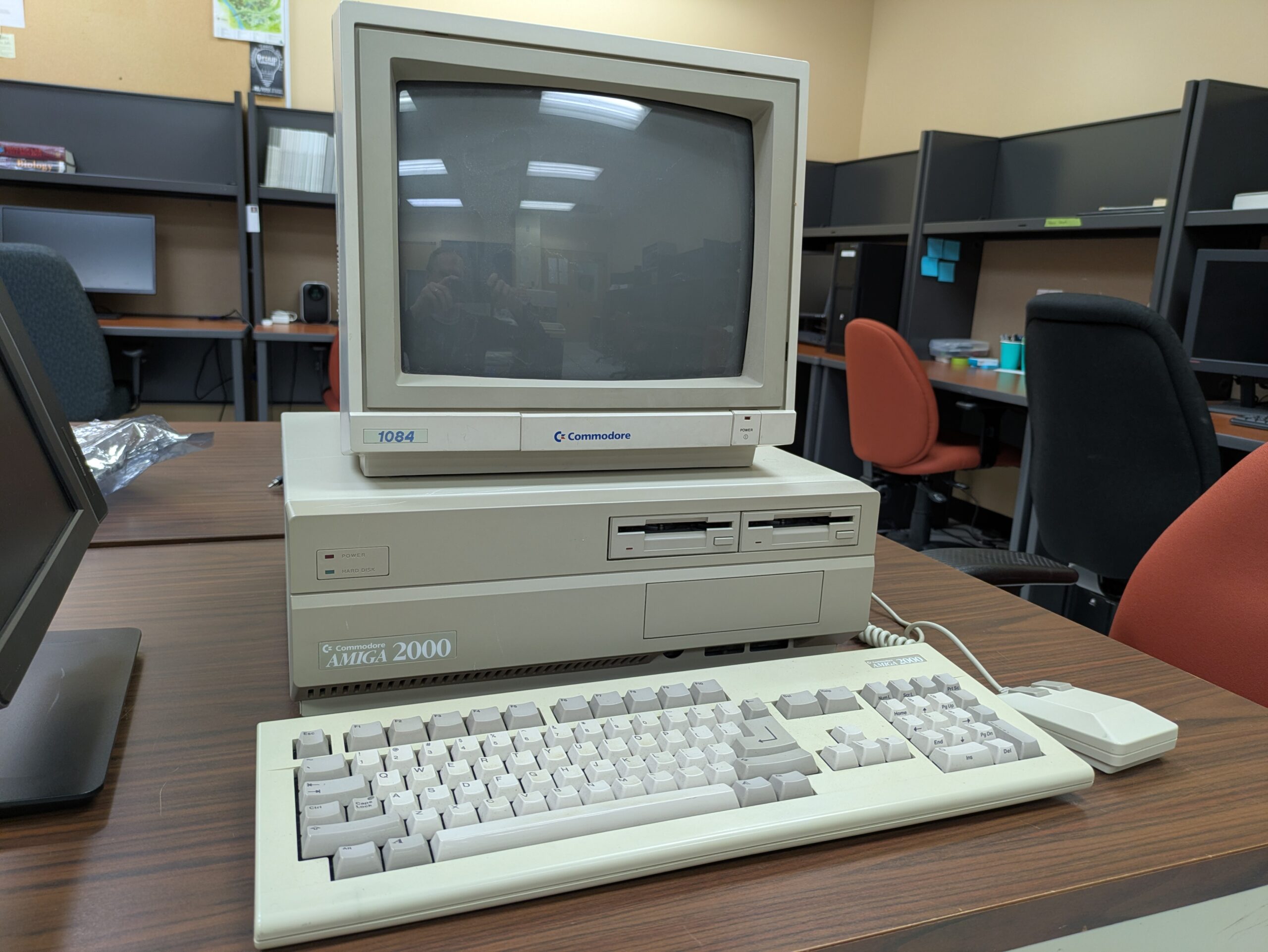
- Manufacturer: Commodore
- Released: March 1987
- Model: 2000
- Type: Personal Computer
- Cost at release: USD $1,495 (CAD ~$4,700 adjusted for inflation)
- Cost with peripherals: a typical configuration with 1 MB RAM and a monitor cost around $2,395 USD (CAD ~$7,500 adjusted for inflation)
- MIPS: 0.7 (700 KIPS)
Hardware Specifications
- CPU: Motorola 68000, 7.16 MHz (NTSC) or 7.09 MHz (PAL)
- RAM: 1 MB standard (configurations varied: 512 KB chip + 512 KB fast RAM or 1 MB chip RAM), expandable up to 2 MB chip RAM (with hardware mods), 8 MB fast RAM (without CPU upgrade), up to 128 MB with CPU card
- ROM: 256 KB or 512 KB Kickstart ROM
- Chipset: Original Chip Set (OCS) or Enhanced Chip Set (ECS) in later models
- Graphics:
- 12-bit color palette (4096 colors)
- Up to 32, 64 (EHB), or 4096 (HAM) on-screen colors at 320×200–320×400 (NTSC) or 320×256–320×512 (PAL)
- Up to 16 on-screen colors at 640×200–640×400 (NTSC) or 640×256–640×512 (PAL)
- Additional ECS modes: up to 1280×512i, 640×480p, 800×600i
- Audio: 4-channel, 8-bit PCM stereo, up to 28 kHz DMA sampling rate (56 kHz in ECS), 70 dB S/N ratio
- Storage:
- 3.5″ DD floppy drive (880 KB)
- Optional internal SCSI hard drive (A2000HD model)
- Expansion:
- 5 × Zorro II (100-pin, 16-bit) slots
- 2 × 16-bit ISA slots (with bridgeboard)
- 2 × 8-bit ISA slots (with bridgeboard)
- 1 × CPU/MMU expansion slot
- Ports:
- RGB video out (DB-23M)
- Composite video out (RCA, some models)
- Stereo audio out (RCA)
- 2 × Mouse/Joystick (DE9)
- RS-232 serial (DB-25M)
- Parallel port (DB-25F)
- Floppy disk drive port (DB-23F)
- Drive Bays: 2 × 3.5″ (front-accessible), 1 × 5.25″ (front-accessible)
- Operating System: AmigaOS 1.2/1.3 or 2.0 (with appropriate Kickstart/Workbench)
- Weight: 12.5 kg (approx. 27.5 lbs)
Operating System & Programming Languages
- O/S: AmigaOS, specifically versions 1.2 or 1.3 at launch, with later models supporting AmigaOS 2.0. AmigaOS was known for its preemptive multitasking, graphical desktop (Workbench), and command-line interface (AmigaShell)
- Programming Languages:
- Assembly (e.g., ASM-One, Devpac, SEKA)
- C (e.g., Aztec C, Lattice C, SAS/C, GNU gcc)
- BASIC dialects (e.g., AmigaBASIC, ABasic, AMOS BASIC, Blitz BASIC, GFA BASIC)
- Pascal (e.g., Amiga Pascal, HiSoft Pascal, Free Pascal)
- Other languages: Forth, FORTRAN, Logo, Oberon, Perl, Ruby, Amiga E, Python, REBOL, Scheme, Modula-2, Eiffel, Java (JAmiga), Draco, ML, and more
Notables
- The Amiga 2000 was nicknamed “The Bridgeboard” due to its unique ability to add IBM PC compatibility via a special expansion card, allowing users to run both Amiga and PC software on the same machine.
- It was the first Amiga model to feature internal expansion slots, with five Zorro II and four ISA slots, making it exceptionally versatile for upgrades and professional use.
- The A2000 was widely used in television studios and by organizations like NASA, especially after the introduction of the NewTek Video Toaster, which revolutionized affordable video production.
- Its open architecture and expandability made it Commodore’s most successful higher-end Amiga and a favorite among professionals in video, graphics, and technical fields.
- The A2000 was sometimes referred to as “The Hollywood Star” for its role in multimedia and TV production.
- Despite its professional focus, it was also highly compatible with Amiga 500 games, making it popular with enthusiasts who wanted both expandability and entertainment.
- The Amiga 2000 played a role in space exploration, being used by NASA for certain technical applications.
- Its design was the result of a compromise between Commodore’s US and German divisions, with the German team’s practical, PC-compatible approach winning out.
- The A2000’s styling was often described as “an ugly duckling,” more similar to IBM PCs than the sleeker Amiga 1000 or 500, but this allowed for its roomy, highly expandable case.
- In terms of advertising, Commodore promoted the A2000 as a professional, all-in-one multimedia workstation, though their marketing efforts were sometimes criticized as lackluster compared to the machine’s capabilities
Donated by: Arlen Michaels