Apple Macintosh II
[vin62]
The Apple Macintosh II, launched in 1987, was the first Macintosh to feature color graphics, modular design with separate monitor and case, and true hardware expandability via six NuBus slots, allowing users to add multiple monitors and upgrade components easily. Its claim to fame was introducing color to the Mac line, supporting up to 16.7 million colors and multiple display setups, which made it a favorite among professionals in desktop publishing, graphics, and multimedia, and set a new industry standard for personal computers. Although expensive and targeted at high-end users, the Macintosh II was influential in shifting Apple toward open, expandable systems and helped cement the Mac’s reputation in creative industries.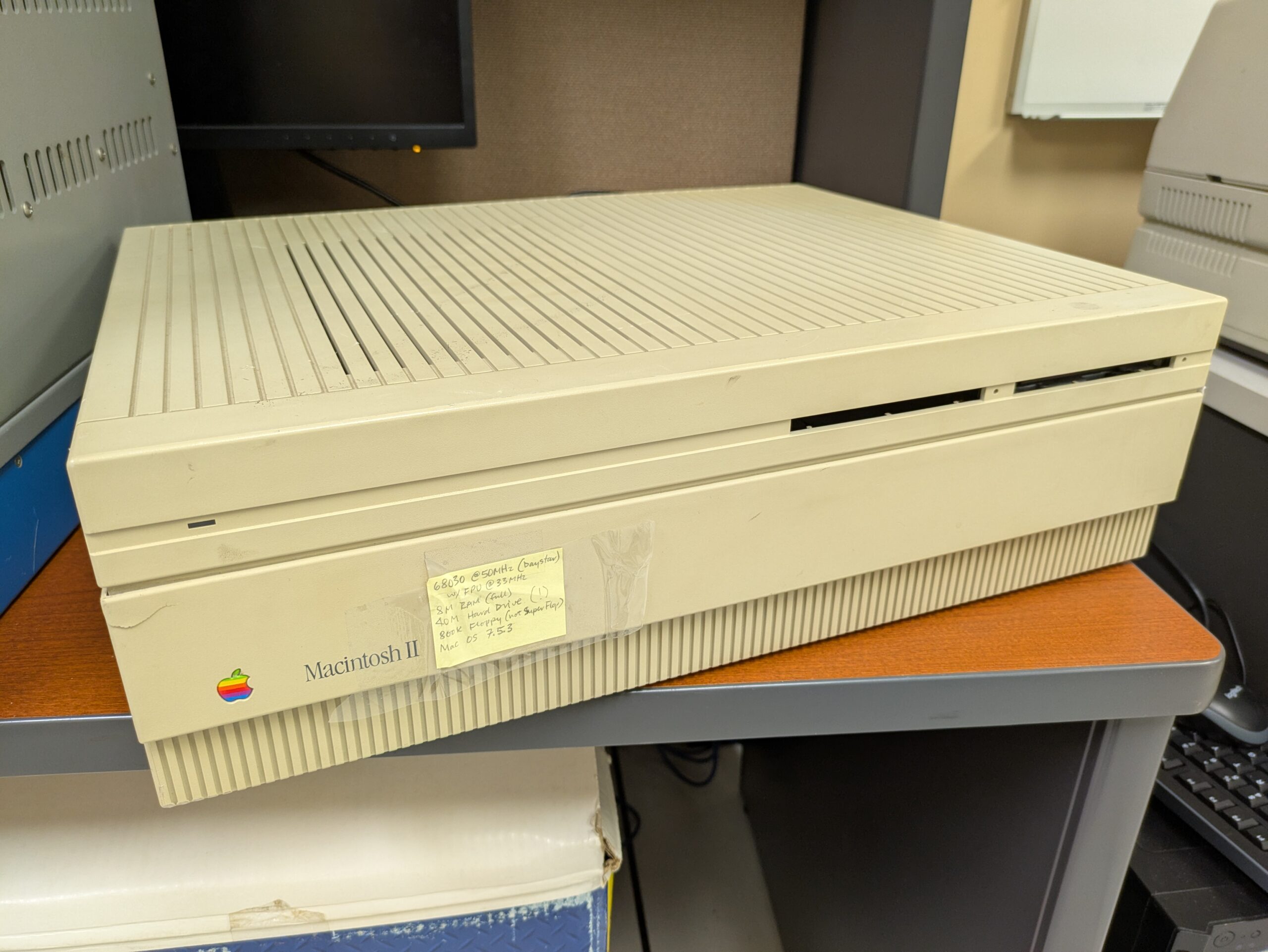
- Manufacturer: Apple Computer Inc.
- Released: 1987
- Type: Personal Computer
- Cost at release: USD $5,498 (CAD ~$17,250 adjusted for inflation)
- MIPS: 2.6
Hardware Specifications
- CPU: Motorola 68020, 16 MHz, with optional 68851 PMMU and standard 68881 FPU
- RAM: 1 MB standard, expandable to 20 MB (or up to 68 MB with FDHD upgrade), 8 slots for 30-pin SIMMs, installed in groups of 4
- Storage: Optional internal 40 MB or 80 MB SCSI hard drive; one or two 800 kB 3.5″ floppy drives (upgradeable to SuperDrive)
- Expansion: 6 NuBus slots for hardware expansion
- Graphics: Requires video card; supported up to 16.7 million colors, with resolutions such as 512×384 and 640×480
- Ports: 2 ADB (Apple Desktop Bus), 2 serial (Mini DIN-8), SCSI DB-25, audio out, printer, modem
- Power: 230 watts maximum, voltage 90-270 V, frequency 48-62 Hz
- Weight: 24 lbs (10.9 kg)
Operating System & Programming Languages
- O/S: System 3.0/Finder 5.1 and supported Mac OS versions from 2.0 up to 7.5.5, with some later upgrades allowing for Mac OS 7.6 on models with a 68030 CPU upgrade
- Programming Languages:
- Pascal (the standard language for Mac OS Classic development and APIs)
- C and C++ (supported via Apple’s MPW development environment and later tools)
- Assembly language (for performance-critical applications)
- Object Pascal (used in Apple’s MacApp framework)
- Other languages, such as BASIC and FORTRAN, were also available through third-party compilers and interpreters.
Notables
- The Macintosh II was the first Mac to support color graphics, allowing up to 16.7 million colors and multiple monitors—a revolutionary leap for creative and professional users.
- It was the first modular Macintosh, with a separate monitor and case, and featured six NuBus expansion slots, making it highly customizable and expandable.
- The Mac II was the first Macintosh to use a Motorola 68020 processor and to support screen resolutions higher than 512×384.
- Its code names included “Little Big Mac,” “Milwaukee,” “Ikki,” “Cabernet,” “Reno,” “Becks,” “Paris,” and “Uzi”.
- The Mac II allowed users to open the case and upgrade components without voiding the warranty—a rarity for Apple products at the time.
- Its 13″ color monitor, based on a Sony Trinitron CRT, was widely praised as the best of its class for image quality and color fidelity.
- The Mac II was used in notable professional settings, such as by Industrial Light & Magic for film image processing and by AnimEigo for subtitling anime.
- The project was famously kept secret from Steve Jobs and was championed internally by Jean-Louis Gassée, who supported the idea of an “open” Mac.
- While expensive, the Mac II’s flexibility and power made it a favorite in desktop publishing, scientific, and graphics fields, competing with high-end workstations from Silicon Graphics and Sun Microsystems
Donated by: Dr. Arlen Michaels